There is a category of dish that Italian food writers and Italian grandmothers would recognize as Italian-adjacent rather than specifically Italian — dishes that use Italian ingredients (garlic, sun-dried tomatoes, Parmesan, cream, spinach) in combinations and proportions that are more American than Tuscan, that bear the name of a place as shorthand for a flavor profile rather than as a claim of geographical origin. Tuscan garlic chicken is one of these dishes. It is not from Tuscany. No Florentine nonna is making it in her kitchen. What it is is a dish built on the specific and excellent flavor combination that the word “Tuscan” has come to signify in American food culture: garlic, sun-dried tomatoes, Parmesan, and greens in a creamy sauce — and that combination is genuinely excellent, whatever its provenance.
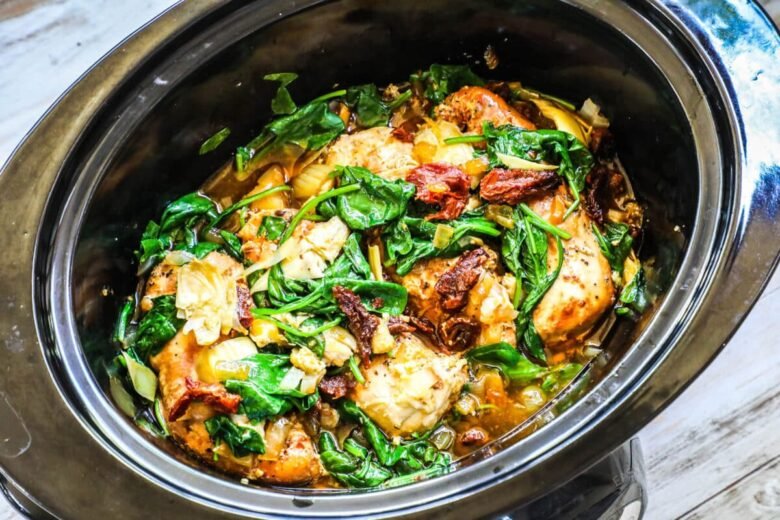
Slow cooker Tuscan garlic chicken is the weeknight version of this idea at its most practical and its most satisfying. Chicken — boneless, skinless thighs or breasts — braises in a sauce of chicken broth, garlic, sun-dried tomatoes, and Italian seasoning for four to five hours until completely tender. The cream and Parmesan go in at the end. The spinach goes in last of all — thirty seconds in the warm sauce is sufficient for the spinach to wilt completely without losing its color or becoming overcooked. The result is a creamy, garlicky, slightly tangy sauce (from the sun-dried tomatoes) with tender chicken and vibrant green spinach, served over pasta or with bread for the sauce.
It is not complicated. It is not authentically Tuscan. It is specifically delicious, and it is available on a weeknight.
The Flavor Profile: What Makes This Dish Work
Tuscan garlic chicken’s flavor is built on a combination of ingredients that complement each other with unusual precision — each one addressing a quality that the others need.
Garlic — generously used, six to eight cloves — is the aromatic backbone. In the slow cooker over four to five hours, garlic loses its raw pungency and develops into a rounded, sweet, savory depth that permeates the entire sauce. This mellowed garlic note is different from quickly sautéed garlic; it is what makes the slow cooker version of this dish specifically garlic-forward in a way that is pleasant rather than aggressive.
Sun-dried tomatoes are the ingredient that most defines the dish and that most distinguishes it from a generic cream sauce. Oil-packed sun-dried tomatoes — drained — add a concentrated, slightly sweet, slightly acidic tomato note that is completely different from fresh tomatoes or canned tomatoes. Their intensity is the counterbalance to the cream’s richness: every bite that encounters a sun-dried tomato piece provides the acidity and the concentrated tomato flavor that prevents the cream sauce from becoming one-dimensionally rich.
Heavy cream enriches the braising liquid into the creamy sauce that is the dish’s signature. Added at the end to the KEEP WARM slow cooker, it produces a smooth, coating sauce.
Parmesan adds the salty, nutty, umami depth that cream alone cannot provide. Freshly grated, added at the end alongside the cream, it melts into the sauce and adds a savory complexity that is specifically Italian in character.
Baby spinach — added at the very end, directly to the warm sauce — provides freshness, color, and a green vegetable note that cuts through the richness of the cream and Parmesan. It wilts in thirty to sixty seconds and turns from raw to perfectly softened without any separate cooking step.
Italian seasoning, red pepper flakes, and black pepper provide the spice background that makes the cream sauce feel alive rather than flat.
Each ingredient addresses the others: the garlic softens what the sun-dried tomato concentrates; the cream softens what the Parmesan sharpens; the spinach freshens what the cream enriches. The result is a sauce that is complex for its simplicity.
The Chicken
Boneless, skinless chicken thighs are the better choice for all the same reasons that apply throughout this series. Their higher fat content keeps them moist through the four-to-five-hour slow cook and produces a more richly flavored braising liquid that enriches the cream sauce. Thighs are more forgiving of timing and produce a more satisfying finished dish.
Boneless, skinless chicken breasts produce a leaner, cleaner result — more appropriate for those who specifically prefer white meat. They cook faster and should be checked at the three-to-three-and-a-half-hour mark on LOW to prevent overcooking. The finished breast meat shreds or slices cleanly into the sauce.
Keeping whole vs. shredding. Unlike many slow cooker chicken recipes in this series, Tuscan garlic chicken can be served with the chicken pieces intact — sliced on a cutting board and arranged over the pasta — rather than shredded into the sauce. This presentation is more elegant and specifically appropriate when the dish is being served at a dinner table rather than as casual family food. Shredding produces a more uniform, more integrated sauce-and-chicken result; slicing produces a more composed presentation.
Scoring and seasoning. Season the chicken generously with salt, black pepper, and garlic powder before it goes into the slow cooker. A light score through the thickest part of the thigh — two to three shallow cuts — allows the braising liquid to penetrate more deeply during the cook.
The Sun-Dried Tomatoes
Sun-dried tomatoes are the ingredient most likely to be omitted from a home cook’s version of this dish — they seem like a specialty ingredient, they require draining, they are an unusual texture — and their omission is the single change that most diminishes the finished dish.
Oil-packed sun-dried tomatoes are the correct form — they have been preserved in olive oil, which gives them a richer, more complex flavor than the dry-packed variety and makes them immediately usable from the jar without rehydration. Drain them before adding to the slow cooker; the oil in the jar can be saved and used as a flavorful cooking fat for other preparations.
The quantity. A third of a cup of drained, roughly chopped sun-dried tomatoes for a full batch — enough to contribute their specific flavor to every spoonful of sauce without dominating. More produces a more assertively tomato-forward sauce; less produces a more subtle presence.
Dry-packed sun-dried tomatoes can be substituted — rehydrate in warm water for fifteen to twenty minutes before adding to the slow cooker. The flavor is slightly less complex than oil-packed but otherwise excellent.
The function. Sun-dried tomatoes in the slow cooker release their concentrated tomato flavor and the oils they have been packed in into the braising liquid during the long cook. By the end of five hours, the tomato flavor has permeated the entire sauce. The pieces themselves become soft and slightly jammy — chewing through one in the finished dish is the most intense flavor moment in any spoonful.
The Cream and Parmesan Finish
The cream and Parmesan are added together at KEEP WARM temperature after the slow cooker has finished cooking — the same technique as the Alfredo, the white chili, and the tikka masala. The reasoning is identical: both are sensitive to sustained high heat, both produce the best results when added to a warm sauce rather than a hot one.
Heavy cream — half a cup — is the correct dairy. Its high fat content produces a stable emulsion with the Parmesan and the braising liquid, creating the sauce’s smooth, coating quality.
Freshly grated Parmesan — half a cup, not pre-shredded — melts cleanly into the cream and the warm braising liquid. Pre-shredded Parmesan’s anti-caking agents prevent smooth melting and produce a slightly grainy result.
The stirring. Add the cream first and stir to combine with the braising liquid. Then add the Parmesan in two or three additions, stirring after each until fully melted before adding the next. This gradual addition prevents the Parmesan from clumping and produces the smoothest possible sauce.
Additional enriching options. A tablespoon of the oil from the sun-dried tomato jar, stirred into the sauce alongside the cream, adds a concentrated tomato-and-olive oil depth that is specifically excellent. A tablespoon of unsalted butter stirred in at the very end adds gloss and richness — the same cold butter finish that appears in the beef tips with gravy notes.
The Spinach
Baby spinach is the green that the dish is built around, and it is handled with deliberate brevity — thirty to sixty seconds in the warm sauce is all it needs.
Baby spinach — three to four cups, which collapses to a fraction of its raw volume — is the most practical and most appropriate form. Its tender leaves wilt almost immediately in the warm sauce without any toughness or bitterness. The volume of raw spinach looks alarming; it collapses to the correct amount within seconds of contact with the warm liquid.
Regular spinach — larger leaves, tougher stems — should have the stems removed and leaves roughly torn before adding. It takes slightly longer to wilt than baby spinach and produces a slightly more textured result.
Frozen spinach — thawed and squeezed very dry before adding — is an acceptable substitute. It adds less freshness than fresh spinach but is a convenient pantry option. Squeeze out as much water as possible before adding, as excess moisture will dilute the sauce.
The timing. The spinach goes in after the cream and Parmesan have been stirred through — at KEEP WARM temperature, right before the dish is served. Stir the spinach into the warm sauce and watch it collapse — thirty to sixty seconds. Do not continue cooking after the spinach has wilted; further cooking turns it from vibrant green to dull olive.
Serving the Tuscan Garlic Chicken
Over pasta. The most natural and most popular serving format. Pappardelle, fettuccine, or linguine — broad or long noodles that carry the cream sauce effectively. Cook the pasta separately in generously salted water, drain, toss with a spoonful of the sauce in the pasta pot, and divide into bowls. Spoon the chicken (sliced or whole) and the sauce generously over the top.
Over polenta. Creamy soft polenta — cooked with Parmesan and butter — is the most Italian-feeling base for this dish. The polenta absorbs the cream sauce in a way that is specifically satisfying and that makes the dish feel like something from a Florentine trattoria regardless of its actual origins.
With crusty bread. For scooping the sauce. Mandatory alongside any cream-sauced chicken dish.
Over rice. For a lighter, more neutral base that allows the sauce to be the primary flavor.
Tips for Perfect Slow Cooker Tuscan Garlic Chicken
1. Do not skimp on garlic. Six to eight cloves is the correct quantity. The slow cook mellows garlic’s pungency into a rounded sweetness — the dish is named for garlic and should taste of it. Under-garlicked Tuscan garlic chicken is a different and lesser dish.
2. Use oil-packed sun-dried tomatoes. Their flavor is more complex and more immediately usable than dry-packed. Drain them but reserve the oil — it is a flavorful cooking fat for other uses.
3. Add cream and Parmesan at KEEP WARM. The same instruction as every other cream and Parmesan recipe in this series. Added during the slow cook, both can separate or become grainy. Added at KEEP WARM temperature, stirred gradually, they produce the smooth, glossy sauce the dish requires.
4. Grate your own Parmesan. Pre-shredded Parmesan does not melt cleanly into cream sauce. A block and a fine grater takes three minutes and produces a categorically better sauce.
5. Add spinach last. The spinach goes in after the cream and Parmesan — at serving time, thirty to sixty seconds before the dish reaches the table. Spinach added earlier loses its vibrant color and becomes overcooked.
6. Taste before serving — the sun-dried tomatoes add salt. Oil-packed sun-dried tomatoes are typically salted. The Parmesan is salty. The overall seasoning of the finished dish may need less additional salt than expected. Taste before adding any finishing salt.
7. Serve with pasta or polenta — not just bread. The sauce is generous and specific. It needs something starchy underneath to absorb it and to extend the experience of each spoonful. Bread is for the sauce on the plate; the primary base should be pasta, polenta, or rice.
The Complete Table
Serving bases:
- Pappardelle or fettuccine — the most natural pairing
- Soft polenta with Parmesan — the most Italian presentation
- Crusty ciabatta or baguette — for the sauce
- Short-grain white rice — for a simpler presentation
Sides:
- Simple arugula salad with lemon and Parmesan — bitter and bright against the richness
- Roasted cherry tomatoes — acidic and sweet, specifically good alongside cream sauce
- Garlic bread — for maximum indulgence
- Blanched green beans with olive oil and garlic — clean and simple
Garnishes:
- Freshly grated Parmesan over everything
- Fresh basil, torn — specifically Italian in character
- Red pepper flakes for those who want heat
- A drizzle of the reserved sun-dried tomato oil
Drinks:
- A Tuscan white — Vernaccia di San Gimignano, Pinot Grigio
- A light Chianti — specifically complementary to the sun-dried tomato and Parmesan
- Sparkling water with lemon
The Day-After Uses
Leftover slow cooker Tuscan garlic chicken with spinach refrigerates well for three to four days — the sauce thickens overnight into something closer to a cream of garlic and tomato soup, which reheats to a flowing sauce with a splash of broth. Reheated over fresh pasta, it is often better the next day — the garlic has deepened further and the sun-dried tomato flavor has integrated more completely. The leftover chicken, pulled from the sauce and sliced cold, is excellent on a sandwich with fresh arugula, a smear of Dijon, and a drizzle of the reserved sun-dried tomato oil. The sauce, strained of the chicken, becomes a pasta sauce for any other pasta in the pantry. Stirred through cooked rice with a fried egg on top and a pinch of Parmesan, it becomes a Tuscan garlic rice bowl of specific excellence.
Easy Variations
- Tuscan garlic chicken with artichokes. Add one can of quartered artichoke hearts (drained) to the slow cooker alongside the sun-dried tomatoes. The artichokes absorb the cream and garlic sauce and become deeply flavored, tender accompaniments that are specifically complementary to the sun-dried tomato and Parmesan base.
- Tuscan garlic shrimp. Replace the chicken with one and a half pounds of large shrimp, peeled and deveined, added in the final thirty to forty-five minutes. The sauce braises for four hours without protein; the shrimp are added only at the end and cook through in the warm sauce.
- Tuscan garlic white beans. Replace the chicken with two cans of drained cannellini beans, added at the start. The beans absorb the garlic-and-sun-dried-tomato sauce and become deeply flavored, creamy, and specifically excellent as a vegetarian main course. Serve over polenta for the most Italian presentation.
- Spicy Tuscan garlic chicken. Increase the red pepper flakes to one teaspoon and add one minced fresh red chile (Fresno or similar) to the braising base. The heat version of this dish is particularly good with the creaminess of the sauce as the counterbalance.
- Tuscan garlic chicken with mushrooms. Add eight ounces of sliced cremini mushrooms to the slow cooker at the start. The mushrooms absorb the garlic and sun-dried tomato flavors and add earthy depth to the cream sauce — a variation that is substantially more complex than the standard version.
Make-Ahead and Storage
Make-ahead: The chicken and sauce (without cream, Parmesan, and spinach) can be made up to two days ahead and refrigerated. On the day of serving, reheat in the slow cooker on LOW for one hour, then add the cream, Parmesan, and spinach at KEEP WARM as directed.
Refrigerator: Keeps for three to four days. The cream sauce thickens during refrigeration — add a splash of broth or cream when reheating to restore the correct consistency.
Reheating: Gently on the stovetop over medium-low heat, stirring with a splash of broth to loosen, or in the microwave at 70 percent power in 60-second bursts. The spinach becomes slightly darker and softer during refrigeration — for reheated leftovers, add a small handful of fresh spinach to the warm sauce and stir through for fresh color.
Freezer: Freeze without the cream, Parmesan, and spinach for up to two months. Add fresh cream, Parmesan, and spinach when reheating from frozen. Dairy-enriched sauces separate during freezing. Thaw overnight in the refrigerator and reheat gently.
Shopping List
The Chicken
- 2 lbs (900g) boneless, skinless chicken thighs or breasts
- Salt, black pepper, garlic powder (for seasoning)
The Sauce Base
- 6–8 garlic cloves, minced or thinly sliced
- ⅓ cup (55g) oil-packed sun-dried tomatoes, drained and roughly chopped
- 1 cup (240ml) chicken broth
- 1 tsp Italian seasoning
- ½ tsp red pepper flakes
- ½ tsp salt
The Cream Finish
- ½ cup (120ml) heavy cream — added after cooking
- ½ cup (50g) Parmigiano-Reggiano, freshly grated — added after cooking
The Spinach
- 3–4 cups (90–120g) baby spinach — added at KEEP WARM, right before serving
For Serving
- Pappardelle, fettuccine, or pasta of choice
- Crusty bread
- Additional freshly grated Parmesan
- Fresh basil, torn
Slow Cooker Tuscan Garlic Chicken with Spinach
Boneless, skinless chicken thighs seasoned with salt, black pepper, and garlic powder — slow-cooked on LOW for four to five hours with minced garlic, oil-packed sun-dried tomatoes, chicken broth, Italian seasoning, and red pepper flakes until the chicken is completely tender and the garlic has mellowed into a sweet, rounded, aromatic depth that permeates the braising liquid. Heavy cream and freshly grated Parmesan stirred in at KEEP WARM until the sauce is smooth, glossy, and creamy. Baby spinach stirred through for thirty to sixty seconds until just wilted. Served over pappardelle or fettuccine with additional Parmesan grated over the top and crusty bread for the sauce. The slow cooker Tuscan garlic chicken that is not from Tuscany and is worth making regardless.
- Total Time: 4 hours 25 minutes
- Yield: 4–6 servings 1x
Ingredients
The Chicken
- 2 lbs (900g) boneless, skinless chicken thighs
- ½ tsp salt
- ¼ tsp black pepper
- ½ tsp garlic powder
The Sauce Base
- 6–8 garlic cloves, minced or thinly sliced
- ⅓ cup (55g) oil-packed sun-dried tomatoes, drained and roughly chopped
- 1 cup (240ml) chicken broth
- 1 tsp Italian seasoning
- ½ tsp red pepper flakes
- ½ tsp salt
The Cream and Cheese Finish
- ½ cup (120ml) heavy cream — added after cooking at KEEP WARM
- ½ cup (50g) Parmigiano-Reggiano, freshly grated — added after cooking at KEEP WARM
The Spinach
- 3–4 cups (90–120g) baby spinach — added at serving, right before plating
For Serving
- 12 oz (340g) pappardelle, fettuccine, or pasta of choice
- Additional freshly grated Parmesan
- Fresh basil, torn
- Crusty bread
Instructions
- Season the chicken. Pat the chicken thighs dry and season on both sides with salt, black pepper, and garlic powder.
- Build the slow cooker. Place the chicken in the slow cooker. Add the minced garlic, sun-dried tomatoes, chicken broth, Italian seasoning, red pepper flakes, and salt. Stir briefly to distribute the aromatics around the chicken.
- Cook. Set to LOW and cook for 4 to 5 hours, until the chicken is completely tender and reads 165°F (74°C) internally. The garlic should be completely soft and the sun-dried tomatoes plump and fragrant.
- Slice or shred the chicken. Transfer the chicken to a cutting board and slice into strips or shred with two forks. Return to the slow cooker.
- Add cream and Parmesan. Switch to KEEP WARM. Pour in the heavy cream and stir to combine with the braising liquid. Add the Parmesan in two additions, stirring after each until fully melted and smooth before adding the next. Taste and adjust seasoning — salt, black pepper, red pepper flakes.
- Cook the pasta. Meanwhile, bring a large pot of generously salted water to a boil. Cook the pasta according to package directions until just al dente. Reserve ¼ cup of pasta cooking water. Drain.
- Add the spinach. Stir the baby spinach into the warm sauce at KEEP WARM. Stir continuously for 30 to 60 seconds until completely wilted and bright green. Do not overcook — remove from heat immediately once wilted.
- Combine and serve. Add the drained pasta to the slow cooker and toss with the sauce, adding a splash of pasta cooking water to help the sauce coat the pasta. Alternatively, divide pasta into bowls and spoon the chicken and sauce generously over the top. Finish with freshly grated Parmesan, torn basil, and crusty bread alongside.
Notes
- Six to eight cloves of garlic is correct — do not reduce. The dish is called Tuscan garlic chicken and is designed around a generous quantity of garlic that mellows and sweetens during the slow cook. Under-garlicked versions taste like a generic cream sauce with chicken. The slow cooker transforms the raw pungency of six to eight cloves into a rounded, sweet, pervasive garlic depth that is the dish’s defining character.
- Sun-dried tomatoes are essential — do not omit. They are the ingredient that most distinguishes this cream sauce from any other. Their concentrated, slightly sweet, slightly acidic tomato note provides the contrast that prevents the cream and Parmesan from becoming one-dimensional. The dish is a different and lesser thing without them.
- Cream and Parmesan at KEEP WARM. The same instruction that applies across every cream-and-cheese sauce recipe in this series. Added during the slow cook, they can separate or become grainy. Added at KEEP WARM temperature, stirred gradually, they produce the smooth, glossy sauce the recipe requires.
- Spinach wilts in thirty to sixty seconds. It does not need to cook. The KEEP WARM temperature is sufficient to wilt baby spinach immediately. Stirring it through the warm sauce for thirty to sixty seconds is all it needs. Remove from heat immediately — further time turns it from vibrant green to dull olive.
- Grate your own Parmesan. Pre-shredded Parmesan in a bag does not melt cleanly into cream sauce. A block and a fine grater produces a categorically better sauce.
- Reserve pasta cooking water. The starchy water helps the sauce cling to the pasta — the same technique as the Alfredo, the pasta sauce, and every other pasta dish in this series.
- The dish improves overnight. The garlic and sun-dried tomato flavors continue to develop in the refrigerator. Day-two Tuscan garlic chicken, reheated with a splash of broth to loosen the thickened cream sauce, is consistently more complex than the freshly made version.
- Prep Time: 10 minutes
- Cook Time: 4–5 hours (on LOW)
- Category: Dinner, Main Dish
- Method: Slow Cooking
- Cuisine: American
Frequently Asked Questions
Can I use fresh tomatoes instead of sun-dried? Fresh tomatoes produce a completely different sauce — brighter, more watery, less concentrated, without the specific intensity that makes sun-dried tomatoes the defining flavor of this dish. Fresh tomatoes can be used if sun-dried are unavailable, but the resulting dish is closer to a tomato cream sauce than Tuscan garlic chicken specifically. If using fresh, choose a small quantity of very ripe, concentrated tomatoes — four to five cherry tomatoes halved, or one Roma tomato diced — and expect a fresher, less assertive tomato note. Canned tomatoes are closer to sun-dried in concentration but still lack the specific sweet-acidic intensity of the dried version.
Why is my cream sauce grainy? Grainy cream sauce in this recipe is almost always from one of two causes: the Parmesan was added while the slow cooker was still on LOW or HIGH rather than at KEEP WARM temperature, causing the cheese proteins to seize; or pre-shredded Parmesan with anti-caking agents was used, which prevents smooth melting. For an already-grainy sauce: switch to KEEP WARM if not already there, add a splash of warm broth, and stir vigorously — gentle heat and agitation can sometimes bring a slightly broken sauce together. Significantly grainy sauce cannot be fully recovered. Prevention through correct technique — KEEP WARM temperature, gradually added freshly grated Parmesan — is always the correct approach.
Can I add pasta directly to the slow cooker instead of cooking it separately? The pasta should always be cooked separately for the same reason as every other pasta recipe in this series: pasta added to the slow cooker absorbs the sauce, swells, and can leave the dish dry or paste-like by the time it is served. Cooked separately until al dente and tossed with the sauce at serving, it is perfectly textured and evenly coated. The only exception is if the pasta is added in the final thirty minutes on HIGH and watched carefully — but this requires timing precision that the separate-cooking method does not.
How do I make this dairy-free? Replace the heavy cream with full-fat canned coconut milk — it produces a slightly sweet, rich sauce that is surprisingly compatible with the garlic and sun-dried tomato flavors. Replace the Parmesan with four to six tablespoons of nutritional yeast, which provides a nutty, cheese-adjacent flavor that cannot fully replicate Parmesan but produces an acceptable dairy-free approximation of the sauce’s depth. The dish without Parmesan and with coconut milk is genuinely good, though it is a different-flavored dish than the dairy version.
The spinach turned an unappetizing dark green by the time I served it. What went wrong? The spinach was in the hot sauce too long. Baby spinach wilts in thirty to sixty seconds in a warm sauce and is at its most vibrant green immediately after wilting. After two to three minutes in the warm sauce, it turns from bright green to dull olive as the heat breaks down the chlorophyll. The solution is to add the spinach at the very last moment — immediately before the pasta is plated and the bowls reach the table. For a gathering where there is a gap between the sauce being ready and the food being served, stir the spinach through immediately before each serving rather than adding it to the entire batch.
Can I use kale or Swiss chard instead of spinach? Yes — both work in this recipe but require different timing. Kale (stripped from the stems, roughly torn) needs three to four minutes in the warm sauce to become fully tender — it does not wilt as quickly as baby spinach and will be tough if undercooked. Swiss chard (stems removed, leaves roughly torn) falls between spinach and kale in cooking time — one to two minutes. Both hold their color better during storage than spinach, making them better choices if the dish will be made ahead. The flavor of kale is slightly more bitter and more assertive than spinach; Swiss chard is milder and more neutral. Either can replace the spinach with minor timing adjustments.
What makes this “Tuscan” if it is not from Tuscany? In American cooking, “Tuscan” has become a flavor shorthand — a term that signals the specific combination of garlic, sun-dried tomatoes, Parmesan, and greens in an Italian-inflected cream or olive oil sauce. This usage is similar to how “Mediterranean” in American recipe writing signals a combination of feta, olives, and tomatoes rather than a specific regional tradition. The word “Tuscan” in the recipe title accurately describes the flavor profile the dish is built around — even if it does not describe the geographical origin. The dish uses Italian ingredients in a combination inspired by Italian cooking traditions, presented in a format suited to American weeknight cooking. It is Italian-American, not Italian — the same distinction that applies to chicken Alfredo, pasta with meat sauce, and most other “Italian” dishes that are genuinely beloved in the American kitchen.