
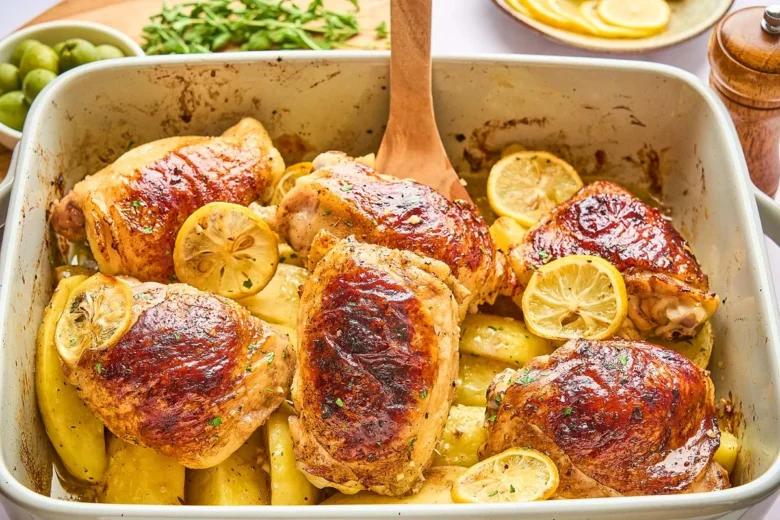
Greek cooking has a philosophy at its center that is so simple it barely counts as a philosophy: take good ingredients, season them honestly, apply heat, and get out of the way. The cuisine does not require elaborate technique or unusual equipment or ingredients sourced from anywhere distant. It requires olive oil of quality, lemon, garlic, oregano, and protein or vegetable that can stand up to those flavors — which, in the case of chicken and potatoes, they emphatically can.
Greek lemon chicken is the expression of this philosophy at its most direct. Chicken — preferably bone-in, skin-on, thighs or a combination of pieces — marinated and then roasted with potatoes in a bath of lemon juice, olive oil, garlic, and dried oregano until the potatoes are tender and have absorbed every drop of the lemony pan juices, the chicken skin has bronzed and blistered, and the kitchen smells of a specific combination of ingredients that is instantly recognizable as Greek, as coastal, as something that belongs on a white table with a view of the Aegean.
The slow cooker version takes this dish out of the oven and applies the same low-and-slow logic that has made every other recipe in this series excellent. The potatoes, which in the oven version require precise timing to become tender without burning at the edges while the chicken finishes above them, cook in the slow cooker at a pace that suits them — becoming gradually, evenly saturated with the lemon-olive oil braising liquid, absorbing the chicken’s rendered fat and juices as they soften. The chicken, which benefits from the slow cooker’s moist heat, stays juicy and deeply flavored throughout. The lemon and garlic and oregano bloom over the hours into the braising liquid in the way that distinguishes a long-cooked dish from a quickly seasoned one.
The broiler finish — five minutes at the end — produces the bronzed skin that the slow cooker cannot achieve on its own and that is one of the most appealing things about this dish. It takes the slow cooker Greek lemon chicken from pale-but-excellent to golden-and-spectacular.
The Philosophy of the Greek Marinade
Greek marinade is not really a marinade in the modern sense of something elaborate designed to add layers of complexity. It is a formula — lemon, olive oil, garlic, oregano, salt, and black pepper — that has been applied to meat and fish in Greek cooking for centuries because these ingredients in this combination are simply correct. They are correct for chicken. They are correct for lamb. They are correct for fish. They are correct for octopus grilled over charcoal. The formula does not vary because it does not need to.
Lemon provides the acidity that tenderizes the chicken slightly during any marinating period and that cuts through the fat of the olive oil and the rendered chicken skin during cooking. Fresh lemon juice — not bottled — is the only acceptable form. The zest of the lemon is equally important: the essential oils in the lemon peel are more intensely lemon-flavored than the juice and add an aromatic quality that the juice alone lacks. Both juice and zest belong in the marinade.
Olive oil is the fat that carries the fat-soluble aromatic compounds from the garlic and oregano throughout the marinade and into the chicken. Good quality extra virgin olive oil contributes its own flavor — slightly peppery, grassy, fruity — that is part of what makes the dish taste specifically Greek. This is not the place for a neutral vegetable oil.
Garlic — five to six cloves, minced or grated — is the pungent aromatic that mellows during the long slow cook into a rounded, sweet garlic note that permeates the braising liquid and the potatoes. Greek cooking uses garlic generously and without apology.
Dried oregano is the defining herb. Greek oregano (rigani) is more assertive, more pungent, and more aromatic than the Italian variety — if it is available at a Greek or Mediterranean grocery store, use it. Standard dried oregano from the supermarket is entirely correct. The herb blooms slowly in the olive oil and lemon during the slow cook, becoming part of the liquid rather than sitting on the surface.
Salt and black pepper — applied more generously than feels comfortable, because the marinade’s seasoning distributes through a large amount of chicken and potato and must be sufficient to season both.
Dried thyme — half a teaspoon, optional — is a complementary herb that adds a background note beneath the oregano.
Honey — a teaspoon, optional — adds a small amount of sweetness that encourages caramelization during the broiler finish and rounds the acidity of the lemon.
The Chicken
The cut of chicken is more consequential in this recipe than in most slow cooker chicken dishes because the dish is as much about the presentation as the eating — Greek lemon chicken arrives at the table as whole pieces, bronzed and glistening, rather than as shredded meat.
Bone-in, skin-on chicken thighs are the best choice. They have the fat and collagen to stay moist through the slow cook, the dark meat flavor to hold their own against the assertive lemon and garlic marinade, and the skin — which becomes the vehicle for the broiler finish. Bone-in thighs produce the richest braising liquid and the most deeply flavored potatoes.
Bone-in, skin-on drumsticks produce a similar result and are more visually dramatic on the platter — the drumstick shape is specifically good for a table presentation where the dish is served family-style.
A combination of thighs and drumsticks — the traditional Greek taverna approach — is the best of both worlds and the most festive presentation.
Bone-in, skin-on chicken breasts can be used but require careful monitoring — chicken breast overcooks more easily than dark meat in the slow cooker and can become dry if left too long. For breasts, reduce the cook time to three to four hours on LOW and check early.
Scoring. For the marinade to penetrate the chicken pieces, score the thighs and drumsticks with three or four shallow cuts through the skin and into the flesh before marinating. The cuts allow the lemon and olive oil to penetrate more deeply and produce a more evenly flavored finished piece.
The Potatoes
The potatoes are not a side dish in this recipe. They are an equal protagonist — the element that absorbs the lemony olive oil braising liquid throughout the cook and arrives at the table having transformed from raw potato into something that has taken on the character of everything around it.
Yukon Gold potatoes are the correct choice. Their waxy, creamy flesh holds together through the long slow cook without disintegrating into mush and absorbs the braising liquid while maintaining their identity as potatoes. Cut into large wedges — quarters for medium potatoes, sixths for larger ones.
Baby potatoes halved produce an excellent result and require less preparation than cutting larger potatoes. Their size also means they cook slightly more evenly in the slow cooker.
Russet potatoes are too starchy for this application — they tend to break down and become mealy during the long cook rather than absorbing the liquid cleanly.
The preparation. The potatoes go into the slow cooker first — laid across the bottom of the insert — and the chicken pieces are placed on top of them. This arrangement is important: the potatoes in the bottom position are submerged in the braising liquid that accumulates, absorbing it continuously. The chicken on top allows the skin to remain above the liquid level so it has some chance of maintaining texture through the cook.
The size matters. Uniformly sized potato pieces cook evenly. Varying sizes produce some pieces that are overcooked and breaking down while others are still firm. Take the time to cut evenly.
The Braising Liquid
The braising liquid in slow cooker Greek lemon chicken is not a separate sauce built from multiple components — it is the marinade, augmented, that becomes the cooking liquid.
Fresh lemon juice — the juice of two large lemons — is the primary acid. It tenderizes, brightens, and provides the characteristic lemon note that defines the dish.
Lemon zest — of those same two lemons — adds the essential oil compounds that make the lemon flavor aromatic and rounded rather than simply sour.
Extra virgin olive oil — a quarter cup — is the fat component that carries the aromatics and bastes the chicken and potatoes throughout the cook.
Chicken broth — half a cup — provides additional liquid and depth. The braising liquid should be generous enough to partially cover the potatoes and reach partway up the chicken pieces.
Dijon mustard — one teaspoon — emulsifies the olive oil and lemon juice slightly, adds a subtle sharpness, and is a traditional component of some Greek marinades.
The ratio. The finished braising liquid after eight hours will be more concentrated and more intensely flavored than when it went in — the lemon will be slightly less sharp, the garlic rounder, the oregano more fully bloomed. The potatoes will have absorbed a significant portion of the liquid. This concentration is the point: the braising liquid is the sauce, and its intensity after the long cook is what makes the dish taste specifically excellent.
The Broiler Finish
The broiler finish is not optional if you want the dish to look as good as it tastes. Chicken emerging from eight hours in the slow cooker is pale — the skin is soft and without color, regardless of how well the dish tastes. Five minutes under a preheated broiler transforms this completely.
The method. Transfer the chicken pieces to a foil-lined baking sheet skin-side up. Spoon some of the braising liquid over each piece — this provides additional fat and sugar for caramelization. Slide under a preheated broiler 5 to 6 inches from the element. Broil for 4 to 6 minutes, watching constantly, until the skin is golden, blistered in spots, and beginning to char at the thinnest edges.
The potatoes. The potato wedges can be broiled alongside the chicken or separately immediately after. Arrange them cut side up on the baking sheet with the chicken, or in a single layer on a separate foil-lined sheet. Two to three minutes under the broiler produces golden edges and slightly crisped surfaces that contrast beautifully with the interior softness.
The braising liquid while the chicken broils. Pour the remaining braising liquid from the slow cooker into a small saucepan. Bring to a boil and reduce for three to four minutes until slightly syrupy. This is the sauce served alongside the finished dish — intensely flavored, slightly thickened, specifically lemony.
Tips for Perfect Slow Cooker Greek Lemon Chicken with Potatoes
1. Marinate if time allows — even thirty minutes makes a difference. The scoring and marinating of the chicken in the lemon-olive oil-garlic-oregano mixture before it goes into the slow cooker produces a more evenly flavored, more deeply seasoned finished piece. Overnight in the refrigerator produces the best result. Thirty minutes on the counter is the minimum worthwhile. If no time is available, add the marinade ingredients directly to the slow cooker — still excellent, just less penetrating.
2. Score the chicken before marinating. Three to four shallow cuts through the skin and into the flesh of each piece allow the marinade to penetrate below the surface. Unscored chicken is seasoned on the surface only during marinating — the interior remains unseasoned until the long slow cook does its work.
3. Potatoes go in first, chicken on top. The potatoes need to be in contact with the braising liquid that accumulates at the bottom. The chicken skin, placed above the liquid level, maintains more texture through the cook than it would if submerged.
4. Use fresh lemon — both juice and zest. Bottled lemon juice produces a flat, one-dimensional lemon flavor. Fresh lemon juice, combined with fresh zest, produces the aromatic, rounded lemon character that defines the dish. The zest specifically is irreplaceable — its essential oils are the most intensely lemon-flavored component of the fruit and are absent from any processed lemon product.
5. Do not use boneless, skinless chicken. The skin is what becomes the vehicle for the broiler finish — the golden, blistered, lemon-basted surface that makes the dish visually compelling. Boneless, skinless chicken produces a pale, textureless result that the broiler cannot rescue. Keep the skin.
6. Broil skin-side up on a dry baking sheet. Chicken skin placed on a baking sheet with a spoonful of the braising liquid over it has the fat it needs to blister and bronze under the broiler. Chicken returned to the slow cooker after the cook and broiled in place cannot achieve the same result — the steam environment of the slow cooker works against browning.
7. Reduce the braising liquid before serving. The braising liquid after eight hours is delicious but thin. Five minutes of reduction on the stovetop concentrates it into something closer to a sauce — intensely lemony, slightly syrupy, deeply flavored. Serve it in a small pitcher alongside the chicken and potatoes.
8. Squeeze fresh lemon over the finished plate. A squeeze of fresh lemon juice over the broiled chicken and potatoes immediately before serving is the final brightness that makes the dish taste alive. Cooked lemon mellows and rounds; fresh lemon at serving is the sharp, vibrant note that the dish needs at the end.
Serving the Greek Lemon Chicken
The platter. The most naturally appropriate presentation: a large serving platter or wooden board, the bronzed chicken pieces arranged in one section, the potato wedges in another — golden-edged and glistening — a handful of fresh herbs (flat-leaf parsley or fresh oregano) scattered over everything, and a few lemon slices or wedges arranged around the board for squeezing. The reduced braising liquid in a small pitcher alongside.
Family-style. This dish is specifically suited to family-style serving — placed in the center of the table and passed. The communal format suits both the Greek taverna tradition the dish comes from and the visual generosity of a platter of bronzed chicken pieces and golden potatoes.
With a simple salad. A Greek salad — tomatoes, cucumber, kalamata olives, red onion, and feta, dressed with olive oil and red wine vinegar — alongside the chicken and potatoes provides the cool, acidic, sharp contrast the rich braised chicken requires.
The Complete Table
Sides:
- Greek salad — tomatoes, cucumber, olives, feta, red onion — the essential accompaniment
- Tzatziki — cool, creamy, with fresh cucumber and dill — for dipping and spooning
- Warm pita bread — for the braising liquid
- Roasted lemon asparagus — bright and fresh alongside the richness
- Steamed green beans with olive oil and garlic
- Simple orzo with butter and lemon
Garnishes:
- Fresh flat-leaf parsley or fresh oregano — torn and scattered
- Lemon wedges — for squeezing at the table
- Kalamata olives alongside
- Crumbled feta over the potatoes — excellent and specifically Greek
Drinks:
- A crisp Greek white wine — Assyrtiko from Santorini, Moschofilero from the Peloponnese
- A dry Rosé — specifically complementary to lemon and herb chicken
- Sparkling water with lemon — clean and natural
The Day-After Greek Lemon Chicken Uses
Leftover Greek lemon chicken, refrigerated in the braising liquid for up to four days, is a versatile and specifically excellent leftover. Cold leftover chicken, shredded from the bone and combined with the reduced braising liquid, becomes the filling for a pita wrap with tzatziki, shredded lettuce, and sliced tomato — one of the best weekday lunches in this collection. The chicken shredded and combined with orzo, the braising liquid as the cooking liquid, and a handful of spinach stirred through at the end produces a Greek lemon chicken orzo soup of extraordinary quality. Sliced over a green salad with cucumber, tomato, and feta, the cold leftover chicken produces a composed Greek chicken salad that requires no additional dressing — the braising liquid, thinned with a splash of olive oil and red wine vinegar, is the dressing. The potatoes, reheated in a skillet with a knob of butter until the cut sides are golden, are an excellent side dish for any subsequent meal.
Easy Variations
- Greek lemon chicken with artichokes. Add one can of quartered artichoke hearts (drained) to the slow cooker alongside the potatoes. The artichokes absorb the lemon-olive oil braising liquid and become deeply flavored, tender accompaniments that are specifically Greek in character.
- Greek lemon chicken with olives and capers. Add half a cup of kalamata olives and two tablespoons of capers to the braising liquid. The briny, savory notes of both ingredients add complexity to the sauce and are a natural pairing with lemon and oregano.
- Greek lemon lamb. Replace the chicken with bone-in lamb shoulder or lamb shanks. Increase the cook time to eight to nine hours on LOW. The lamb produces a richer, more complex braising liquid than the chicken version and is the most authentically Greek of all the variations — lamb kleftiko is the slow-cooked lamb dish of the Greek countryside, and this is its slow cooker adaptation.
- Greek lemon chicken with chickpeas. Add one can of drained, rinsed chickpeas to the slow cooker in the final two hours of cooking. The chickpeas absorb the braising liquid and become creamy and deeply flavored — an excellent protein addition that makes the dish more substantial without adding complexity to the preparation.
- Spanakotyropita chicken. Add a layer of frozen spinach (thawed and squeezed dry) and crumbled feta over the potatoes before the chicken goes in. The spinach wilts into the braising liquid; the feta melts partially and adds a creamy, salty note to the sauce.
Make-Ahead and Storage
Make-ahead: The chicken can be scored, marinated, and refrigerated in the marinade for up to 24 hours before the slow cook begins — in fact, this produces the best result. The braising liquid can be assembled up to two days ahead and refrigerated.
Refrigerator: Leftover chicken and potatoes keep in the braising liquid for four days in an airtight container. The braising liquid gels slightly overnight from the gelatin in the chicken bones — this is correct. Reheat gently in the oven at 300°F (150°C) for 20 to 25 minutes, covered, then broil briefly to re-crisp the skin.
Reheating the skin. Chicken skin loses its texture during refrigeration. For reheated leftovers, arrange the chicken pieces skin-side up on a baking sheet and slide under the broiler for 3 to 4 minutes before serving — the skin crisps again quickly and the presentation is nearly as good as the first day.
Freezer: Freeze without potatoes (which do not freeze and thaw well) for up to three months. The chicken in its braising liquid freezes excellently. Thaw overnight in the refrigerator and reheat gently as above.
Shopping List
The Chicken
- 3–4 lbs (1.4–1.8kg) bone-in, skin-on chicken thighs and/or drumsticks (6–8 pieces)
The Marinade and Braising Liquid
- 2 large lemons — zest and juice
- ¼ cup (60ml) extra virgin olive oil
- ½ cup (120ml) chicken broth
- 5–6 garlic cloves, minced or grated
- 1 tsp dried oregano (Greek rigani preferred)
- ½ tsp dried thyme
- 1 tsp Dijon mustard
- 1 tsp honey (optional)
- 1½ tsp salt
- ½ tsp black pepper
The Potatoes
- 2 lbs (900g) Yukon Gold potatoes or baby potatoes, cut into large wedges
For Serving
- 1 additional lemon for squeezing at the table
- Fresh flat-leaf parsley or fresh oregano, roughly torn
- Lemon wedges
- Tzatziki, Greek salad, warm pita (optional accompaniments)
Slow Cooker Greek Lemon Chicken with Potatoes
Bone-in, skin-on chicken thighs and drumsticks scored and marinated in a combination of fresh lemon juice and zest, extra virgin olive oil, garlic, dried oregano, and Dijon — then placed over a layer of Yukon Gold potato wedges in the slow cooker with additional chicken broth, and cooked on LOW for six to seven hours until the potatoes have absorbed every drop of the lemony braising liquid and the chicken is completely tender. The chicken transferred to a baking sheet and broiled for five to six minutes until the skin is golden and blistered. The braising liquid reduced briefly and served alongside. A squeeze of fresh lemon over everything at serving. Greek lemon chicken that fills the house with the smell of a coastal taverna and takes almost no effort to produce.
- Total Time: 6 hours 21 minutes (plus marinating)
- Yield: 4–6 servings 1x
Ingredients
The Chicken
- 3–4 lbs (1.4–1.8kg) bone-in, skin-on chicken thighs and/or drumsticks (6–8 pieces)
The Marinade/Braising Liquid
- Zest of 2 large lemons
- Juice of 2 large lemons (about ½ cup / 120ml)
- ¼ cup (60ml) extra virgin olive oil
- ½ cup (120ml) chicken broth
- 5–6 garlic cloves, finely minced or grated
- 1½ tsp dried oregano
- ½ tsp dried thyme
- 1 tsp Dijon mustard
- 1 tsp honey (optional)
- 1½ tsp salt
- ½ tsp black pepper
The Potatoes
- 2 lbs (900g) Yukon Gold potatoes or baby potatoes, cut into large wedges
For Serving
- 1 lemon, cut into wedges
- Fresh flat-leaf parsley or fresh oregano, roughly torn
- Tzatziki alongside (optional but specifically recommended)
Instructions
- Score and marinate the chicken. Using a sharp knife, make three to four shallow cuts through the skin and into the flesh of each chicken piece. In a large bowl or zip-lock bag, combine the lemon zest, lemon juice, olive oil, garlic, oregano, thyme, Dijon, honey (if using), salt, and black pepper. Add the chicken pieces and turn to coat thoroughly. Marinate for at least 30 minutes at room temperature, or refrigerate overnight for best results.
- Prepare the potatoes. Cut the Yukon Gold potatoes into large, even wedges. Season lightly with salt, pepper, and a drizzle of olive oil if desired.
- Build the slow cooker. Arrange the potato wedges in an even layer across the bottom of the slow cooker insert. Pour any remaining marinade liquid over the potatoes. Add the chicken broth.
- Add the chicken. Place the marinated chicken pieces skin-side up on top of the potato layer, fitting them snugly. Pour any remaining marinade from the bowl over the chicken pieces. The liquid should reach approximately halfway up the potatoes; add a small amount of additional broth if needed.
- Cook. Set the slow cooker to LOW and cook for 6 to 7 hours, until the chicken is completely tender and reads 165°F (74°C) internally and the potatoes are fully cooked through and have absorbed the braising liquid. Do not lift the lid during cooking.
- Broil the chicken. Preheat the broiler to HIGH. Line a rimmed baking sheet with foil. Using tongs, carefully transfer the chicken pieces skin-side up to the prepared baking sheet. Spoon two tablespoons of the braising liquid over each piece. Broil 5 to 6 inches from the element for 4 to 6 minutes, watching constantly, until the skin is golden, blistered, and beginning to char at the thinnest edges.
- Broil the potatoes. Transfer the potato wedges to the baking sheet alongside the chicken or to a separate foil-lined sheet. Broil for 2 to 3 minutes until the edges are golden and slightly crisp.
- Reduce the braising liquid. While everything is under the broiler, pour the remaining braising liquid from the slow cooker into a small saucepan. Bring to a boil over medium-high heat and reduce for 3 to 5 minutes until slightly concentrated. Taste and adjust seasoning. Add a squeeze of fresh lemon.
- Serve. Arrange the broiled chicken and potatoes on a large platter or board. Scatter fresh herbs over everything. Add lemon wedges around the edge. Squeeze fresh lemon over the entire platter immediately before serving. Serve the reduced braising liquid in a small pitcher alongside. Bring to the table.
Notes
- Marinate overnight if possible. The scoring and overnight marination are the preparation steps that most improve the finished dish. The marinade penetrates deeply into the scored chicken, producing meat that is seasoned all the way through rather than just at the surface. If overnight is not possible, even thirty minutes produces a measurably better result than cooking immediately from the packet.
- Score the chicken — it matters. Shallow cuts through the skin and into the flesh allow the marinade to penetrate below the surface during marinating and allow the braising liquid to enter the meat during cooking. Unscored chicken has a marinade-on-the-surface, braising-liquid-on-the-outside quality; scored chicken absorbs from both directions.
- Potatoes on the bottom — always. The potatoes need to be in contact with the braising liquid that accumulates at the bottom of the insert. They absorb it continuously throughout the cook, becoming the most flavorful element on the plate. The chicken on top sits above the liquid level and maintains slightly more skin texture than if it were submerged.
- Fresh lemon juice and zest — not bottled. The zest is the most important form of lemon in this recipe. The essential oils in the lemon peel are more intensely lemon-flavored than the juice and produce the aromatic quality that defines the dish. No bottled lemon product contains lemon zest. Use fresh lemons and zest them before juicing.
- The broiler is not optional. Slow cooker chicken emerges pale and soft-skinned regardless of how well it was seasoned. The broiler — five to six minutes — produces the golden, blistered skin that makes the dish look as good as it tastes. Without the broiler, this is excellent food. With it, it is a dish that makes people say it tastes like a restaurant.
- Squeeze fresh lemon at the table. The lemon note in the braising liquid has mellowed and rounded during the long cook. A squeeze of fresh lemon over the finished plate at serving is the sharp, vibrant note that makes the dish taste specifically alive. Do not skip this final touch.
- Tzatziki alongside is specifically correct. The cool, creamy, cucumber-dill tanginess of tzatziki against the warm, lemony, garlic-forward chicken is the contrast that makes the Greek flavor profile complete. A spoonful of tzatziki over a piece of the broiled chicken, with a bite of lemon potato alongside, is one of the great simple combinations in Mediterranean cooking.
- Prep Time: 15 minutes
- Cook Time: 6–7 hours (on LOW)
- Category: Dinner, Main Dish
- Method: Slow Cooking
- Cuisine: Greek
- Diet: Dairy-Free, Gluten-Free
Frequently Asked Questions
Can I use boneless, skinless chicken in this recipe? Technically yes, but the result is significantly different and the dish loses one of its most important elements. The skin is what the broiler works on — what becomes golden and blistered and lacquered with the lemon braising liquid during the five minutes of high heat. Without skin, the broiler produces a pale, slightly dried surface rather than the bronzed, glistening exterior that makes the dish visually compelling. The bone contributes flavour and collagen to the braising liquid — boneless chicken produces a thinner, less rich braising liquid and drier meat after the long slow cook. If boneless skinless chicken is the only option, reduce the cook time to three to four hours on LOW and skip the broiler — serve directly from the slow cooker with the braising liquid poured over the top.
Why is my chicken skin still soft after the slow cooker? Because the slow cooker’s steam environment specifically prevents browning and crisping of any protein surface. This is expected and is not a failure — it is simply the nature of slow cooker cooking. The broiler finish is the solution and it is specifically designed for this. Five to six minutes under a preheated broiler with the chicken skin-side up and brushed with braising liquid transforms the soft, pale slow-cooked skin into something golden, blistered, and properly textured. This two-step method — slow cooker for tenderness and flavor development, broiler for surface texture and color — is the pattern used by the French dip, the cheesesteak, the baby back ribs, and several other recipes in this collection. It always works.
Can I add other vegetables to the slow cooker? Yes — Greek cooking embraces a generous approach to vegetables in braised dishes. Green beans (whole, added in the final two hours), cherry tomatoes (added in the final hour, where they burst and contribute sweetness to the sauce), artichoke hearts (canned or frozen, added at the start), and zucchini (added in the final one to two hours to prevent over-softening) all work well. Kalamata olives added in the final thirty minutes retain their character without over-softening and add a briny, savory note specifically characteristic of Greek cooking. Avoid adding anything that overcooks easily — spinach, kale, or other leafy greens — at the start of the cook.
My potatoes are falling apart. How do I prevent this? Two possible causes: the potatoes were cut too small, producing pieces that overcook before the chicken is done; or Russet potatoes were used instead of Yukon Gold or waxy varieties, which break down easily in moist heat. For future batches, use Yukon Gold or baby potatoes cut into large wedges — sixths for medium potatoes, quarters for smaller ones. Larger pieces hold together better through the six to seven hour cook. If the potatoes are already overcooked in a current batch, remove them carefully, add them to the broiler sheet alongside the chicken, and the brief high heat will crisp any intact surfaces and make them more presentable.
Can I make this with lamb instead of chicken? Yes — and lamb is arguably the more specifically Greek option. Bone-in lamb shoulder, cut into large pieces, or lamb shanks (one per person) braise beautifully in the lemon-olive oil-oregano liquid over eight to nine hours on LOW. The lamb produces a richer, more intensely flavored braising liquid than chicken and suits the same potato-and-lemon pairing. This is essentially a slow cooker adaptation of arnaki kleftiko — the Greek slow-roasted lamb dish traditionally wrapped in parchment and cooked in a sealed clay oven. The flavour combination is outstanding and the dish is worth making as a special-occasion variation.
Is this dish traditionally Greek? How close is it to actual Greek cooking? The core flavour combination — lemon, olive oil, garlic, oregano, chicken, and potatoes — is genuinely and specifically Greek. Kotopoulo lemonato (lemon chicken) is a traditional Greek dish, typically roasted in the oven with potatoes, and this slow cooker version adapts the same ingredients and the same flavour philosophy to a different cooking method. The marinade composition is authentic; the slow cooker method is the adaptation. Greek cooking has a long tradition of slow-cooked meat dishes (lamb cooked in sealed pots, kleftiko, stifado), so the low-and-slow principle is not foreign to the cuisine even if the specific appliance is. This recipe is respectful, accurate in its flavours, and genuine in its Greek inspiration — not a fusion or a distant approximation.
What is the best way to reheat leftover Greek lemon chicken? The best method preserves as much skin texture as possible. Arrange the leftover chicken pieces skin-side up on a baking sheet. Spoon a tablespoon of the leftover braising liquid over each piece. Cover loosely with foil and reheat in a 300°F (150°C) oven for 15 to 20 minutes until warmed through. Remove the foil, increase the oven to 425°F (220°C) or switch to broil, and cook for a further 3 to 5 minutes until the skin is re-crisped. The potatoes can be reheated in a skillet with a small amount of olive oil until the cut surfaces are golden — they are excellent re-crisped this way and are often better on Day 2 than when first made.