The enchilada is one of the great edible architectures — corn tortillas filled with seasoned meat or cheese, rolled, layered in a baking dish, covered in chile sauce and cheese, baked until the sauce has soaked into every layer and the cheese has melted and browned at the edges into something that is simultaneously a vehicle for the filling and a dish in its own right. At its best, the enchilada is the defining Mexican comfort food: rich, chile-forward, deeply savory, and assembled with a care that is evident in every bite.
The slow cooker enchilada casserole does not roll individual enchiladas. It layers them — tortillas, filling, sauce, cheese, repeat — in the same way that lasagna layers pasta, meat sauce, and béchamel. The slow cooker then does what it does best: applies low, even heat over several hours that allows the layers to meld and integrate, the tortillas to soften completely into the chile sauce, the chicken to absorb the enchilada flavors, and the cheese to melt through every layer rather than simply sitting on top. The result is not an enchilada. It is something better described as an enchilada casserole — scoopable, deeply flavored, and more integrated in texture than the rolled individual version.
It is also faster to assemble than rolled enchiladas, feeds a larger group from the same slow cooker without requiring multiple baking dishes, and produces a result that most people who eat it find more satisfying than the restaurant version — not because it is more skillfully made, but because the slow cooker’s long cook produces a depth of flavor that the oven’s thirty minutes of baking cannot match.
Taco Tuesday upgraded. Enchilada Wednesday simplified. A crowd-feeding, chile-sauce-saturated casserole that the slow cooker builds for you.
Why the Casserole Format Works in the Slow Cooker
Rolled enchiladas in a slow cooker present a structural problem: the sauce softens the rolled tortillas within an hour, causing the rolls to unravel and the structure of the individual enchiladas to collapse. The casserole format — layers rather than rolls — solves this problem entirely. The tortillas are meant to soften and integrate with the sauce; there is no structure to preserve. The result is intentional and correct.
The slow cooker’s moist heat environment is specifically well-suited to the casserole format. In an oven, a casserole bakes — the top browns, the edges may crisp, and the layers cook somewhat unevenly depending on the distance from the heat source. In the slow cooker, the heat comes from all directions — bottom, sides, and the steam trapped by the lid — producing a casserole that cooks uniformly from edge to center, with every layer reaching the same temperature simultaneously. The tortillas on the bottom soften and meld with the filling below them as thoroughly as the tortillas in the middle. No layer is undercooked. No edge is overdone.
The cheese is the one element that the slow cooker cannot finish completely — it melts but does not brown. The broiler finish, applied to the top layer of cheese for three to four minutes before serving, produces the golden, slightly blistered cheese surface that makes the casserole look as finished and as inviting as its flavor deserves.
The Chicken
The chicken filling for a slow cooker enchilada casserole is cooked in the slow cooker as part of the same process — not pre-cooked and then added to the casserole, but starting raw in the bottom of the slow cooker, cooking through in the enchilada sauce, and shredded directly into the casserole filling before the layers are built.
Boneless, skinless chicken breasts are the most commonly used option and produce a clean, lean shredded chicken that absorbs the enchilada sauce completely. They shred easily after three to four hours on LOW in the sauce. The primary risk is drying out — chicken breast overcooked in the slow cooker becomes chalky and fibrous. Check at the three-hour mark.
Boneless, skinless chicken thighs are the better choice for flavor and moisture. Dark meat’s higher fat content means it stays moist through the full cook even if the timing is slightly over, and its more assertive chicken flavor holds its own against the bold enchilada sauce. Thighs shred slightly less cleanly than breasts but produce a juicier, more flavorful filling.
Rotisserie chicken — shredded from a store-bought rotisserie — is the fastest option. Add it to the enchilada sauce in the slow cooker for thirty minutes on LOW to absorb the flavors, then proceed with the casserole assembly. The rotisserie option reduces the total cook time significantly and is specifically good for a weeknight when time is limited.
The two-stage cook. For the most integrated flavor, cook the raw chicken directly in the enchilada sauce for three to four hours on LOW before shredding and layering. For a faster assembly, use the rotisserie method. Both produce excellent casseroles.
The Enchilada Sauce
The enchilada sauce is the flavor foundation of this casserole — the chile-forward, slightly smoky, savory liquid that the tortillas absorb and that defines every bite. It is worth understanding because the quality of the sauce directly determines the quality of the finished dish.
Store-bought red enchilada sauce is the practical choice for most weeknight cooks and produces an excellent casserole. Good quality options — Las Palmas, Hatch, or similar — are adequately flavored and have the right consistency for the casserole format. Avoid very thin, pale, or overly salty store-bought sauces.
Homemade red enchilada sauce, made from dried chiles (ancho, guajillo, and pasilla are the traditional combination), toasted in a dry skillet and blended with soaked chile water, garlic, cumin, and a small amount of tomato, is considerably more complex and specifically excellent. It takes thirty minutes and produces a sauce that no commercial product matches. For a special occasion or a batch made specifically for this casserole, homemade is worth the effort.
The quantity. Two cups of enchilada sauce for a six-serving casserole is the starting point — enough to saturate every tortilla layer without producing a soupy result. More sauce produces a wetter casserole; less produces a drier one. Two cups is the calibrated middle.
Green enchilada sauce — made from tomatillos, green chiles, and sometimes jalapeño — produces a brighter, tangier, slightly less complex casserole than the red version. Both are excellent; they suit different moods and different toppings.
The Tortillas
The tortillas in an enchilada casserole are not a neutral vehicle — they are an active component that absorbs the sauce and becomes part of the texture of the finished dish.
Corn tortillas are the traditional and most specifically correct choice. Their earthy, slightly chewy character holds up better to the sauce than flour tortillas and contributes a corn flavor that is part of the dish’s identity. They will soften completely during the slow cook — this is the intention.
Flour tortillas produce a softer, slightly gummier casserole — they absorb more moisture than corn tortillas and can produce a texture that some find too soft. They also produce a more neutral-flavored casserole where the sauce is the primary flavor note rather than the interplay of corn and sauce. They work; corn tortillas are better.
The preparation. Corn tortillas benefit from a brief warm in a dry skillet or a thirty-second pass through a microwave before layering — warmed tortillas are more pliable and break less when handled. Cold, straight-from-the-bag corn tortillas can crack when layered, creating gaps in the casserole structure.
The size. Standard six-inch corn tortillas are the correct size for a six-quart oval slow cooker — they overlap slightly and cover the surface area of the insert effectively. For a round slow cooker, cutting tortillas into pieces to fit the shape produces the same result as whole tortillas in terms of final texture.
The Cheese
The cheese in an enchilada casserole is not one thing — it is a component at every layer and a feature of the finished presentation.
Mexican blend shredded cheese — the pre-shredded combination of Monterey Jack, cheddar, and queso quesadilla — is the most convenient choice and melts smoothly throughout the layers. The combination of cheeses produces different melting points and a more complex result than any single cheese alone.
Monterey Jack melts the most smoothly and is the most neutral in flavor — it lets the enchilada sauce and chicken do the talking. The best choice for a casserole where the chile flavor is meant to dominate.
Sharp cheddar adds a more assertive, tangy dairy note and melts less smoothly than Monterey Jack but contributes flavor that mild cheeses cannot match.
Cotija — crumbled over the top before the broiler finish — adds a salty, dry, specifically Mexican dairy note that is distinct from melted cheese and provides a flavor contrast to the gooey interior layers.
Queso fresco — crumbled over the finished casserole at serving, rather than melted during cooking — adds a cool, fresh dairy note that cuts through the richness.
The Filling Components
Beyond the chicken and sauce, several additional filling components add texture, flavor, and substance to the casserole.
Black beans — one can, drained and rinsed — add protein, texture, and the earthy, creamy note that suits the chile sauce. They are mixed into the shredded chicken filling and distributed through the layers.
Corn — fresh, frozen, or canned and drained — adds sweetness and textural contrast. One cup of corn mixed through the filling produces a casserole with occasional sweet, juicy bites against the savory chicken and sauce.
Diced green chiles — one small can of diced mild green chiles — adds a mild, slightly smoky pepper note that deepens the filling without adding significant heat.
Red bell pepper — one, diced — adds sweetness and color. Sautéed briefly before adding to the filling produces a softer, more integrated result; added raw it retains more texture through the slow cook.
Onion — one medium, diced — provides the aromatic base. It can be added raw to the slow cooker with the chicken and sauce, where it softens completely during the three-hour initial cook.
Garlic — three to four cloves, minced — adds aromatic depth to the filling.
Cumin and chili powder — one teaspoon each — season the filling directly, independent of the enchilada sauce, ensuring the chicken is seasoned from the inside out rather than relying entirely on the sauce for flavor.
Building the Casserole
The layering sequence is the most important technique decision in the recipe, and it follows a simple logic: sauce on the bottom to prevent sticking, then tortillas, then filling, then cheese, repeat.
Layer one: sauce. Spread a quarter cup of enchilada sauce across the bottom of the slow cooker insert. This prevents the first tortilla layer from sticking to the ceramic surface and ensures the bottom of the casserole is adequately sauced.
Layer two: tortillas. Lay corn tortillas across the sauce, overlapping slightly to cover the bottom of the insert. For a round slow cooker, cut tortillas to fit around the edges.
Layer three: filling. Spread a generous layer of the shredded chicken mixture over the tortillas. This is the protein, bean, and vegetable layer.
Layer four: sauce. Spoon enchilada sauce over the filling — enough to moisten the layer completely and begin soaking into the tortilla below.
Layer five: cheese. A generous handful of shredded cheese over the sauce layer.
Repeat the sequence — tortillas, filling, sauce, cheese — two to three times depending on the depth of the slow cooker insert. Finish with a final layer of tortillas, the remaining sauce poured evenly over the top, and the remaining cheese distributed across the entire surface.
Tips for Perfect Slow Cooker Chicken Enchilada Casserole
1. Cook the chicken in the sauce first — then build the casserole. Raw chicken cooked directly in the enchilada sauce for three to four hours on LOW before shredding produces chicken that has absorbed the sauce from the inside out. Layering raw chicken into the casserole produces unevenly cooked, less-integrated filling. The two-stage approach (chicken first, casserole layer second) produces the best result.
2. Warm the tortillas before layering. Cold corn tortillas crack when handled. Thirty seconds in the microwave or a brief pass through a warm dry skillet makes them pliable and easy to lay without breaking.
3. Don’t skip the enchilada sauce on the bottom. The sauce on the bottom layer prevents sticking and ensures the casserole releases cleanly when served. Without it, the bottom tortilla layer adheres to the ceramic insert.
4. Press down gently after each layer. Light pressure on each filling and tortilla layer as it goes in ensures even contact throughout the casserole and prevents air pockets that create uneven cooking.
5. Do not open the lid during cooking. The layered casserole cooks from the heat of the insert walls and the trapped steam. Every lid lift drops the temperature and disrupts the even heat that allows the tortillas to soften uniformly.
6. Finish under the broiler. The slow cooker melts the top cheese layer but cannot produce the browned, blistered surface that makes the casserole look finished. Two to three minutes under the broiler — with the slow cooker insert transferred to the oven if it is oven-safe, or with the casserole scooped into a broiler-safe baking dish — produces the golden finish.
7. Rest before serving. Five to ten minutes of resting after the cook allows the casserole to set slightly, making it easier to scoop into clean portions. A freshly finished casserole is somewhat fluid — a brief rest firms the layers and makes serving neater.
8. Serve with cold toppings. The hot, rich casserole specifically needs the contrast of cold, acidic, fresh toppings: sour cream, fresh pico de gallo, sliced avocado, fresh cilantro. These are not garnish — they complete the dish.
Serving the Chicken Enchilada Casserole
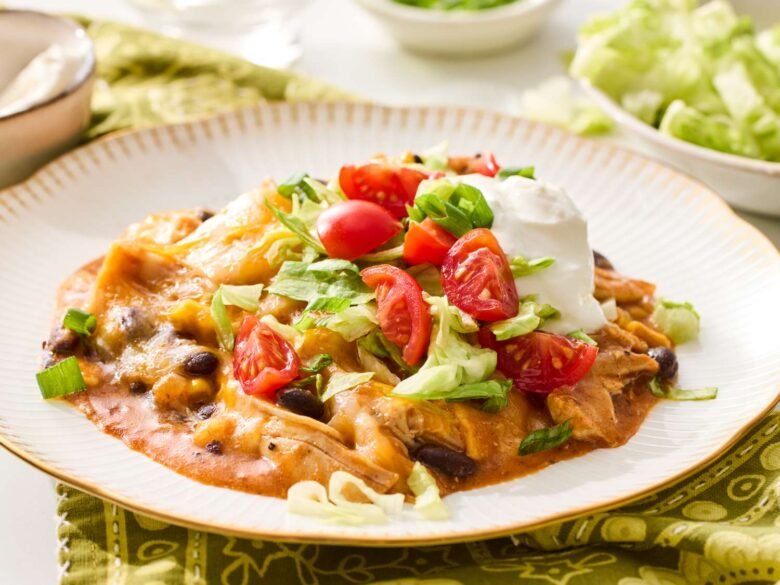
The scoop. A large spoon or serving spatula inserted firmly through the layers and lifted produces a portion that shows all the layers — the alternating bands of tortilla, filling, and melted cheese — in the cross-section. Serve into wide, shallow bowls rather than plates so the sauce can pool around the casserole rather than running off.
The toppings bar. The casserole is the foundation. The toppings are what each person applies to their portion according to preference. Set out: sour cream or Mexican crema, sliced avocado or guacamole, fresh pico de gallo or diced tomato and onion, fresh cilantro, sliced jalapeños, hot sauce, lime wedges. The toppings provide the cold, acidic contrast that the hot, rich casserole specifically requires.
For a party. The slow cooker on KEEP WARM on the serving table, the toppings in individual bowls alongside. Guests serve themselves. The casserole stays warm and portionable for hours.
The Complete Table
Toppings — essential:
- Sour cream or Mexican crema — cooling and rich
- Sliced avocado or guacamole — creamy and fatty
- Fresh pico de gallo — acidic, bright, tomato-forward
- Fresh cilantro — herbal and fresh
- Lime wedges — for squeezing
- Sliced pickled jalapeños — for heat
Sides:
- Mexican rice — seasoned with tomato and cumin
- Refried beans — creamy and complementary
- Simple black bean salad with lime and cilantro
- Elote (Mexican street corn) — sweet and rich
- Warm tortilla chips for scooping
Drinks:
- A cold Mexican lager — Modelo Especial, Pacifico, Tecate
- Horchata — sweet, cool, and specifically complementary
- Agua fresca (hibiscus or tamarind)
- Margarita on the rocks for the adults
The Day-After Enchilada Casserole Uses
Leftover slow cooker enchilada casserole keeps refrigerated for four days and is one of the most versatile leftover dishes in this collection. Reheated in the microwave with a spoonful of fresh pico de gallo on top, it is the best possible weekday lunch. Scooped into a flour tortilla with a drizzle of sour cream and a pinch of fresh cilantro, it becomes an enchilada burrito that takes ninety seconds to assemble. Pressed into a skillet with a small amount of oil over medium heat until the bottom crisps, then flipped and pressed until the other side crisps, it becomes enchilada casserole hash — crunchy at the edges, molten in the middle — that is specifically excellent as a weekend breakfast topped with fried eggs. Used as the filling for a baked potato with sour cream and cheese, it turns a plain potato into something significantly more exciting.
Easy Variations
- Green chile chicken enchilada casserole. Replace the red enchilada sauce with green enchilada sauce (tomatillo-based). Add one can of diced green chiles and replace the cheddar with Monterey Jack. The green version is brighter, tangier, and more citrus-forward than the red.
- Beef enchilada casserole. Replace the chicken with one and a half pounds of ground beef, browned and seasoned with cumin, chili powder, garlic, and onion. The beef version is richer and more assertively flavored than chicken — specifically good for those who prefer beef in their enchiladas.
- Vegetarian enchilada casserole. Omit the chicken entirely and double the black beans, add one can of pinto beans, and add two cups of frozen corn and one large diced zucchini. Season aggressively with cumin, chili powder, and garlic. The vegetarian version is substantial and deeply flavored.
- White enchilada casserole. Replace the red enchilada sauce with a white sauce: one can of cream of chicken soup, one cup of sour cream, one cup of chicken broth, and one can of diced green chiles whisked together. The white version is creamier, milder, and less chile-forward — specifically good for those who find red enchilada sauce too assertive.
- Spicy enchilada casserole. Use a hot enchilada sauce, add two minced chipotle peppers in adobo to the filling, and layer fresh or pickled jalapeño slices between the filling layers. Finish with a drizzle of sriracha over the broiled cheese.
Make-Ahead and Storage
Make-ahead: The chicken filling can be made up to two days ahead and refrigerated — cook the chicken in the sauce, shred, and store. On the day of serving, assemble the casserole layers in the slow cooker and cook for two to three hours on LOW (since the filling is already cooked, the total cook time is shorter).
Refrigerator: Leftover casserole keeps in an airtight container for four days. The tortilla layers absorb more sauce during refrigeration — the day-after casserole is more integrated and arguably better than the freshly made version.
Reheating: Individual portions in the microwave at 70 percent power for 90 seconds, covered. The full casserole reheated in the slow cooker on LOW for one hour, or in a 350°F (175°C) oven covered with foil for 20 to 25 minutes.
Freezer: Freeze in portions for up to two months. The tortillas become softer after freezing and thawing — the casserole is still excellent but slightly less textured. Thaw overnight in the refrigerator and reheat as above.
Shopping List
The Chicken
- 2 lbs (900g) boneless, skinless chicken thighs or breasts
- 2 cups (480ml) red enchilada sauce, divided (store-bought or homemade)
The Filling
- 1 can (15 oz / 425g) black beans, drained and rinsed
- 1 cup (150g) frozen or canned corn, drained
- 1 can (4 oz / 115g) diced mild green chiles
- 1 medium onion, diced
- 1 red bell pepper, diced
- 3–4 garlic cloves, minced
- 1 tsp ground cumin
- 1 tsp chili powder
- Salt and pepper to taste
The Tortillas
- 12–15 small (6-inch) corn tortillas
The Cheese
- 2 cups (225g) shredded Mexican blend or Monterey Jack cheese
For Serving
- Sour cream or crema
- Sliced avocado or guacamole
- Fresh pico de gallo or diced tomato
- Fresh cilantro
- Lime wedges
- Hot sauce
Slow Cooker Chicken Enchilada Casserole
Boneless, skinless chicken thighs cooked for three to four hours on LOW in red enchilada sauce with onion, garlic, cumin, and chili powder until fully tender and shreddable — then shredded and combined with black beans, corn, and diced green chiles into a deeply flavored enchilada filling. The slow cooker layered with enchilada sauce, overlapping corn tortillas, filling, more sauce, and shredded cheese, repeated three times. Cooked on LOW for a further two hours until the tortillas have softened completely into the chile-saturated layers and the cheese has melted throughout. The top cheese layer finished under the broiler for three minutes until golden and blistered. Served in wide bowls with sour cream, sliced avocado, fresh pico de gallo, cilantro, and lime wedges. The enchilada casserole that feeds six from one slow cooker and tastes like it took considerably more effort.
- Total Time: 5 hours 33 minutes
- Yield: 6–8 servings 1x
Ingredients
Stage One: The Chicken
- 2 lbs (900g) boneless, skinless chicken thighs
- 1 cup (240ml) red enchilada sauce
- 1 medium onion, diced
- 3–4 garlic cloves, minced
- 1 tsp ground cumin
- 1 tsp chili powder
- ½ tsp salt
- ¼ tsp black pepper
The Filling (added after shredding)
- 1 can (15 oz / 425g) black beans, drained and rinsed
- 1 cup (150g) frozen or canned corn, drained
- 1 can (4 oz / 115g) diced mild green chiles, drained
- 1 red bell pepper, diced
Stage Two: The Casserole Layers
- 12–15 small (6-inch) corn tortillas, warmed
- 1 cup (240ml) red enchilada sauce (remaining)
- 2 cups (225g) shredded Mexican blend cheese or Monterey Jack, divided
For Serving
- Sour cream or Mexican crema
- Sliced avocado or guacamole
- Fresh pico de gallo or diced fresh tomato and onion
- Fresh cilantro, roughly chopped
- Lime wedges
- Hot sauce
Instructions
Stage One: Cook the Chicken
- Build the chicken base. Place the chicken thighs in the slow cooker. Add the diced onion, minced garlic, one cup of enchilada sauce, cumin, chili powder, salt, and pepper. Stir to combine and coat the chicken.
- Cook the chicken. Set to LOW and cook for 3 to 4 hours, until the chicken is completely cooked through and shreds easily when pressed with a fork. Do not add any additional liquid — the chicken releases its own juices.
- Shred and combine. Transfer the chicken to a cutting board and shred into pieces using two forks. Return the shredded chicken to the slow cooker. Add the drained black beans, corn, green chiles, and diced red bell pepper. Stir everything together until well combined. Taste and adjust seasoning. Transfer this filling mixture to a large bowl and set aside.
Stage Two: Build the Casserole
- Clean the insert. Quickly wipe the slow cooker insert with a paper towel if needed to remove any stuck bits.
- Layer one. Spread 2 to 3 tablespoons of enchilada sauce across the bottom of the slow cooker. Arrange a layer of warmed corn tortillas over the sauce, overlapping slightly to cover the bottom completely.
- Layer two. Spread one third of the chicken filling evenly over the tortillas. Spoon 3 to 4 tablespoons of enchilada sauce over the filling. Sprinkle a generous handful of shredded cheese over the sauce.
- Repeat. Add another tortilla layer, then another third of the filling, more sauce, and more cheese. Repeat one more time — three complete layers total.
- Final layer. Top with a final layer of tortillas, pour the remaining enchilada sauce evenly over the top, and distribute the remaining cheese generously across the entire surface.
- Cook the casserole. Replace the lid. Set to LOW and cook for 2 to 3 hours, until the tortillas have softened completely into the layers, the cheese is melted throughout, and the casserole is heated through.
- Broil the top. Transfer the slow cooker insert to the oven broiler if oven-safe, or scoop the top layer carefully into a broiler-safe dish. Broil 5 to 6 inches from the element for 2 to 3 minutes, watching constantly, until the top cheese is golden and blistered. Alternatively, cover with the slow cooker lid for the final 10 minutes on HIGH — the trapped steam melts the cheese, though without browning.
- Rest and serve. Allow the casserole to rest for 5 minutes before serving. Scoop into wide bowls, ensuring each portion captures all layers. Serve immediately with sour cream, avocado, pico de gallo, cilantro, and lime wedges.
Notes
- Two stages produce the best result. The chicken cooked in enchilada sauce for three to four hours before the casserole is assembled produces filling that has absorbed the chile flavor throughout. Layering raw chicken into the casserole produces filling that cooks unevenly and absorbs less flavor from the sauce. The two-stage approach requires a brief pause for assembly but produces a significantly more integrated, more deeply flavored casserole.
- Warm the tortillas before layering. Cold corn tortillas crack when handled. Thirty seconds in the microwave wrapped in a damp paper towel, or a brief pass through a warm dry skillet, makes them flexible and easy to lay without breaking. Cracked tortillas create gaps in the layers that the sauce cannot fully fill.
- Sauce on the bottom prevents sticking. The first layer of enchilada sauce on the insert bottom is a practical step that makes a meaningful difference at serving time — the casserole releases cleanly rather than adhering to the ceramic. Do not skip it.
- Press each layer down lightly. As you build the layers, press down gently with the back of a spoon after each addition. This ensures good contact between layers and prevents air pockets that create uneven cooking.
- The broiler finish matters. Slow cooker cheese melts but does not brown. The three minutes under the broiler produces the golden, blistered top that makes the casserole look finished and specifically appealing. Without it, the top is pale and the presentation is less compelling.
- Cold toppings complete the dish. The hot, chile-rich casserole needs the contrast of cold sour cream, fresh pico de gallo, and sliced avocado. These are not optional garnishes — they are flavor components that balance the richness and heat of the casserole. Set them out before the casserole is served.
- Day two is better. The tortilla layers absorb more sauce overnight in the refrigerator, and the flavors integrate further. Leftover enchilada casserole, reheated the next day, is often more cohesive and more deeply flavored than the freshly made version.
- Prep Time: 15 minutes
- Cook Time: 3–4 hours (on LOW)
- Category: Dinner, Main Dish
- Method: Slow Cooking
- Cuisine: American, Mexican
Frequently Asked Questions
Can I use flour tortillas instead of corn? Yes — flour tortillas produce a softer, slightly gummier casserole with a more neutral flavor. Corn tortillas are the traditional and more specifically correct choice for an enchilada preparation — their earthy, slightly chewy texture absorbs the sauce differently and contributes a corn flavor that is part of the dish’s character. Flour tortillas absorb more moisture during the cook and can produce a casserole that feels slightly pasty rather than the distinct-layer texture of the corn version. If flour tortillas are preferred, reduce the sauce quantity slightly to compensate for their higher absorption rate.
Can I assemble the casserole the night before and cook it the next day? Yes — with one caveat. The corn tortillas in contact with the enchilada sauce will begin to soften during overnight refrigeration, which means the slow cooker cook time may need to be reduced by thirty minutes to an hour since the tortillas are already partially softened before the cook begins. Assemble the layers, cover the slow cooker insert tightly, and refrigerate overnight. Add the cold insert to the slow cooker (do not preheat), set to LOW, and cook for one and a half to two hours rather than the standard two to three — check for a fully heated center before the broil finish.
My casserole is watery. How do I prevent this? Watery enchilada casserole has a few common causes. First: the chicken was not fully drained of excess liquid before being incorporated into the filling — transfer the shredded chicken with a slotted spoon rather than dumping the entire contents of the slow cooker into the casserole. Second: too much enchilada sauce was used — the sauce quantity in the recipe is calibrated for the tortilla-to-sauce ratio that produces a cohesive, not soggy result. Third: canned corn or beans were not fully drained — any excess liquid from canned goods adds to the sauce pool during the cook. For an already-made watery casserole, cook uncovered on HIGH for the final thirty minutes to allow some moisture to evaporate.
Can I make this with green enchilada sauce instead of red? Yes — green enchilada sauce (salsa verde-based, made from tomatillos) produces a brighter, tangier, more citrus-forward casserole than the red chile version. The substitution is direct — use the same quantity and follow the same method. Green enchilada sauce pairs particularly well with chicken and with Monterey Jack cheese. For the green version, finish with crumbled queso fresco rather than melted cheddar for a specifically complementary flavor pairing.
What makes this different from a regular baked enchilada casserole? The most significant difference is the depth of flavor that develops during the slow cooker’s extended cooking time. A standard baked enchilada casserole is typically assembled from pre-cooked chicken and baked for thirty to forty minutes — adequate for melting the cheese and heating the filling but not enough time for the tortillas to fully absorb the sauce or for the flavors to integrate. The slow cooker version cooks for a total of five to seven hours, during which the chicken absorbs the enchilada sauce flavors deeply, the tortillas become part of the sauce rather than separate layers, and the cheese melts through every layer rather than sitting on top. The result is more cohesive, more deeply flavored, and — particularly the next day — noticeably more integrated in texture and taste.
Can I skip the two-stage process and put everything in at once? Yes — combine the raw chicken, vegetables, filling ingredients, and enchilada sauce in the slow cooker, top with tortilla layers and cheese, and cook on LOW for five to six hours total. The result is acceptable but noticeably different from the two-stage version: the chicken is less evenly distributed through the filling (it cooks in one location rather than being shredded and mixed), the filling is less cohesive, and the flavors are less deeply integrated. The two-stage process takes an additional fifteen minutes of assembly time but produces a casserole that is meaningfully better. For a weeknight when even fifteen minutes of assembly is too much, the single-stage method works — but plan the two-stage version whenever time allows.
How do I know when the casserole is fully cooked? The casserole is done when the center is hot throughout — a thermometer inserted into the center of the casserole should read 165°F (74°C). Visually, the top cheese layer should be fully melted, the tortilla edges should appear soft and integrated with the sauce (not crisp or pale), and the casserole should be pulling slightly away from the edges of the insert. If there is any doubt, replace the lid and cook for another thirty minutes before checking again.