
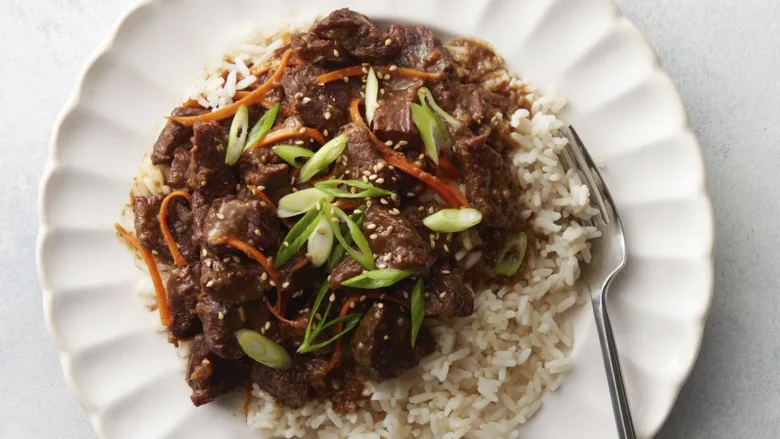
Mongolian beef is, despite its name, not Mongolian. It is a dish that was invented in Taiwan in the mid-twentieth century, refined in American Chinese restaurants into the form most people recognize, and has never had any meaningful connection to the cuisine of Mongolia — a country whose traditional food is built almost entirely on lamb, dairy, and minimal seasoning, as far from the garlic-ginger-soy-brown-sugar combination of Mongolian beef as it is possible to get. The name, like General Tso’s chicken and fortune cookies, is a piece of American Chinese restaurant mythology that stuck.
None of this makes the dish any less worth making. Mongolian beef — whatever its provenance — is one of the great American Chinese restaurant dishes: tender slices of beef coated in a dark, slightly sweet, deeply savory sauce of soy, brown sugar, garlic, and ginger, with a heat from the slow cooker that has had time to caramelize the sugars and concentrate the sauce into something glossy and cling-to-the-beef perfect. The restaurant version is made in a screaming-hot wok, which is why restaurant Mongolian beef is difficult to replicate at home on a standard residential stove. The slow cooker version takes a different approach entirely — and produces a result that competes with the restaurant version on flavor while exceeding it on tenderness.
The beef in slow cooker Mongolian beef has hours, rather than seconds, to absorb the sauce. The sauce has hours to reduce around the beef rather than being applied in a flash. The garlic and ginger bloom and mellow rather than char. The brown sugar caramelizes gradually rather than violently. The result is a Mongolian beef that is different from the wok version — less crispy, deeper in flavor, more yielding in texture — and in its own right an excellent dinner that takes fifteen minutes of preparation and feeds six people from a single slow cooker.
Why the Slow Cooker Produces a Different but Excellent Mongolian Beef
Restaurant Mongolian beef is a wok dish. The wok, heated to temperatures that a residential stove cannot approach, produces what Chinese cooks call “wok hei” — the breath of the wok — a smoky, caramelized, slightly charred quality that comes from the immediate and violent contact between protein and superhot metal. The beef crisps slightly at the edges before the sauce is applied. The sauce reduces in seconds. The whole dish takes under three minutes from the moment the beef hits the wok.
The slow cooker cannot produce wok hei. The temperatures are not available, the violence of the heat is not available, the speed is not available. Attempting to directly replicate the wok-cooked dish in a slow cooker is the wrong goal — the result will always be a lesser version of the wok version, lacking the crispness and the char.
The slow cooker version is not a lesser version. It is a different version with its own specific qualities. The beef — flank steak, skirt steak, or chuck sliced thin — braises in the sauce for four to five hours on LOW, absorbing the soy and ginger and garlic and brown sugar throughout rather than being coated on the surface. The sauce, rather than being applied in a burst to already-cooked beef, reduces around the raw beef and concentrates as the beef cooks, producing a sauce that is thicker, deeper, and more integrated with the beef than the wok version allows time for. The garlic and ginger, having spent four hours in the sauce rather than thirty seconds, mellow from sharp and pungent into something sweeter and more complex.
The slow cooker version is the right version for home cooking. It is reliable, produces excellent results without equipment or technique that most home kitchens cannot replicate, and creates a dinner that is genuinely impressive for the effort invested.
Choosing Your Beef
The cut of beef is the most important decision in this recipe, and flank steak is the most common choice but not the only excellent one.
Flank steak is the traditional Mongolian beef cut — it has a pronounced grain that, when sliced thinly and against the grain, produces flat, tender pieces that absorb the sauce beautifully and have enough beefy flavor to hold their own against the assertive sauce. Slice against the grain, perpendicular to the long muscle fibers, into pieces no thicker than a quarter inch. Partially freezing the flank steak for twenty to thirty minutes before slicing makes the cutting significantly easier and produces more uniform slices.
Skirt steak behaves similarly to flank steak and is frequently used interchangeably. It has an even more pronounced grain than flank and, sliced correctly, produces a very tender, slightly more intensely flavored piece of beef. Skirt steak is often less expensive than flank steak and is the better value option when available.
Chuck roast, sliced thinly against the grain or cut into thin strips, is the most budget-friendly option and produces an excellent slow cooker Mongolian beef — arguably more tender than the flank steak version because of chuck’s higher collagen content, which converts to gelatin during the long braise and adds body to the sauce. Chuck Mongolian beef shreds slightly more readily than flank but the sauce is richer.
Sirloin, sliced thin, produces a leaner, slightly firmer result. It holds its shape well and slices cleanly. Less rich than chuck, less characterful than flank, but an acceptable option.
The coating. Before the beef goes into the slow cooker, it is tossed in cornstarch — a quarter cup for two pounds of beef. The cornstarch does two things: it coats the beef in a thin starchy layer that absorbs sauce during the slow cook and eventually thickens it from the inside, and it produces a very slight texture on the beef surface that gives the sauce something to cling to. This is the most important beef-preparation step in the recipe and takes thirty seconds.
The Sauce
Mongolian beef sauce is a simple composition in which the balance between sweet, savory, and aromatic is the entire point.
Soy sauce is the primary savory and salt component — a generous half cup for a full batch. Low-sodium soy sauce can be used and is recommended if sodium sensitivity is a concern, as the sauce is concentrated during the slow cook. Regular soy sauce produces a deeply savory, appropriately salty sauce. Tamari is an excellent gluten-free substitute.
Brown sugar — a half cup, packed — is the sweetener that creates the characteristic sweet note of Mongolian beef sauce and contributes to the caramelized, glossy quality of the finished sauce. Dark brown sugar produces a more molasses-forward, complex sweetness; light brown sugar produces a cleaner, less assertive sweetness. Either is correct.
Fresh garlic — five to six cloves, minced — is the aromatic backbone. It blooms and mellows over four to five hours in the slow cooker into a sweet, rounded garlic note.
Fresh ginger root — a tablespoon of freshly grated — adds the clean, spicy brightness that lifts the soy and brown sugar combination out of flatness. Ground ginger can be used in a pinch but produces a duller, less bright result. Fresh ginger root is the correct ingredient.
Beef broth — a quarter cup — adds depth and provides the liquid needed for the braising environment without diluting the sauce. The broth and soy combination forms the braising liquid in which the beef cooks.
Hoisin sauce — two tablespoons, optional — adds a complex, slightly sweet, slightly tangy note that deepens the sauce beyond the soy-sugar base. Many restaurant Mongolian beef sauces include hoisin; its addition is recommended.
Sesame oil — one teaspoon, added after cooking — is the aromatic finish. Sesame oil added at the start of a long slow cook loses its delicate, toasted sesame fragrance completely. Added after the cook, immediately before serving, it adds the distinctive sesame note that makes the dish smell and taste finished. This is the same late-addition principle as vanilla in the drinks series — heat destroys volatile aromatic compounds, so they are always added at the end.
Red pepper flakes — half a teaspoon to one teaspoon, adjustable — add heat that is not traditional in all Mongolian beef versions but specifically good in the slow cooker version, where the sustained heat mellows the flakes into a background warmth rather than a sharp bite.
The Cornstarch Finish
The slow cooker produces a delicious Mongolian beef with one consistent characteristic: the sauce is thinner than the restaurant version. This is because the slow cooker’s enclosed environment traps moisture rather than evaporating it the way a wok does.
The fix is simple and takes five minutes: a cornstarch slurry added in the final thirty minutes of cooking on HIGH, or the sauce transferred to a small saucepan after cooking and reduced briefly, thickens the sauce from its braising-liquid consistency to the glossy, clingy, restaurant-style coating that makes Mongolian beef look and eat the way it should.
The slurry method. Mix two tablespoons of cornstarch with three tablespoons of cold water until completely smooth. Stir into the slow cooker, replace the lid, and cook on HIGH for twenty to thirty minutes until thickened. This is the most hands-off approach.
The stovetop reduction. Remove the beef with a slotted spoon or tongs to a plate. Pour the remaining sauce into a small saucepan and bring to a boil over medium-high heat. Reduce for five to eight minutes until thickened and glossy. Return the beef to the sauce or pour the sauce over the plated beef. This method gives more control over the final consistency and produces a slightly more refined result.
Either method is correct. The slurry is faster and requires fewer dishes. The stovetop reduction allows more precise thickening.
Tips for Perfect Slow Cooker Mongolian Beef
1. Toss the beef in cornstarch before it goes in. The cornstarch coating on the beef absorbs the sauce during cooking and eventually thickens it from the inside, producing a sauce that clings to the beef more effectively than an uncoated piece of beef in the same sauce. It also gives the sauce something to grip. Toss the sliced beef with the cornstarch in a zip-lock bag or bowl until every piece is coated.
2. Slice against the grain — thin. The grain in flank and skirt steak is clearly visible as parallel lines running the length of the meat. Slicing perpendicular to those lines produces tender, short-fiber pieces that are yielding in the mouth. Slicing with the grain produces tough, chewy strips. A quarter inch or thinner is the target. Partial freezing (twenty to thirty minutes in the freezer) makes thin, even slicing dramatically easier.
3. Do not add the sesame oil at the start. Sesame oil’s toasted sesame fragrance evaporates completely during a four-hour slow cook. Added at the very end — immediately before serving — it contributes the aromatic finish that makes the dish smell like Mongolian beef rather than soy sauce with beef. This step takes ten seconds and makes an immediately detectable difference.
4. Thicken the sauce before serving. Slow cooker Mongolian beef sauce is thin at the end of the cook. The cornstarch slurry or stovetop reduction step is the step that produces the restaurant-quality glossy, clingy sauce. Do not serve the dish without thickening — the thin version lacks the visual and textural appeal of the properly finished dish.
5. Cook on LOW — four to five hours. HIGH produces edible Mongolian beef in two to three hours but with a slightly less tender result and a noticeably less developed sauce. The four to five hours on LOW is what produces the fully absorbed, deeply flavored beef and the sauce that has had time to concentrate and mellow.
6. Do not crowd the slow cooker. Mongolian beef benefits from the beef pieces being in contact with the sauce from all directions. Too much beef crammed into a small slow cooker produces uneven cooking — the pieces on top cook more slowly than those submerged in sauce. In a 6-quart slow cooker, two pounds of beef is the correct quantity for even cooking.
7. Serve immediately after thickening. The thickened sauce begins to set slightly as it cools. Mongolian beef is at its best served immediately from the slow cooker over freshly steamed rice, before the sauce has time to cool and thicken further toward stickiness.
Serving the Mongolian Beef
Over steamed white rice is the definitive serving — jasmine rice is the most natural pairing, absorbing the dark, glossy sauce in the way that the flat, long-grain rice is built to do. Pile the beef and its sauce generously over the rice and serve immediately.
Over lo mein noodles — cooked egg noodles tossed with a small amount of sesame oil and soy sauce — produces a noodle version that is equally excellent and specifically good for those who prefer noodles to rice.
With steamed or stir-fried bok choy alongside — a green, slightly bitter vegetable that cuts through the richness of the sauce — is the most natural vegetable pairing. Baby bok choy halved and steamed for three minutes, dressed with a small amount of sesame oil and soy sauce, is the accompaniment that makes the plate feel complete.
The garnish. Thinly sliced green onions scattered generously over the top of the finished dish — this is not optional decoration, it is a flavor component. The raw, fresh sharpness of green onion cuts through the sweet-savory richness of the sauce and adds a textural contrast. A scatter of toasted sesame seeds adds crunch and visual appeal. Both together are the correct finish for the dish.
The Complete Table
Sides:
- Steamed jasmine rice — the definitive pairing
- Lo mein noodles — for a noodle-forward version
- Steamed bok choy with sesame oil — the essential green accompaniment
- Stir-fried snap peas with garlic — bright and crisp against the richness
- Cucumber salad with rice vinegar and sesame — cool, acidic contrast
- Steamed broccoli — simple, neutral, practical
Garnishes:
- Thinly sliced green onions — essential
- Toasted sesame seeds — for crunch and visual appeal
- A drizzle of extra sesame oil over the finished plate
- Sliced red chillies for additional heat
Drinks:
- Ice-cold lager or light beer — the most natural pairing
- Jasmine green tea — clean and complementary
- Sparkling water with cucumber for a non-alcoholic pairing
The Day-After Mongolian Beef Uses
Leftover Mongolian beef, refrigerated in its sauce, is one of the most versatile weekday lunch ingredients. Warmed briefly in a skillet with a splash of water to loosen the sauce, it becomes the filling for a Mongolian beef rice bowl with a fried egg on top and sliced cucumber alongside — a ten-minute lunch of genuine quality. Tossed with cooked lo mein noodles and a handful of shredded cabbage, it becomes a Mongolian beef noodle bowl that reheats in under two minutes. Stuffed into a flour tortilla with shredded lettuce and a drizzle of hoisin-sriracha, it becomes the best possible fusion burrito. Used as the filling for lettuce cups with rice and green onions, it is one of the freshest possible presentations of a rich, deeply sauced beef.
Easy Variations
- Spicy Mongolian beef. Increase the red pepper flakes to one and a half teaspoons and add one tablespoon of sambal oelek or chili garlic paste to the sauce. The heat version of this dish is specifically excellent and suits those who find the standard version too sweet.
- Mongolian beef with vegetables. Add sliced bell peppers and broccoli florets to the slow cooker in the final hour of cooking. They soften into the sauce without over-cooking and turn the dish into a complete one-pot meal with no additional preparation.
- Orange Mongolian beef. Add the zest and juice of one orange to the sauce ingredients. The orange adds a citrus brightness that lifts the soy-brown sugar combination into a different register — closer to orange beef — and is particularly good with the ginger.
- Mongolian lamb. Replace the beef with lamb shoulder or leg, thinly sliced. Lamb’s more assertive flavor stands up to the Mongolian sauce in a way that produces a richer, more complex dish. A genuinely underused variation that is exceptional.
- Mongolian tofu. Replace the beef with extra-firm tofu, pressed and cubed. Toss in cornstarch as with the beef. The tofu absorbs the sauce beautifully during the slow cook and produces a completely vegan version of the dish that is surprisingly satisfying.
Make-Ahead and Storage
Make-ahead: The sauce can be mixed up to three days ahead and refrigerated. The beef can be sliced, tossed in cornstarch, and refrigerated for up to 24 hours before cooking. Combine in the slow cooker directly from the refrigerator on cooking day.
Refrigerator: Leftover Mongolian beef keeps in an airtight container for up to four days. The sauce thickens further during refrigeration — add a small splash of water or broth when reheating and stir to loosen.
Reheating: Gently in a skillet over medium-low heat with a splash of water, or in the microwave at 70 percent power in 60-second bursts, stirring between. Do not overheat — the beef will toughen if reheated at high temperature.
Freezer: Mongolian beef freezes well for up to two months. Freeze in portions with sauce. Thaw overnight in the refrigerator and reheat gently as above. The sauce may need a small additional thickening with fresh cornstarch slurry after thawing if it has become watery during the freeze-thaw process.
Shopping List
The Beef
- 2 lbs (900g) flank steak or skirt steak, sliced ¼-inch thin against the grain
- ¼ cup (30g) cornstarch (for coating)
The Sauce
- ½ cup (120ml) soy sauce (or tamari for gluten-free)
- ½ cup (110g) brown sugar, packed
- ¼ cup (60ml) beef broth
- 5–6 garlic cloves, minced
- 1 tbsp fresh ginger root, grated
- 2 tbsp hoisin sauce (optional)
- ½–1 tsp red pepper flakes (to taste)
The Cornstarch Finish
- 2 tbsp cornstarch
- 3 tbsp cold water
The Finish (added after cooking)
- 1 tsp toasted sesame oil
For Serving
- Steamed jasmine rice
- 4–5 green onions, thinly sliced
- 2 tbsp toasted sesame seeds
- Steamed bok choy or broccoli alongside
Slow Cooker Mongolian Beef
Two pounds of flank steak sliced thin against the grain, tossed in cornstarch, and slow-cooked on LOW for four to five hours in a sauce of soy, brown sugar, fresh garlic, fresh ginger, and beef broth — the beef absorbing the sauce throughout as the sauce concentrates and deepens around it. Finished with a cornstarch slurry to produce the glossy, clingy, restaurant-quality coating, then topped with sesame oil added at the very end to preserve its fragrance. Served over jasmine rice with a generous scatter of green onions, toasted sesame seeds, and steamed bok choy alongside. The slow cooker Mongolian beef that is different from the wok version and better than any attempt to replicate the wok version at home.
- Total Time: 4 hours 45 minutes
- Yield: 4–6 servings 1x
Ingredients
The Beef
- 2 lbs (900g) flank steak or skirt steak
- ¼ cup (30g) cornstarch
The Sauce
- ½ cup (120ml) soy sauce
- ½ cup (110g) packed brown sugar
- ¼ cup (60ml) beef broth
- 5–6 garlic cloves, minced
- 1 tbsp fresh ginger root, finely grated
- 2 tbsp hoisin sauce (optional but recommended)
- ½–1 tsp red pepper flakes (to taste)
The Cornstarch Slurry (to finish)
- 2 tbsp cornstarch
- 3 tbsp cold water
The Finish
- 1 tsp toasted sesame oil — added after cooking
For Serving
- Steamed jasmine rice
- 4–5 green onions, thinly sliced
- 2 tbsp toasted sesame seeds
- Steamed bok choy or broccoli
Instructions
- Slice the beef. For easier slicing, place the flank steak in the freezer for 20 to 30 minutes until partially firm but not frozen solid. Slice against the grain — perpendicular to the visible muscle fibers — into strips approximately ¼ inch thick. If the strips are long, cut them in half crosswise.
- Coat in cornstarch. Place the sliced beef in a large zip-lock bag or bowl. Add the cornstarch and toss until every piece is evenly coated. Shake off any excess. The beef should have a light, even coating — not clumped.
- Make the sauce. In a medium bowl or measuring jug, whisk together the soy sauce, brown sugar, beef broth, minced garlic, grated ginger, hoisin sauce (if using), and red pepper flakes until the sugar is dissolved.
- Build the slow cooker. Place the cornstarch-coated beef in the slow cooker. Pour the sauce over the beef and stir once gently to ensure the beef is evenly distributed and coated.
- Cook. Set the slow cooker to LOW and cook for 4 to 5 hours, until the beef is tender and has absorbed the sauce. The sauce will be thinner than the final intended consistency — this is normal.
- Thicken the sauce. In a small bowl, mix the 2 tablespoons of cornstarch with 3 tablespoons of cold water until completely smooth. Stir the slurry into the slow cooker. Switch to HIGH and cook uncovered for 20 to 30 minutes, stirring once or twice, until the sauce has thickened to a glossy, coating consistency. Alternatively: remove the beef with a slotted spoon, pour the sauce into a small saucepan, bring to a boil, add the slurry, and reduce for 3 to 5 minutes until glossy.
- Finish. Stir in the toasted sesame oil immediately before serving.
- Serve. Spoon the Mongolian beef and its sauce over steamed jasmine rice. Scatter green onions and toasted sesame seeds generously over the top. Serve with steamed bok choy or broccoli alongside.
Notes
- Slice against the grain — always. The grain of flank steak is clearly visible as parallel lines running the length of the cut. Slicing perpendicular to those lines shortens the muscle fibers and produces tender, yielding strips. Slicing with the grain produces long, intact fibers that are tough and chewy regardless of how long they are cooked. Identify the grain direction before making the first cut.
- Partial freezing makes slicing easy. Twenty to thirty minutes in the freezer firms the flank steak just enough to allow clean, thin, consistent slices without the meat sliding away from the knife. Fully frozen beef is too hard to slice; partially frozen is ideal. This single step produces noticeably more uniform slices than cutting from room temperature.
- The cornstarch coating is not optional. It absorbs the sauce during the slow cook, thickens the braising liquid from the inside, and gives the sauce something to grip. Without it, the beef sits in a thin, pale sauce that does not cling or coat. With it, the finished sauce is darker, thicker, and fully integrated with the beef.
- Sesame oil goes in at the very end. Toasted sesame oil added to the slow cooker at the start of a four-hour cook loses its distinctive fragrance entirely — the volatile aromatic compounds evaporate completely. Added immediately before serving, it is the aromatic signature of the dish. Ten seconds. Never skip it.
- The sauce will be thin before thickening. This is expected and not a sign that anything has gone wrong. The slow cooker traps moisture. The thickening step — slurry or stovetop reduction — is what converts the braising liquid into the glossy restaurant sauce. Do not serve without this step.
- Green onions are a flavor component, not decoration. The raw, fresh sharpness of thinly sliced green onion cuts through the sweet-savory richness of the Mongolian beef sauce and balances the plate. A generous scatter — not a polite garnish — is correct.
- The dish is sweet by design. Half a cup of brown sugar in a Mongolian beef sauce is a lot of sugar, and first-time makers sometimes question it. The sweetness is the point — it is what makes Mongolian beef Mongolian beef rather than generic beef in soy sauce. The soy sauce’s salinity and the ginger’s spice balance it. If the finished dish seems too sweet, add a small splash of rice vinegar or an extra teaspoon of soy sauce to adjust.
- Prep Time: 15 minutes
- Cook Time: 4–5 hours (on LOW)
- Category: Dinner, Main Dish
- Method: Slow Cooking
- Cuisine: American, Asian
- Diet: Dairy-Free, Gluten-Free
Frequently Asked Questions
Why is this called Mongolian beef if it’s not from Mongolia? Mongolian beef is an American Chinese restaurant dish that originated in Taiwan in the mid-twentieth century and was developed and popularized in American Chinese restaurants from the 1970s onward. The name has no specific connection to Mongolian cuisine — it may have been borrowed from the Mongolian barbecue restaurants (also Taiwanese in origin) that were popular at the time, or it may simply be one of the many evocatively named dishes in the American Chinese canon. Traditional Mongolian cuisine is built around lamb, dairy products, and simple preparations suited to nomadic life — entirely unlike the soy-ginger-brown-sugar dish that bears its name. The dish is excellent regardless of its nomenclature.
Can I use a different cut of beef? Yes. Skirt steak is the closest alternative to flank steak — similar grain structure, similar flavor, often less expensive, equally tender when sliced correctly against the grain. Chuck roast, sliced thin against the grain, produces a more tender, more collagen-rich result with a richer sauce — excellent and budget-friendly. Sirloin produces a leaner, slightly firmer result. Ribeye, thinly sliced, produces the most luxurious version of the dish — the fat marbling produces extraordinary tenderness and richness, though at the cost of the most expensive cut. The cornstarch coating and the slow cook method work with any of these options.
My sauce is too thin even after adding the cornstarch slurry. What do I do? Make a second, slightly stronger slurry — three tablespoons of cornstarch mixed with four tablespoons of cold water — and stir into the slow cooker or saucepan while the sauce is still hot. Alternatively, transfer the sauce to a saucepan and reduce over medium-high heat without the slurry until it reaches the desired consistency. Thin sauce from a slow cooker Mongolian beef is almost always the result of the beef releasing more liquid than the cornstarch in the original coating could absorb — additional thickener at the end is always the correct fix rather than trying to reduce the liquid from the start by using less broth.
Can I make this gluten-free? Yes — replace the soy sauce with tamari (which is naturally wheat-free) or a certified gluten-free soy sauce. Replace the hoisin sauce with a gluten-free hoisin (available at most Asian grocery stores and online) or omit it. The cornstarch is naturally gluten-free. Every other ingredient in the recipe is naturally without gluten. The finished dish is entirely gluten-free when these substitutions are made.
How do I prevent the beef from becoming tough? Tough slow cooker Mongolian beef has almost always been sliced with the grain rather than against it, or cooked on HIGH for the full duration rather than LOW. Slicing against the grain shortens the muscle fibers — it is the single most important step in producing tender beef in this recipe. Cooking on LOW for four to five hours rather than HIGH for two to three produces a noticeably more tender result because the lower temperature allows collagen to convert to gelatin gradually without the proteins seizing. If the beef is consistently tough despite correct slicing, it may also be because the cut is too lean — flank and skirt steak have the correct fat content; very lean cuts tighten during a long slow cook regardless of grain orientation.
Can I add vegetables to the slow cooker with the beef? Yes, with timing attention. Bell peppers, broccoli, and snap peas are the most natural additions — but they should be added in the final hour of cooking only, not at the start. Vegetables added at the start of a four to five hour slow cook become waterlogged and overcooked, adding excess liquid to the sauce and losing their texture entirely. Added in the final hour, they soften pleasantly without disintegrating and absorb the sauce without releasing too much additional moisture. For broccoli specifically, which overcooks very quickly, the final 30 to 45 minutes is the correct window.
What is the correct consistency for the finished sauce? The finished Mongolian beef sauce should coat the back of a spoon — thick enough that a line drawn through the coating holds its edges cleanly for several seconds, but fluid enough to pour and coat the rice when ladled. The restaurant version is sometimes thicker than this — almost sticky — which can be achieved with an additional tablespoon of cornstarch in the slurry. The home version with a standard slurry produces a slightly looser sauce that is easier to serve and equally delicious. If the sauce is so thick that it sets on the beef rather than pools around it, add a splash of warm beef broth and stir to loosen.