The Philly cheesesteak is one of the most argued-about sandwiches in American food culture, and the argument is mostly between people from Philadelphia and everyone else. People from Philadelphia are correct that the original — thinly shaved ribeye cooked on a flat iron griddle, piled into an Amoroso roll, topped with Cheez Whiz or provolone — is one of the great sandwiches of the world, and that most versions made outside Philadelphia are approximations at best. Everyone else is correct that you do not need to be in Philadelphia, or have a flat iron griddle, or track down an Amoroso roll to make a cheesesteak that is deeply worth eating.
The slow cooker cheesesteak resolves this argument by not attempting to replicate the original. It does something different: it braises the beef and the onions and the peppers together over hours until the beef is impossibly tender, the vegetables are soft and sweet, and the accumulated juices in the slow cooker have produced a braising liquid so flavorful that it functions as a natural dipping sauce for the sandwich — making this version, in some ways, a hybrid of the cheesesteak and the French dip. The beef in a slow cooker cheesesteak has more depth than the flat-iron griddled version. The onions are more fully caramelized. The peppers are more completely softened. The cheese — melted over the top under the broiler at the very end — seals the whole sandwich in a glossy, bubbling layer that makes the sandwich look and taste specifically assembled rather than simply filled.
It is not the Pat’s or Geno’s cheesesteak. It is a slow cooker cheesesteak — a different and genuinely excellent thing — and it is worth making specifically for what it is rather than as a substitute for something it is not trying to be.
The History and the Argument
The cheesesteak was invented in Philadelphia in the 1930s, attributed by competing accounts to Pat Olivieri, a hot dog vendor who allegedly threw beef scraps on his grill one day and discovered something better than hot dogs. The Amoroso roll — long, slightly crusty, soft enough to compress without breaking — became the standard vessel. The griddle-cooked, thinly shaved steak became the standard beef. The cheese debate — Cheez Whiz (the most traditional), provolone (the most common), or American cheese — has never been resolved and probably never will be.
What is not disputed is the method: the flat iron griddle. The cheesesteak’s characteristic texture — the beef cooked in its own fat on a screaming-hot surface, the onions charred and softened alongside, everything piled together with the cheese melted over it by trapping a small amount of steam — is a function of the griddle in a way that no other cooking method replicates exactly.
The slow cooker version does not attempt the griddle texture. What it offers instead is the braised version of the same ingredients — the beef slow-cooked until it pulls apart, the onions collapsed and sweet, the peppers fully softened, the cooking juices available for dipping — and this version is as legitimate and as genuinely worth eating as the original, simply different in its execution.
Choosing Your Beef
The cut of beef is the most consequential decision in slow cooker Philly cheesesteak, and the answer here is different from the flat-iron griddle version.
Chuck roast is the best choice for the slow cooker version — a three to four pound chuck roast, cooked for seven to eight hours on LOW until it shreds completely. Chuck’s high collagen content converts to gelatin during the long braise, enriching the cooking juices that become the dipping sauce. Chuck cheesesteak beef, pulled into shreds and piled on a roll with melted provolone and the softened peppers and onions, is one of the most satisfying sandwiches in this collection. It is distinctly not the thinly sliced flat-iron griddle version — it is something richer, more yielding, more deeply flavored.
Sirloin tip roast holds together better than chuck and can be sliced thinly after the slow cook — producing a more traditional cheesesteak texture. Slice against the grain after the cook, thinly, and layer onto the roll. The sirloin version is closer to the visual presentation of the original and is the choice for those who want thin-sliced beef rather than shredded.
Flank steak or skirt steak — sliced thin before cooking, like the Mongolian beef recipe — can be used for a faster cook (three to four hours on LOW) and a more traditional thin-beef texture. Less collagen means less rich cooking juices but a faster result.
The sear. As with every beef braise in this series, searing the chuck roast before it goes into the slow cooker is the step that most improves the depth and color of the cooking juices. Ten minutes in a hot skillet, all sides browned, the skillet deglazed with beef broth and the fond scraped into the slow cooker — this step is not mandatory but produces a noticeably richer, darker braising liquid that becomes a better dipping sauce.
The Vegetables
The vegetables in a Philly cheesesteak — specifically the peppers and onions — are as important as the beef, and the slow cooker does to them what the griddle does but more slowly and more completely.
Yellow onions — two large ones, thinly sliced — are the essential vegetable. They cook down over seven to eight hours until they are completely soft, slightly sweet, and deeply golden. The slow cooker caramelizes them more gently and more evenly than the griddle’s high heat, producing a sweeter, more mellow onion note. Onions added at the start of the cook need no attention — they collapse completely into the beef by the time the cook is done.
Green bell peppers — one to two, thinly sliced — are the most traditional cheesesteak vegetable. Their slightly bitter, grassy note cuts through the richness of the beef and cheese. They soften completely in the slow cooker without the charring that the griddle produces — a different texture, equally good.
Red bell peppers add sweetness and color. The combination of one green and one red pepper is the most visually appealing and the most balanced in flavor.
Mushrooms — eight ounces of cremini or button mushrooms, sliced — are a common cheesesteak addition that some Philadelphia purists reject and most non-Philadelphians happily include. They add earthy depth and absorb the beef braising liquid beautifully during the slow cook. Optional but recommended.
Garlic — four to five cloves, minced — goes in with the vegetables and softens and mellows during the long cook into the sweet, rounded garlic note that deepens the braising liquid.
The Braising Liquid
The braising liquid in slow cooker cheesesteak is what produces both the tender beef and the dipping sauce — both functions from the same liquid.
Beef broth — one cup — is the base. The better the broth, the better the starting point for the dipping sauce.
Worcestershire sauce — two tablespoons — adds the umami depth that makes the braising liquid taste specifically beefy rather than just meaty.
Soy sauce — one tablespoon — amplifies the savory depth without tasting of soy in the finished liquid.
Onion powder and garlic powder — one teaspoon each — add aromatic depth to the braising liquid from the start, before the raw onions and garlic have had time to contribute their full flavor.
Italian seasoning — one teaspoon — adds the herbal note that bridges the beef and the vegetable components.
The accumulated cooking juices. The most important component of the dipping sauce is not what goes in at the start but what comes out during the cook: the juices released by the beef, the caramelized sugars from the onions, the collagen from the chuck converted to gelatin over eight hours. The braising liquid at the end of the cook is not the broth that went in — it is something considerably richer, darker, and more complex. Strain it, skim it lightly, taste it, and serve it warm in individual cups alongside each sandwich.
The Cheese
The cheese question in Philly cheesesteak is the most debated element of the sandwich, and all three traditional options produce excellent slow cooker cheesesteaks.
Provolone is the most widely used outside Philadelphia and the most practical choice for a slow cooker cheesesteak. It melts smoothly under the broiler, has a mild, slightly sharp flavor that suits the rich beef and sweet onions, and produces the glossy, bubbling layer that makes the sandwich look correct. Sharp provolone is better than mild — its more assertive flavor registers through the richness of the braised beef.
Cheez Whiz is the most traditional and authentically Philadelphia choice. Its processed, extremely smooth texture and intense, salty flavor are exactly what Pat’s original cheesesteak used. For a slow cooker cheesesteak, Cheez Whiz is applied hot — either microwaved and spooned over the assembled sandwich or warmed in a small saucepan and poured over. It does not require the broiler. It is the choice for maximum authenticity and the choice that will generate the most comments from Philadelphians at the table.
American cheese — specifically the good quality deli variety, not individually wrapped singles — melts the most smoothly of any option and produces a creamy, very mild cheese layer that allows the beef flavor to come forward more clearly. Two to three slices per sandwich, allowed to melt from the heat of the warm beef without needing the broiler.
Provolone and Cheez Whiz together — a layer of Cheez Whiz applied first, sharp provolone melted over under the broiler — is the most indulgent option and the choice that produces the maximum cheese flavor and the most visually spectacular sandwich.
The Roll
The roll for a slow cooker cheesesteak faces the same engineering requirements as the French dip roll — it must survive the moisture from the braised beef and any dipping without disintegrating.
Hoagie rolls — eight to ten inches, with a slightly crusty exterior — are the most widely available correct choice. The crust provides structural integrity; the soft interior compresses around the beef without crumbling.
Amoroso rolls, if available (primarily in the Philadelphia region), are the authentic choice and specifically designed for this sandwich. Their particular combination of a slightly chewy crust and a soft, yielding interior is difficult to replicate with any substitute.
French bread cut into sandwich lengths is an excellent and widely accessible alternative. Its crust is more pronounced than a hoagie roll and holds up better to very juicy braised beef.
Ciabatta works well and adds a slightly more artisanal character to the sandwich.
Toasting. The cut side of the roll should always be toasted — under the broiler for two to three minutes until golden. The toasted surface creates a moisture barrier that prevents the bottom of the roll from becoming soggy immediately on contact with the juicy beef. This is the same logic as the French dip — toasting is mandatory for structural integrity.
The Broiler Finish
The broiler finish is what transforms the slow cooker cheesesteak from an assembled sandwich into a specifically deliberate one.
The assembly. Open the toasted roll. Pile the beef and vegetables — shredded or sliced from the slow cooker — generously on the bottom half. Layer cheese over the beef.
The broil. Slide the open-faced loaded sandwich under a preheated broiler, five to six inches from the element. Broil for two to three minutes, watching constantly, until the cheese is melted, bubbling, and beginning to brown at the thinnest edges.
Close the sandwich. Press the top half of the roll onto the melted cheese. The pressure from the closing compresses everything and seals the cheese against the beef. Cut in half on a diagonal and serve immediately with a cup of the warm dipping broth alongside.
Tips for Perfect Slow Cooker Philly Cheesesteak Sandwiches
1. Sear the beef first. The ten minutes of searing produces a darker, richer braising liquid that becomes the dipping sauce. Unseared chuck produces a pale, thin cooking juice. Seared and deglazed chuck produces the dark, savory dipping broth that makes this sandwich a full French dip-adjacent experience.
2. Slice the onions and peppers thin. Thick vegetable pieces take longer to soften and may still have some firmness at the eight-hour mark. Thin slices — a quarter inch or less — cook down completely into a soft, sweet mass that integrates with the beef without needing to be identified as separate pieces.
3. Shred the beef while it is warm. Chuck roast pulled from the slow cooker is most easily shredded while still warm — the proteins are relaxed and the connective tissue is fully gelatinized. Once cold, the beef firms and shredding requires more effort. Shred directly from the slow cooker, before the beef has rested, for the easiest result.
4. Toast the rolls. A non-negotiable step for structural integrity. The toasted surface is the moisture barrier between the juicy braised beef and the bread. Without toasting, the bottom of the roll becomes saturated and tears within the first minute of assembly.
5. Strain and skim the cooking juices for the dipping sauce. The cooking juices need two minutes of attention before becoming the dipping broth: strain through a fine mesh strainer to remove any loose vegetable or beef particles, then skim the fat from the surface with a ladle or fat separator. The result is a clear, dark, intensely flavored dipping sauce.
6. Pile generously. The slow cooker cheesesteak is a substantial sandwich and should look like one. A thin layer of beef under a generous layer of melted cheese is not a cheesesteak — it is a hot open-faced sandwich. Pile the beef high, add the vegetables, add the cheese, broil, close, serve.
7. Serve the dipping broth separately and hot. The dipping broth cools quickly in a small cup. Pre-warm the cups with hot water, pour out, and ladle the broth in immediately before serving. Serve in individual cups alongside each sandwich — not in a shared bowl — so each diner controls their dipping.
Serving the Cheesesteak
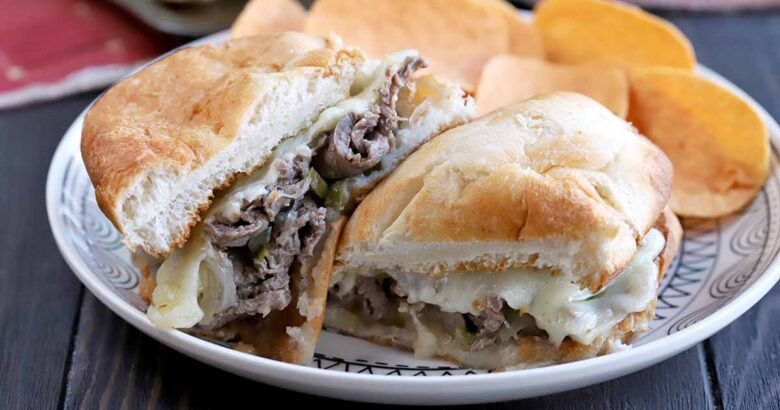
The individual sandwich. One hoagie roll, piled with beef and vegetables, covered with provolone, broiled, closed, cut diagonally, served with the warm dipping broth alongside and a handful of chips or fries on the plate. This is the correct presentation.
For a party or game day. The slow cooker on the serving table, the beef and vegetables held warm inside, a bowl of toasted rolls, a plate of cheese slices, and a small warmer with the dipping broth alongside. Guests assemble their own sandwiches — a build-your-own cheesesteak station that requires no host involvement and consistently produces the best possible version for each individual guest’s preference.
The open-faced version. The loaded, cheesed, broiled open-faced sandwich — served on a plate with a fork and knife alongside — is the most dramatic presentation and the most practical for very juicy versions of the sandwich that resist being closed without the filling escaping.
The Complete Table
Sides:
- French fries — the definitive cheesesteak accompaniment
- Onion rings — for maximum indulgence
- Classic coleslaw — cool and acidic against the richness
- Potato chips — the simplest and most practical alongside
- Dill pickles — tucked into the sandwich or served alongside
- A simple green salad with vinaigrette — for those who want something lighter
Condiments:
- The dipping broth — served alongside, essential
- Hot sauce — Tabasco or Frank’s RedHot
- Banana peppers or pepperoncini — bright, tangy, specifically good on cheesesteak
- Ketchup — for the fries
Drinks:
- A cold lager — the definitive cheesesteak drink
- An amber ale or pale ale
- Iced tea for a non-alcoholic pairing
The Day-After Cheesesteak Uses
Leftover slow cooker cheesesteak beef and vegetables — refrigerated in their braising liquid — are one of the most versatile leftovers in this collection. Reheated with a splash of broth and folded into scrambled eggs with a handful of cheese, the mixture produces a cheesesteak scramble that is the best possible Saturday morning eggs. Stuffed into a baked potato and covered with Cheez Whiz or provolone and broiled, it produces a cheesesteak stuffed potato that requires no further justification. Tossed with cooked pasta, a handful of grated Parmesan, and a ladle of the braising liquid as a pasta sauce, it becomes a Philly cheesesteak pasta that sounds strange and tastes excellent. Used as the filling for empanadas with melted cheese mixed through, it produces an American-Latin fusion empanada that is one of the best crossover uses in this series.
Easy Variations
- Cheesesteak with mushrooms. Add eight ounces of sliced cremini mushrooms to the slow cooker alongside the onions and peppers. The mushrooms absorb the braising liquid and add earthy depth that is particularly good with sharp provolone.
- Spicy cheesesteak. Add one to two seeded and sliced jalapeños to the vegetable mixture and one tablespoon of hot sauce to the braising liquid. Finish with a drizzle of hot sauce over the melted cheese before closing the roll.
- Cheesesteak with banana peppers. Add half a cup of jarred banana pepper rings — with two tablespoons of their brine — to the slow cooker. The brine adds acidity to the braising liquid; the banana peppers add their mild, tangy heat to every bite.
- Chicken cheesesteak. Replace the chuck roast with two pounds of boneless, skinless chicken thighs. Cook on LOW for four to five hours until fully tender and shreddable. The chicken version is lighter, faster, and specifically excellent with Cheez Whiz.
- Philly cheesesteak soup. After the cook, instead of assembling sandwiches, shred the beef into the slow cooker, add two more cups of beef broth, and serve as a hearty cheesesteak soup topped with provolone croutons — toasted bread rounds with melted provolone floated on the surface. The braising liquid is already most of the way to an excellent soup broth.
Make-Ahead and Storage
Make-ahead: The beef and vegetables can be cooked up to two days ahead and refrigerated in the braising liquid. Reheat in the slow cooker on LOW for one to one and a half hours or in a covered pot on the stovetop over low heat. The flavors improve slightly overnight — the beef absorbs more of the braising liquid during refrigeration.
Refrigerator: Beef and vegetables in the braising liquid keep for four days in an airtight container. The braising liquid gels overnight from the gelatin — this is correct and is not a sign of spoilage. Reheat gently before serving.
Freezer: Freeze in portions with braising liquid for up to three months. Thaw overnight in the refrigerator and reheat gently. The shredded beef freezes particularly well — it thaws and reheats with essentially the same texture as fresh.
Shopping List
The Beef
- 3–4 lbs (1.4–1.8kg) beef chuck roast
- 2 tbsp neutral oil (for searing)
- Salt and black pepper
The Vegetables
- 2 large yellow onions, thinly sliced
- 1 green bell pepper, thinly sliced
- 1 red bell pepper, thinly sliced
- 8 oz (225g) cremini mushrooms, sliced (optional)
- 4–5 garlic cloves, minced
The Braising Liquid
- 1 cup (240ml) beef broth
- 2 tbsp Worcestershire sauce
- 1 tbsp soy sauce
- 1 tsp onion powder
- 1 tsp garlic powder
- 1 tsp Italian seasoning
- Salt and black pepper to taste
The Rolls and Cheese
- 6–8 hoagie rolls or French rolls, split and toasted
- 12–16 slices sharp provolone (or Cheez Whiz, or American cheese)
Condiments
- Banana peppers or pepperoncini for serving
- Hot sauce alongside
Slow Cooker Philly Cheesesteak Sandwiches
A three to four pound beef chuck roast — seared until deeply browned and the skillet deglazed — slow-cooked on LOW for seven to eight hours on a bed of thinly sliced yellow onions, green and red bell peppers, mushrooms, and garlic in a braising liquid of beef broth, Worcestershire, and soy sauce. The beef shredded into the vegetables, piled onto toasted hoagie rolls, covered with sharp provolone, and broiled until the cheese is melted and bubbling. The braising juices strained, skimmed, and served warm in individual cups alongside as the dipping broth. Not the Pat’s cheesesteak. Something different and specifically excellent.
- Total Time: 8 hours 40 minutes
- Yield: 6–8 sandwiches 1x
Ingredients
The Beef
- 3–4 lbs (1.4–1.8kg) beef chuck roast
- 2 tbsp neutral oil
- 1½ tsp salt
- ½ tsp black pepper
The Vegetables
- 2 large yellow onions, thinly sliced into half-moons
- 1 green bell pepper, thinly sliced
- 1 red bell pepper, thinly sliced
- 8 oz (225g) cremini mushrooms, sliced (optional)
- 4–5 garlic cloves, minced
The Braising Liquid
- 1 cup (240ml) beef broth
- 2 tbsp Worcestershire sauce
- 1 tbsp soy sauce
- 1 tsp onion powder
- 1 tsp garlic powder
- 1 tsp Italian seasoning
- Salt and black pepper to taste
For the Sandwiches
- 6–8 hoagie rolls or French rolls, split and toasted
- 12–16 slices sharp provolone (2 slices per sandwich)
- Banana peppers or pepperoncini for serving (optional)
Instructions
- Season and sear the beef. Pat the chuck roast dry with paper towels. Season generously on all sides with salt and black pepper. Heat the neutral oil in a large, heavy-bottomed skillet over medium-high heat until shimmering. Sear the roast on all sides until deeply browned — 2 to 3 minutes per side. Transfer to the slow cooker.
- Deglaze the skillet. Pour a splash of the beef broth (approximately ¼ cup) into the hot skillet and scrape up every browned bit from the bottom. Pour into the slow cooker.
- Add the vegetables and liquid. Add the sliced onions, green and red bell peppers, mushrooms (if using), and minced garlic to the slow cooker around and over the beef. In a small bowl, combine the remaining beef broth, Worcestershire sauce, soy sauce, onion powder, garlic powder, and Italian seasoning. Pour over the beef and vegetables.
- Cook. Set the slow cooker to LOW and cook for 7 to 8 hours, until the beef is completely tender and falls apart when pressed with tongs. The onions and peppers should be completely collapsed and soft.
- Shred the beef. Remove the beef to a cutting board and shred into generous pieces using two forks. Return the shredded beef to the slow cooker and stir to combine with the vegetables and juices. Taste and adjust seasoning.
- Make the dipping broth. Using a ladle or large spoon, transfer the braising juices from the slow cooker — keeping the beef and vegetables separate — to a fine mesh strainer set over a small saucepan. Press the solids to extract all liquid. Skim the fat from the surface with a ladle or fat separator. Keep warm over very low heat or in the slow cooker on KEEP WARM.
- Toast the rolls. Place the rolls cut-side up on a baking sheet. Broil for 2 to 3 minutes until the cut surfaces are golden and slightly crisp.
- Assemble and broil. Pile the shredded beef and vegetables generously onto the bottom halves of the toasted rolls. Lay 2 slices of provolone over each sandwich. Return to the broiler for 2 to 3 minutes until the cheese is fully melted and beginning to bubble and brown at the edges. Watch constantly.
- Serve. Close the sandwiches and cut diagonally. Ladle the warm dipping broth into individual small cups or ramekins — one per sandwich. Serve immediately with banana peppers and hot sauce alongside.
Notes
- Sear the beef — the dipping broth depends on it. The fond from the seared chuck roast, deglazed into the slow cooker, is what gives the dipping broth its dark color and concentrated beef flavor. An unseared roast produces a pale, thin braising liquid. Seared chuck produces a dark, savory dipping broth that elevates the entire sandwich experience.
- Slice the onions and peppers thin — they need to collapse completely. Quarter-inch slices of onion and pepper will be soft and fully cooked after seven to eight hours. Thicker slices may retain some texture. Thin slices collapse into the beef and become part of the filling rather than distinct vegetable pieces — which is the correct result for a cheesesteak.
- Shred while warm. Chuck roast is most easily shredded immediately from the slow cooker while still at cooking temperature. Once it cools, the beef firms and shredding requires considerably more effort. Use two forks or bear claws and shred while the slow cooker is still on.
- The dipping broth is a choice — it is not optional for the full experience. The braising liquid from a seven-to-eight-hour chuck braise is one of the most flavorful things this slow cooker will produce. Straining it, skimming it, and serving it warm alongside the sandwich is the step that makes slow cooker cheesesteak something specifically worth making rather than just a cheesesteak filling produced without a griddle.
- Toast the rolls every time. The bottom of the roll in contact with juicy braised beef becomes saturated and tears within sixty seconds if not toasted. Two minutes under the broiler produces the moisture barrier that keeps the sandwich intact through assembly and the first few bites.
- Two slices of provolone per sandwich — not one. One slice of provolone on a fully loaded cheesesteak is insufficient coverage. Two slices — overlapping slightly — ensure complete cheese coverage across the full length of the sandwich. Under the broiler, the double layer melts into a single, thick, glossy layer that is visually and texturally correct.
- The slow cooker cheesesteak is not the griddle cheesesteak. It is a braised version with different and specific qualities — more tender beef, more fully softened vegetables, a dipping broth component. The comparison is not useful. The slow cooker version is worth making on its own terms.
- Prep Time: 20 minutes
- Cook Time: 7–8 hours (on LOW)
- Category: Dinner, Main Dish, Sandwiches
- Method: Slow Cooking
- Cuisine: American
- Diet: Dairy-Free
Frequently Asked Questions
What is the best cheese for a Philly cheesesteak? The three traditional options are Cheez Whiz (the most authentic Philadelphia choice — intensely processed, salty, extremely smooth), provolone (the most widely used outside Philadelphia — mild, slightly sharp, melts beautifully), and American cheese (the smoothest-melting, mildest option that lets the beef flavor come forward). For the slow cooker version with braised beef, provolone is the most practical and most complementary choice — its slight sharpness cuts through the richness of the long-braised chuck in a way that American cheese, being milder, does not. Cheez Whiz is the most authentic and the most dramatically salty — applied warm, it does not require the broiler. The correct answer is whichever cheese you prefer, applied generously.
Can I use a different cut of beef? Yes. Sirloin tip roast produces a more traditional thin-slice presentation — cook on LOW for six to seven hours, rest, and slice thinly against the grain for a beef closer in appearance to the griddle version. Flank steak or skirt steak, sliced thin before cooking, produces a faster result (three to four hours on LOW) with a more traditional thin-beef texture but a thinner, less rich dipping broth. Chuck roast, as recommended, produces the most tender, most deeply flavored beef and the richest braising liquid for dipping. The cut choice determines both the beef texture and the quality of the dipping sauce.
How do I prevent the roll from getting soggy? Two measures: toast the cut side of the roll until golden under the broiler before assembling, and serve the sandwich immediately once assembled. The toasted surface creates a moisture barrier that slows the absorption of the juicy beef filling. Serving immediately prevents the moisture from penetrating past that barrier during assembly and plating time. A roll assembled and left to sit for ten minutes will begin to soften at the base regardless of toasting. For a party or buffet format, toast the rolls and keep them on a separate tray, assembling individual sandwiches to order as guests request them rather than pre-assembling all sandwiches at once.
Do I have to include mushrooms? No — mushrooms are an optional addition that many traditional cheesesteak purists would exclude entirely. They add earthy depth and absorb the braising liquid beautifully during the slow cook, but the sandwich is complete and excellent without them. For guests with mushroom aversions, the onion and pepper filling alone is entirely sufficient and more traditionally correct in any case.
Can I make this for a party? Yes — the slow cooker cheesesteak is one of the best party formats in this collection. Keep the beef and vegetables warm in the slow cooker on KEEP WARM. Set up a build-your-own station: a basket of toasted hoagie rolls, a plate of provolone slices, a bowl of banana peppers, a jar of hot sauce, and a small pot of dipping broth kept warm on the stovetop. Guests assemble their own sandwiches, slide them under the broiler (or use a panini press if available), and add the dipping broth themselves. The host does nothing after initial setup. For very large parties, two slow cookers running simultaneously doubles the capacity with no additional effort beyond the initial prep.
My dipping broth is too thin. How do I fix it? Reduce it. Pour the strained, skimmed broth into a small saucepan and bring to a boil over medium-high heat. Reduce for five to eight minutes, stirring occasionally, until the flavor concentrates and the broth is slightly more viscous. The gelatin from the chuck roast means the broth will thicken naturally to a soft gel when cold — in the warm, liquid state it may seem thin, but its flavor should be intensely beefy. If the flavor is there but the body is not, a few minutes of reduction on the stovetop is always the correct fix.
What is the difference between this and the French dip recipe? The French dip is specifically a sandwich-and-broth-for-dipping dish, where the beef is the hero and the au jus the accompaniment. The Philly cheesesteak adds bell peppers, onions, and cheese as primary components — the filling is the complete package, not just beef. The cheesesteak’s vegetables are a fundamental part of the filling rather than aromatics for the braising liquid. The dipping broth from the cheesesteak is thicker and more flavorful from the vegetable contribution during the long cook. The cheese — broiled over the filling — is the visual and textural signature of the cheesesteak in a way that the French dip’s bread and broth arrangement is not. Both are outstanding braised beef sandwiches with dipping options. They are different sandwiches.