
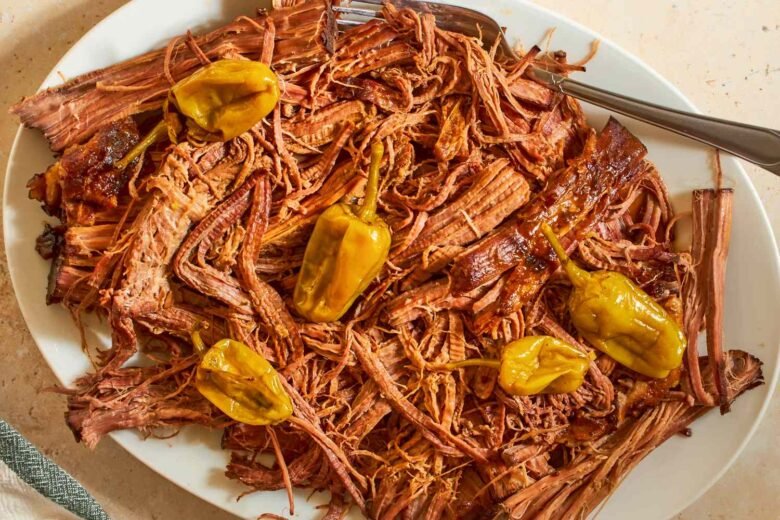
There are recipes that spread because they are clever. There are recipes that spread because they are beautiful. And then there are recipes that spread because they are so good, so simple, and so reliably excellent that every person who makes them tells at least three other people about them, and those three people tell three more, and within a decade a home cook named Robin Chapman from Ripley, Mississippi has invented one of the most replicated slow cooker recipes in American history.
Mississippi pot roast is that recipe. Five ingredients. A chuck roast. A packet of au jus gravy mix. A packet of ranch seasoning. A stick of butter. A handful of pepperoncini peppers. Everything goes into the slow cooker on top of the chuck roast, the lid goes on, and eight hours later the roast has braised in a liquid that is simultaneously buttery, tangy from the pepperoncini, savory from the gravy mix and the ranch, and so deeply flavored that the resulting sauce — which makes itself with no assistance — is one of the most compelling gravies you will taste from a slow cooker. The roast itself falls apart at the touch of a fork.
The recipe spread through church cookbooks and word of mouth in the mid-2000s before it went viral on the internet in the early 2010s, and at that point it became the pot roast recipe — the one that appeared on cooking blogs and Pinterest boards and in the comments section of every slow cooker discussion with the insistence of something that people had tried and could not stop recommending. It has been made millions of times. It has been replicated by food magazine test kitchens and home cooks in equal measure. It consistently produces the same result: a pot roast that people describe, without embarrassment, as the best pot roast they have ever eaten.
The reason it works is worth understanding, because it seems like it should not work as well as it does.
Why Five Ingredients Produce an Extraordinary Result
The Mississippi pot roast’s five ingredients are not a compromise. They are a precisely calibrated combination in which each component does something specific that the others cannot replicate, and the result is a sauce that tastes considerably more complex than its ingredient list suggests.
Chuck roast is the right cut for any long braised pot roast — its high collagen content converts to gelatin during the eight-hour cook, enriching the sauce with body and richness and keeping the meat impossibly moist.
Au jus gravy mix is the salt, the beef depth, and the thickening agent. The dried packet contains salt, dehydrated beef flavor, a small amount of starch, and various flavor enhancers that dissolve into the rendered butter and the pepperoncini brine and the beef juices during the long cook. It is not a sophisticated ingredient. What it produces in this specific combination is specifically excellent.
Ranch seasoning is the aromatic complexity — dill, garlic, onion, buttermilk powder, parsley, and other dried herbs and spices that bloom slowly into the sauce during the long cook. Ranch seasoning in a pot roast seems like a strange idea until you eat the result, at which point it seems like the obvious idea. The herbal, tangy, savory character of ranch seasoning — applied in dried form to a chuck roast braising in butter — produces a sauce with depth and a slightly tangy herb note that distinguishes it from every other pot roast sauce.
Butter — a full stick, half a cup — is the most dramatic-seeming ingredient and the one most responsible for the sauce’s luxurious quality. The butter melts over the top of the roast during the first hours of the cook, bastes the meat continuously, and combines with the rendered beef fat and the pepperoncini brine and the dissolved seasoning packets to produce a braising liquid of extraordinary richness. This is not butter used in the way butter is usually used — it is butter as a braising fat, functioning the way lard functions in Mexican carnitas or duck fat functions in French confit. The fat is the cooking medium. The result is correspondingly rich.
Pepperoncini peppers are the surprise ingredient and the one that makes the dish specifically excellent rather than simply rich. Pepperoncini are mild Italian pickled peppers — their heat is minimal, their flavor tangy, bright, and slightly vinegary. Added whole to the slow cooker, they release their brine into the sauce during the long cook. That brine — acidic, slightly salty, distinctly pickled-pepper flavored — is what prevents the butter and the ranch and the gravy mix from collapsing into simple richness. The pepperoncini brine cuts through the fat. It adds a brightness that no other ingredient in the recipe provides. It is, in the words of many home cooks who have tried to skip it, the ingredient you can’t skip.
The Original Recipe and Its Variations
The original Mississippi pot roast recipe is Robin Chapman’s version: chuck roast, one packet of au jus mix, one packet of Hidden Valley Ranch dressing mix, one stick of butter, and five to eight pepperoncini peppers. No liquid added. No other seasoning. Nothing else.
This version works. It works remarkably well. The butter melts into a substantial braising liquid on its own, combined with the juices released by the chuck roast during the cook.
However, after a decade of home cooks making and adapting the recipe, a few modifications have emerged that are worth considering depending on preference.
The no-packet variation. For cooks who prefer to avoid the sodium-heavy seasoning packets, homemade replacements are straightforward. The au jus packet can be replaced with a teaspoon of beef Better Than Bouillon, a teaspoon of Worcestershire sauce, and a half teaspoon of garlic powder. The ranch packet can be replaced with a tablespoon of dried dill, a teaspoon of garlic powder, a teaspoon of onion powder, a teaspoon of dried parsley, and a teaspoon of buttermilk powder (optional). The result is a slightly more controllable seasoning profile with less sodium.
The added pepperoncini brine. Many cooks have found that adding a quarter cup of the pepperoncini brine from the jar alongside the peppers produces a brighter, more tangy sauce — more obviously pickled-pepper flavored and with more acidity to cut through the butter. For those who love the pepper note, the brine addition is worth making.
The seared version. A quick sear of the chuck roast on all sides before it goes into the slow cooker adds Maillard browning and depth to the sauce — the same logic as every other beef braise in this series. The original recipe skips this step entirely, and it is genuinely excellent without it. But a seared Mississippi pot roast is a deeper, richer, darker-sauced version of the original.
The added vegetables. Potatoes, carrots, and onions added to the slow cooker in the final two to three hours of cooking absorb the butter-and-pepperoncini sauce and turn the dish into a complete one-pot meal. They are not in the original recipe — they do not need to be — but they are specifically excellent additions for a family dinner.
Choosing Your Chuck Roast
The chuck roast selection follows the same logic as every other chuck roast recipe in this series.
Three to four pounds is the optimal size for a 6-quart slow cooker — large enough to produce significant braising juices during the cook, small enough to fit with some clearance around the edges. A four to five pound roast fills a 6-quart adequately; anything larger requires a large oval slow cooker.
Good marbling — visible white fat running through the muscle — is the visual indicator of a chuck that will braise well. More marbling means more fat rendering into the sauce and more collagen available for gelatin conversion.
The fat cap. Leave a thin fat cap on the roast — a quarter inch. Completely trimmed chuck roasts produce a less rich sauce. The fat cap renders into the butter during the cook and adds to the braising liquid’s body.
Bone-in chuck — sometimes available as chuck arm roast or chuck shoulder — produces an even richer braising liquid from the bone marrow. If available, use it.
The Butter Question
Half a cup of butter in a slow cooker pot roast for four to six people is, by any reasonable measure, a lot of butter. It is the ingredient that gives cooks pause before they add it and that they stop questioning after they taste the result.
The butter is not optional. The butter is not reducible to something that still produces the same dish. The butter is what makes the sauce what it is.
Understanding why: butter in the slow cooker does not remain as butter. Over eight hours at low temperature, it melts and combines with the rendered beef fat from the chuck roast, the brine from the pepperoncini, and the dissolved seasoning packets. The fat emulsifies with the water-based components of the sauce, producing something with the body and richness of a finished French sauce — not because any French technique was applied, but because the butter’s fat content and its milk proteins do to the braising liquid what cream or butter does to any sauce: they add body, gloss, and a specific richness that no other ingredient replicates.
The finished sauce from a Mississippi pot roast is notably thicker and glossier than the braising liquid of any other slow cooker pot roast recipe. That quality comes entirely from the butter.
Salted vs unsalted. The original recipe uses salted butter, and the seasoning packets already contain significant sodium. For cooks managing salt intake, unsalted butter with the same packets produces a slightly less salty result. The flavor difference is small. The sodium difference is meaningful if it matters.
Tips for Perfect Slow Cooker Mississippi Pot Roast
1. Do not add liquid. The original recipe is a no-liquid recipe. The butter melts into a braising liquid. The chuck roast releases its own juices. The pepperoncini release their brine. These three sources produce more than enough liquid for the braise. Added broth or water dilutes the concentrated sauce that makes Mississippi pot roast what it is.
2. Place everything on top of the roast — not underneath. The butter, seasoning packets, and pepperoncini go on top of the roast. The butter melts and runs down the sides, basting continuously. Anything placed underneath the roast sits in the pooled fat at the bottom of the insert and does not distribute evenly through the sauce.
3. Do not stir during cooking. Leave the lid on and leave the contents undisturbed for the full eight hours. The sauce builds itself from the interaction of the butter, the beef juices, and the dissolved seasonings — stirring during the cook disrupts this process.
4. Sear for a deeper sauce — or don’t. The original recipe skips the sear. It is excellent. A seared version is deeper in flavor and darker in color. Both are genuinely good. Choose based on time and preference.
5. Add the pepperoncini brine for extra tang. Pour a quarter cup of the brine from the pepperoncini jar into the slow cooker alongside the peppers. The additional brine increases the acidity that cuts through the butter and produces a brighter, more tangy sauce.
6. Cook on LOW for eight hours. HIGH for four to five hours produces a cooked roast. LOW for eight hours produces the specific tenderness — the collagen fully converted, the sauce fully developed — that makes the dish what it is. The patience is rewarded.
7. Taste and adjust the sauce before serving. After eight hours, the sauce is a concentrated combination of butter, beef fat, dissolved seasonings, and pepperoncini brine. It may need a small adjustment of salt (it often does not — the seasoning packets are already salty), a squeeze of lemon for brightness, or a pinch of black pepper. Taste before serving.
8. Spoon the sauce generously. The sauce from Mississippi pot roast is the best thing about it. Spoon it generously over the shredded beef, over the rice or potatoes underneath, over everything on the plate. Nothing in this recipe should be served dry.
Serving the Mississippi Pot Roast
Over mashed potatoes is the most popular and most correct serving. The sauce pools in the mashed potatoes and is absorbed by them — a combination of such specific and perfect comfort that it has become the default presentation of this dish across the country. Spoon the beef and the sauce generously over a mound of buttery mashed potatoes. The potatoes absorb the sauce. Everything on the plate is equally good.
Over egg noodles — wide, buttered — is the alternative that rivals mashed potatoes. The noodles absorb the sauce differently, catching it in their curves and folds.
As a sandwich. Mississippi pot roast beef piled onto a toasted hoagie roll with a drizzle of the sauce and a few of the whole pepperoncini from the slow cooker on top is one of the great sandwiches that can be made from a slow cooker. The pepperoncini on the sandwich provide the acidic crunch that the rich beef requires.
Over rice. Simple, neutral, absorbs the sauce cleanly.
With crusty bread. For soaking up every drop of the butter-and-pepperoncini sauce that pools on the plate. The bread is not optional if the sauce is served generously.
The Complete Table
Sides:
- Creamy mashed potatoes — the definitive pairing
- Buttered egg noodles — the close second
- Roasted carrots and potatoes — for a complete meal from one oven
- Steamed green beans — simple and fresh against the richness
- Dinner rolls — for the sauce
- Corn on the cob — for a Southern-leaning spread
Garnishes:
- Fresh flat-leaf parsley — cuts the richness visually and aromatically
- The whole pepperoncini from the slow cooker — served alongside
- Additional pepperoncini from the jar for those who want more tang
- Red pepper flakes for those who want heat
Drinks:
- A full-bodied red wine — Cabernet, Merlot, or a big Zinfandel
- A cold lager or amber ale
- Sweet iced tea for the Southern table
The Day-After Mississippi Pot Roast Uses
Leftover Mississippi pot roast beef, stored with its sauce and refrigerated for up to four days, is one of the most versatile leftovers in this collection. The sauce, which solidifies overnight into a butter-and-gelatin emulsion, returns to liquid with gentle reheating. Shredded beef in the sauce, spooned over biscuits for a Mississippi pot roast biscuits and gravy, is one of the best possible Southern breakfasts. Stuffed into quesadillas with shredded Monterey Jack and a few of the pepperoncini, it produces a fusion quesadilla of unexpected excellence. Used as the filling for a pot pie — the sauce is already a gravy — under a puff pastry lid baked until golden, it produces a pot pie that could not possibly be better. Piled onto a hoagie roll as described above, it is the sandwich lunch of the week.
Easy Variations
- Mississippi pot roast with vegetables. Add three medium potatoes (quartered), three large carrots (cut into 2-inch chunks), and one large onion (quartered) to the slow cooker in the final 2.5 to 3 hours of cooking. The vegetables absorb the butter-and-pepperoncini sauce and become the accompaniment. Add them too early and they overcook completely; in the final hours they are perfectly tender.
- Mississippi pot roast chicken. Replace the chuck roast with four to six bone-in, skin-on chicken thighs. Reduce the cook time to four to five hours on LOW. The chicken produces a slightly thinner sauce than the beef version but the butter-ranch-pepperoncini combination is equally excellent. Broil briefly after the slow cook for a browned skin.
- Mississippi pot roast with mushrooms. Add eight ounces of sliced cremini mushrooms to the slow cooker alongside the roast. The mushrooms absorb the butter and pepperoncini brine during the cook and become deeply flavored, meaty accompaniments that make the dish feel more complete.
- Spicy Mississippi pot roast. Replace the mild pepperoncini with banana peppers for a similar flavor with slightly more heat, or add a tablespoon of crushed red pepper flakes alongside the standard pepperoncini for a clearly spicy version.
- Mississippi pot roast with cream cheese. Add four ounces of cream cheese to the slow cooker in the final 30 minutes of cooking, allowing it to melt into the sauce. The cream cheese adds richness and a slightly tangy creaminess that thickens the sauce further and adds a dairy note. A variation popular in online slow cooker communities that is worth trying once.
Make-Ahead and Storage
Make-ahead: Mississippi pot roast makes ahead perfectly. Cook, shred, and refrigerate in the sauce for up to three days. The fat from the butter rises and solidifies on top overnight — skim it off for a leaner sauce, or stir it back in for the full original richness. Reheat gently on the stovetop or in the slow cooker on LOW for one hour.
Refrigerator: Shredded beef in sauce keeps for four days. The sauce solidifies completely overnight from the butter and gelatin — this is correct and is not spoilage. Reheat gently until liquid.
Freezer: Freeze in portions with sauce for up to three months. The butter-enriched sauce may separate slightly during freezing — stir vigorously while reheating and it will come back together. Thaw overnight in the refrigerator.
Shopping List
The Five Ingredients
- 3–4 lbs (1.4–1.8kg) beef chuck roast
- 1 packet (1 oz / 28g) au jus gravy mix
- 1 packet (1 oz / 28g) ranch dressing seasoning mix (e.g., Hidden Valley Ranch)
- 1 stick (½ cup / 115g) salted butter
- 5–8 whole pepperoncini peppers (from a jar), plus ¼ cup brine (optional)
For Serving
- Mashed potatoes or egg noodles
- Fresh flat-leaf parsley
- Crusty bread or dinner rolls
Slow Cooker Mississippi Pot Roast (Only 5 Ingredients)
A beef chuck roast placed in the slow cooker, topped with a packet each of au jus gravy mix and ranch seasoning, a full stick of salted butter, and five to eight whole pepperoncini peppers — no added liquid, no other preparation. Cooked on LOW for eight hours until the butter has melted and combined with the beef juices and pepperoncini brine into a rich, tangy, deeply savory sauce of extraordinary quality and the beef has braised to fork-tender, fall-apart tenderness. Shredded into the sauce and served over mashed potatoes with everything spooned generously over the top. Five ingredients. Eight hours. The pot roast that went viral for a reason.
- Total Time: 8 hours 5 minutes
- Yield: 6–8 servings 1x
Ingredients
- 3–4 lbs (1.4–1.8kg) beef chuck roast
- 1 packet (1 oz / 28g) au jus gravy mix
- 1 packet (1 oz / 28g) ranch dressing seasoning mix
- ½ cup (1 stick / 115g) salted butter, cut into tablespoon-sized pats
- 5–8 whole pepperoncini peppers, from a jar
- ¼ cup (60ml) pepperoncini brine, from the jar (optional but recommended)
Instructions
- Place the roast. Set the chuck roast in the slow cooker insert. No added liquid, no oil, no preparation beyond taking it from the packaging.
- Add the seasonings. Sprinkle the au jus gravy mix evenly over the top of the roast. Sprinkle the ranch seasoning evenly over the top.
- Add the butter and peppers. Lay the butter pats evenly across the top of the seasoned roast — distribute them so the entire surface is covered. Add the whole pepperoncini peppers around and on top of the roast. If using the brine, pour it over everything now.
- Cook. Place the lid on the slow cooker. Set to LOW and cook for 8 hours. Do not add any liquid. Do not lift the lid during cooking. Do not stir.
- Shred the beef. After 8 hours, the roast should be completely tender and pulling apart at the touch of a fork or tongs. Using two forks or bear claws, shred the beef directly in the slow cooker, mixing it into the sauce that has accumulated. Taste the sauce and adjust if needed — a pinch of black pepper, a squeeze of lemon for brightness.
- Serve. Spoon the shredded beef and its sauce generously over mashed potatoes, egg noodles, or rice. Garnish with fresh flat-leaf parsley. Place extra pepperoncini alongside. Serve with crusty bread for the remaining sauce.
Notes
- Do not add water, broth, or any liquid. This is the most common mistake made by first-time Mississippi pot roast cooks who look at the recipe and assume something is missing. Nothing is missing. The butter melts into a braising liquid. The beef releases its own juices. The pepperoncini release their brine. By the end of the cook, the slow cooker contains a generous amount of rich, concentrated sauce. Adding water or broth at the start dilutes it into something considerably less impressive.
- Add the pepperoncini brine. It is listed as optional in the ingredients, but it is specifically recommended. A quarter cup of brine from the pepperoncini jar adds acidity and tang that brightens the butter-rich sauce significantly. Most cooks who try the brine version once do not return to the without-brine version.
- Everything goes on top — not underneath. The butter pats and seasoning packets placed on top of the roast melt and run down the sides, basting the meat throughout the cook. Placed underneath, the butter pools in the bottom of the insert before the beef juices accumulate and the seasoning does not distribute evenly.
- LOW for eight hours — not HIGH for four. The specific texture of Mississippi pot roast — the collagen fully converted, the sauce fully built — requires the full eight hours at LOW. HIGH produces a cooked roast in four to five hours, but the sauce is thinner, the collagen conversion less complete, and the beef slightly less yielding. The slow cooker’s full eight hours is what the recipe is designed around.
- The sauce solidifies overnight — this is perfect. Refrigerated leftover Mississippi pot roast sets into a solid, butter-and-gelatin emulsion. This is what gelatin-rich braising liquid with significant butter content does when chilled. Reheat gently and it returns to the glossy, rich liquid it was the day before.
- Spoon everything. The sauce is the most impressive thing about this recipe. Ladle it generously over the beef, over the potatoes, over everything. The instinct to be conservative with it — to think of it as a byproduct rather than a feature — is the instinct to resist.
- The pepperoncini are mild. First-time makers sometimes hesitate at the pepperoncini, worried about heat. Pepperoncini are among the mildest pickled peppers available — their Scoville rating is a fraction of a jalapeño’s. The flavor contribution is tangy and bright, not spicy. Children who eat mild food eat this pot roast without complaint.
- Prep Time: 5 minutes
- Cook Time: 8 hours (on LOW)
- Category: Comfort Food, Dinner, Main Dish
- Method: Slow Cooking
- Cuisine: American
Frequently Asked Questions
Why is there no liquid added to this recipe? The Mississippi pot roast’s no-liquid approach is the most common source of doubt for first-time makers and the thing that most distinguishes it from typical slow cooker pot roast recipes. The butter — half a cup — melts over the first hour or two of the cook and becomes the liquid base of the braise. The chuck roast itself releases substantial juice as the muscle fibers relax and the collagen begins to convert. The pepperoncini release their brine. By the second or third hour of the cook, the slow cooker contains a generous braising liquid built entirely from these three sources. Added water or broth at the start of the cook dilutes this concentrated, specifically flavored liquid into something less impressive and less specifically good. Trust the recipe. Add no liquid.
Can I use homemade seasoning instead of the packets? Yes — and it is a reasonable modification for those who want to control the sodium content or avoid the additives in commercial seasoning packets. For the au jus packet: combine one teaspoon of beef Better Than Bouillon (or one teaspoon of beef bouillon powder), one teaspoon of Worcestershire sauce, half a teaspoon of garlic powder, and half a teaspoon of onion powder. For the ranch packet: combine one tablespoon of dried dill, one teaspoon of garlic powder, one teaspoon of onion powder, one teaspoon of dried parsley, half a teaspoon of dried chives, and, if available, one teaspoon of buttermilk powder. The homemade version produces a slightly less salty, slightly more nuanced sauce — good in its own right, different from the original. Most cooks who try both have a preference; neither is objectively better.
What are pepperoncini and where do I find them? Pepperoncini (also spelled peperoncini) are small, mild Italian pickled peppers — typically two to three inches long, yellow-green in color, with a wrinkled skin and a tangy, mildly vinegary flavor. Their heat level is minimal — roughly 100 to 500 Scoville units, compared to jalapeños at 2,500 to 8,000. They are available in jars in the condiment or Italian foods aisle of virtually every supermarket, often next to the olives and banana peppers. They are sometimes labeled “Tuscan peppers” or “golden peppers.” The specific brand matters less than the style — look for whole peppers in brine rather than sliced or pickled in oil. The brine from the jar is what you may add to the slow cooker alongside the peppers.
Can I use a different cut of beef? Chuck roast is the correct cut for this recipe — its high collagen content is what produces both the fall-apart tender texture and the rich, gelatinous sauce. A brisket (flat cut) can be substituted and produces a slightly more sliceable, less shredable result with a comparable sauce. Sirloin tip roast works but is leaner and produces a thinner sauce. Round roast is the least ideal — its very low fat content produces a drier beef and a thin, less rich sauce. If chuck roast is unavailable, brisket is the best alternative. If neither is available, add two tablespoons of olive oil to compensate for the lower fat content of any leaner cut.
Is this recipe too salty? How do I manage the sodium? The original recipe — using both a full packet of au jus mix and a full packet of ranch seasoning alongside salted butter — is noticeably salty to some palates, particularly when reduced over eight hours. Several adjustments reduce the sodium: use only three-quarters of each packet rather than the full amount; use unsalted butter; use low-sodium ranch seasoning (available at many supermarkets); or use the homemade seasoning substitutes described above. Taste the sauce before serving — if it is too salty, stir in a tablespoon of unsalted butter, a tablespoon of sour cream, or a splash of cream, all of which round the flavor and reduce perceived saltiness.
Can I cook this on HIGH for a faster result? Yes — HIGH for four to five hours produces a cooked, shreddable chuck roast in the Mississippi pot roast seasoning. The result is noticeably different from the LOW eight-hour version: the sauce is slightly less developed, the collagen conversion less complete, the beef slightly firmer in texture. The dish is still very good — the specific combination of butter, ranch, au jus, and pepperoncini produces a genuinely excellent result at any cook time. For the best possible version, LOW for eight hours is the correct choice. For a weeknight when eight hours is not available, HIGH for four to five hours is the practical alternative.
What do I do with the pepperoncini after cooking? The whole pepperoncini peppers, having spent eight hours braising in butter and beef juices, are deeply flavored and extraordinarily soft — they have absorbed the sauce completely and given up their brine entirely to the braising liquid. Some cooks leave them in the dish and serve them alongside the beef, where they provide an occasional tangy, soft burst against the richness. Others remove them before shredding — either discarding or reserving to add to sandwiches. Placed on a Mississippi pot roast sandwich with the shredded beef and a drizzle of sauce, a braised pepperoncini is a specifically excellent condiment. Do whatever serves the occasion.