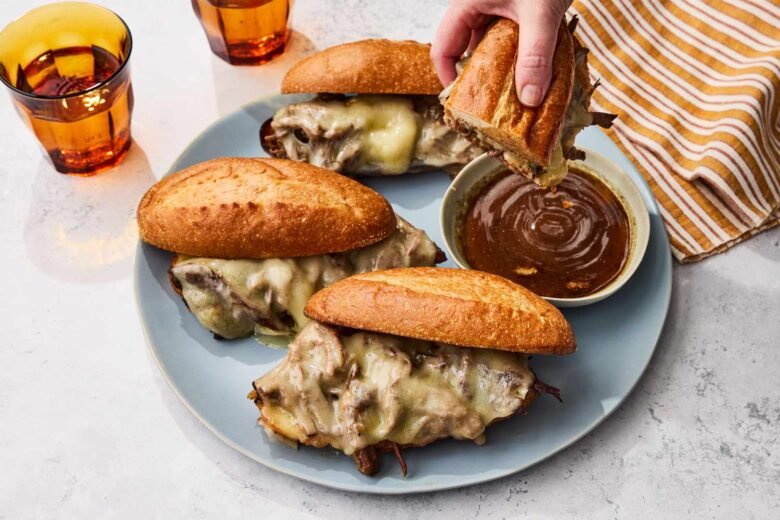
There is a sandwich that does not require explanation to anyone who has encountered it — the French dip. Thinly sliced, tender roast beef piled onto a toasted hoagie roll, served alongside a small cup of warm, deeply savory beef broth into which the sandwich is dipped bite by bite. It is a sandwich that was invented in Los Angeles in the early twentieth century, argued over by two restaurants on the same street for a hundred years, and in that time has become one of the defining American sandwich experiences precisely because of the simplicity of what it does: it makes the sandwich the best possible delivery system for that broth, and the broth the best possible reason to keep eating the sandwich.
The slow cooker version of the French dip is not a compromise on the original. It is the best home kitchen version of it, by a significant margin. A beef chuck roast — or sirloin, or bottom round — braises for eight hours in a combination of beef broth, onions, Worcestershire, garlic, and herbs, emerging as the most tender, most deeply flavored roast beef that home cooking can produce. But what the slow cooker is doing throughout those eight hours is not merely cooking the beef — it is building the au jus. The braising liquid that accumulates in the insert over eight hours, enriched with the collagen from the beef, the sugars from the onion, the umami from the Worcestershire, is the au jus. It requires almost nothing after the cook: a strain, a brief skim of fat, a taste for seasoning, and it is ready — dark, silky, deeply savory, and concentrated in a way that any separately made broth never achieves because it was not made separately. It was made inside the meat.
That au jus is why the French dip is worth making at home. The sandwich is excellent. The broth is extraordinary.
Why the Slow Cooker Makes the Best French Dip
The French dip at a restaurant — when it is good — is made from a roast beef that was cooked slowly in the oven or in a large commercial roaster and sliced against the grain, served on a roll with a cup of consommé or a carefully made jus. The quality of the restaurant version is entirely dependent on the quality of both components.
The slow cooker version produces both components from a single process, and the result is — on the measure of the au jus specifically — better than most restaurant versions. Here is why.
When a beef roast braises in the slow cooker on LOW for eight hours, three things happen simultaneously that cannot be separated. The connective tissue in the beef — primarily collagen — converts slowly to gelatin. That gelatin dissolves into the braising liquid. The braising liquid, enriched with gelatin and with the concentrated beef juices that seep out of the meat during the cook, becomes something with a body and richness and cling that plain beef broth can never develop no matter how long it is reduced, because plain beef broth does not have the collagen of a braising roast dissolving into it continuously for eight hours.
This is the au jus. It is not a sauce. It is not something made separately. It is the liquid that the meat made while it was cooking, strained and seasoned and served warm alongside the sandwich. The Maillard browning on the beef if it was seared first — the caramelized proteins and sugars on the surface of the meat — color and deepen the au jus further. A well-made slow cooker French dip au jus is dark, slightly viscous, deeply beefy, and silky in a way that only gelatin-enriched broth achieves.
The beef, pulled into thick shreds or sliced thinly if it holds together, is the best vehicle for that broth. The roll is the structure that makes eating it without a spoon possible. Everything is in service of the au jus.
Choosing Your Beef
The cut of beef determines the texture of the meat and the richness of the au jus, and the choice between the primary options is meaningful.
Chuck roast is the best overall choice for slow cooker French dip sandwiches — the same reasoning that makes it the best choice for beef tips with gravy and for any long braise. Chuck is heavily worked shoulder muscle, dense with collagen and marbling, that breaks down completely over eight hours on LOW into falling-apart tender beef and contributes more gelatin to the braising liquid than any other cut. Chuck French dip beef shreds easily and completely, producing the pulled, piled, rustic sandwich presentation that is arguably the most satisfying format.
Sirloin tip roast holds its shape better than chuck and can be sliced thinly — producing the more elegant, deli-style French dip presentation of thin, overlapping slices of roast beef on the roll. Sirloin tip is leaner than chuck and produces a slightly less rich au jus, but the cleaner slice and the slightly firmer texture suit the French dip format in a way that fully shredded chuck does not. The choice between chuck (shredded) and sirloin tip (sliced) is the choice between rustic and refined — both are excellent.
Bottom round is leaner than both, holds its shape through the slow cook, and produces a cleaner, thinner au jus than chuck. It is the most economical option and produces a good French dip. Its leanness means it is more susceptible to drying out — keep the liquid level adequate and do not overcook.
The size. A three to four pound roast serves six to eight people generously on French dip sandwiches — the beef is piled high and the sandwiches are substantial. A larger roast (four to five pounds) fits in a large oval slow cooker and makes excellent leftovers that refrigerate and reheat beautifully.
The Sear: Why It Matters Here
The sear is important in every slow cooker beef recipe, but it is particularly important in French dip for a specific reason: the fond.
When a chuck roast or sirloin tip is seared in a very hot, lightly oiled skillet — two to three minutes per side, working in a screaming hot pan — it develops a dark, caramelized crust on every surface. That crust is Maillard reaction: the proteins and sugars on the beef surface react under high, dry heat to produce hundreds of new flavor compounds that give the exterior its roasted, deeply beefy character. When the beef is transferred to the slow cooker and the skillet is deglazed with a splash of broth — the browned bits scraped from the bottom and poured into the slow cooker — every one of those flavor compounds goes directly into the au jus.
The au jus from unseared beef is pale, thinner in flavor, and lacks the color and depth of a seared roast’s braising liquid. The au jus from a seared and deglazed roast is dark, rich, and deeply flavored in a way that directly and significantly improves the French dip experience. The sear takes ten minutes. The difference in the au jus is immediately apparent.
Building the Braising Liquid
The braising liquid is the au jus-in-waiting, and each component contributes to the finished product.
Beef broth is the base — the better the broth, the better the starting point for the au jus. Homemade beef stock is the ideal, but a good quality store-bought beef broth or, better, a good beef bone broth works well. Avoid very low-quality, pale, thin beef broths — the au jus cannot overcome a weak starting point.
Worcestershire sauce — two tablespoons — is the umami depth that makes the au jus taste specifically beefy rather than just meaty. Its fermented, anchovy-based, complex flavor profile amplifies the beef character in a way that no other condiment replicates.
Soy sauce — one tablespoon — adds additional umami and sodium without tasting of soy in the finished au jus. It darkens the liquid slightly and deepens the savory note.
Dijon mustard — one teaspoon — adds sharpness, a small amount of acid, and functions as a subtle emulsifier in the braising liquid.
Onion — one large onion, halved and laid cut side down in the slow cooker — caramelizes slowly during the long braise and releases its sugars into the liquid. The cut side down position means the onion surface browns slightly, adding a caramelized sweetness to the au jus. Remove and discard the onion before straining.
Garlic — four to five cloves, smashed — adds aromatic depth that mellow completely into the liquid over eight hours. No raw garlic edge remains in the finished au jus.
Fresh thyme and bay leaves — the essential braising herbs. Removed before straining.
Beef Better Than Bouillon or similar paste — one teaspoon, optional — adds a concentrated beef flavor boost that deepens the au jus beyond what broth alone achieves. It is a chef’s shortcut that improves the finished product measurably. Optional but recommended.
The Au Jus: The Finishing Process
The braising liquid that comes out of the slow cooker after eight hours is not yet the au jus — it requires a brief but important finishing process that transforms it from a cooking liquid into the thing served in a cup alongside the sandwich.
Step one: Remove the beef. Transfer the cooked beef to a cutting board or a rimmed baking sheet to rest. Do not discard anything in the slow cooker.
Step two: Strain. Pour the braising liquid through a fine mesh strainer into a large measuring jug, pressing the solids (onion, garlic, herbs) firmly to extract every drop of liquid. The strained liquid is the raw au jus.
Step three: Skim the fat. The surface of the strained liquid will have a layer of rendered beef fat. This can be removed in two ways: skim with a ladle (quick but imprecise — some fat remains) or refrigerate for thirty minutes until the fat solidifies and can be lifted off as a solid layer (thorough but requires time). A fat separator pitcher, available inexpensively at kitchen stores, is the most efficient tool for this step. Removing most but not all of the fat is correct — a small amount of fat enriches the au jus. Removing all of it produces a leaner, slightly thinner result.
Step four: Reduce if desired. The au jus at this stage may be slightly thin if the initial broth was thin or the beef released a lot of liquid. Pouring it into a small saucepan and reducing over medium heat for five to eight minutes concentrates the flavor and deepens the color. For most batches, reduction is not necessary — the collagen from the chuck roast has done the thickening work naturally.
Step five: Season. Taste the au jus and adjust with salt, a small amount of soy sauce, or a splash of Worcestershire. The au jus should be intensely savory but not aggressively salty — it will be diluted slightly each time the sandwich is dipped.
Preparing the Beef for the Sandwich
How the beef is prepared after cooking determines the style of the French dip — rustic and piled or refined and sliced.
The pulled/shredded method. For chuck roast, which has cooked to fully falling-apart tenderness, use two forks to pull the beef into thick, generous shreds directly on the cutting board. The meat should separate easily with minimal pressure. Return the shredded beef to a portion of the warm au jus to keep it moist and deeply flavored before piling onto the rolls.
The sliced method. For sirloin tip or bottom round, which hold together better, rest the roast for fifteen minutes before slicing against the grain with a sharp carving knife into the thinnest slices possible — ideally a quarter inch or less. The thin slices stack on the roll and absorb the au jus most efficiently when dipping. A meat slicer, if available, produces the deli-quality slices that make the French dip visually dramatic.
The combination. Slice the outer portion of the roast, which holds together, and shred the interior, which is more tender. Pile both on the roll for a French dip with two textures.
The Roll
The roll is not a neutral component of the French dip — it is an engineering requirement. A French dip roll must be:
Structurally capable. The roll must survive repeated submersion in hot au jus without disintegrating immediately. A soft sandwich roll or hamburger bun fails this test after the first dip. The roll needs a crust.
Correctly sized. An eight to ten-inch hoagie or sub roll is the standard — long enough to hold a substantial portion of beef, sized appropriately for the height of the sandwich.
Toasted. An untoasted roll absorbs the moisture from the beef and the drips from dipping too quickly, becoming soggy from the inside before the dipping even begins. The inside surfaces of the roll should be toasted — either in the oven at 400°F (200°C) for three to four minutes cut side up, or pressed briefly on a dry skillet. The toasted surface creates a moisture barrier that extends the roll’s structural integrity through the dipping process.
Hoagie rolls or French rolls are the most widely available correct options. A baguette cut into sandwich-length sections is the most elegant and structurally excellent choice. Ciabatta rolls work well. Pretzel rolls add a specific character that some prefer.
The Cheese: Optional but Excellent
Traditional French dip sandwiches do not always include cheese — the original Los Angeles versions did not — but cheese on a French dip is not a departure from the spirit of the sandwich. It is a specific improvement to it, and several cheeses suit the format particularly well.
Provolone is the most commonly used and the most naturally complementary — it melts smoothly without becoming greasy, has a mild flavor that does not compete with the beef and au jus, and provides the dairy richness that balances the savory intensity of the sandwich.
Swiss cheese — specifically Emmental or Gruyère — is the choice for a more complex, nuttier flavor. Gruyère in particular melts into a smooth, slightly caramelized layer under the broiler and adds a depth that provolone cannot match.
Horseradish cream cheese spread on the cut side of the roll before assembling is the condiment that elevates the French dip most significantly — the heat of the horseradish cuts through the richness of the beef and cheese and provides the sharpness that the sandwich benefits from without any additional assembly step.
Tips for Perfect Slow Cooker French Dip Sandwiches
1. Sear the beef — it transforms the au jus. The ten minutes spent searing the roast and deglazing the pan is the single biggest quality improvement available in this recipe. Unseared beef produces a pale, thin au jus. A seared and deglazed roast produces a dark, rich, deeply flavored au jus that is the reason to make French dip at home.
2. Keep the liquid level correct. The braising liquid should come approximately halfway up the sides of the beef roast — enough to create steam and baste the lower half of the beef, not so much that the beef is submerged (which produces boiled beef rather than braised beef). Add additional broth if needed at the start, but resist the instinct to add significantly more than the recipe requires.
3. Cook on LOW — always. Eight hours on LOW produces beef that is tender, deeply flavored, and still cohesive enough to slice or shred cleanly. HIGH produces tighter, drier beef in four to five hours with a less rich au jus. The eight hours on LOW is the investment that makes the French dip worth making.
4. Toast the rolls. This is not optional. An untoasted roll in contact with warm, juicy beef disintegrates before the sandwich makes it to the table. Toast cut side up under the broiler for three to four minutes or in a dry skillet until golden. The toasted surface holds the sandwich together through the dipping process.
5. Skim the fat from the au jus. A layer of rendered beef fat on the surface of the au jus produces an unpleasant, greasy dipping experience and obscures the flavor of the broth beneath. Skim thoroughly — a fat separator is the best tool, ten minutes of careful ladling is the accessible alternative.
6. Taste the au jus before serving. The au jus should be intensely savory but not aggressively salty — it will be consumed alongside the already-seasoned beef and bread. Taste and adjust with salt, a splash of Worcestershire, or a small amount of soy sauce.
7. Serve the au jus hot and in individual cups. Cold au jus is not au jus — it is cold beef jelly, which is an accurate description of what gelatin-enriched broth becomes at room temperature. Keep the au jus in the slow cooker on KEEP WARM and ladle into individual small cups — espresso cups, small ramekins, or proper French dip cups — per sandwich. The cup should be small enough that the sandwich can be dipped without needing to submerge the entire roll.
8. Rest the beef before slicing. If slicing the beef rather than shredding, fifteen minutes of rest on a cutting board allows the muscle fibers to relax and the juices to redistribute. Beef sliced immediately from the slow cooker bleeds excessively and loses the moisture that keeps it tender in the sandwich.
Serving the French Dip
The French dip is not a complex dish to serve — but the details of the serving setup determine how much the dipping format works rather than becomes awkward.
Individual cups. The au jus goes in a small cup or ramekin beside each sandwich — enough for the full dipping experience, refillable from the slow cooker. The cup should be wide enough for the end of the sandwich to submerge but not so large that dipping feels ceremonial.
The pile. A French dip sandwich with too little beef is a tragedy. Pile the shredded or sliced beef generously — more than seems reasonable — on the toasted roll. The au jus compresses the beef slightly when the sandwich is dipped. Start with a generous pile.
Condiments. Horseradish cream or prepared horseradish alongside is the most complementary condiment — the sharpness cuts the richness of the beef and cheese and provides contrast. Dijon mustard is the alternative. Neither should be applied to the roll before serving — they are dipped-into or applied per bite according to individual preference.
Caramelized onions. A small pile of slow-cooked, sweet, deep-brown caramelized onions on top of the beef before the roll is closed is the optional addition that makes the French dip noticeably better. They can be made in a separate skillet while the beef slow cooks, or as a separate batch the day before. They are not traditional but they are excellent.
The Complete Table
Sides:
- French fries or seasoned wedges — the definitive French dip accompaniment
- Creamy coleslaw — cool and acidic against the richness
- Dill pickle slices — essential, either alongside or tucked into the sandwich itself
- Onion rings — for maximum indulgence
- Simple green salad with vinaigrette — the lighter alternative
- Au gratin potatoes — for a winter dinner version
Condiments alongside:
- Prepared horseradish or horseradish cream
- Dijon mustard
- Extra au jus for the table in a small pitcher
- Pickled pepperoncini
Drinks:
- A full-bodied red wine — Cabernet or Merlot — alongside the sandwich at dinner
- A cold craft lager or amber ale
- Iced water — the palate cleanser between bites
The Day-After French Dip
Leftover French dip beef and au jus are two of the best refrigerator ingredients in the cold-weather kitchen. The beef, reheated gently in a spoonful of au jus in a covered skillet, makes the best possible quick lunch sandwich — two minutes of reheating, a fresh toasted roll, and it is better than the first day because the beef has spent the night absorbing the au jus. The remaining au jus, stored separately in a jar, is a cooking liquid of extraordinary value: use it as the braising liquid for short ribs, as the base for a rich French onion soup (already halfway there in flavor), or as the liquid for cooking rice or grains — whatever it touches tastes specifically and deeply of beef in a way that store-bought broth never achieves. The au jus thickens into a soft gel overnight from the gelatin — this is correct and is not spoilage. Reheat gently and it returns to liquid.
Easy Variations
- Italian beef French dip. Add one tablespoon of Italian seasoning, a teaspoon of red pepper flakes, and one cup of sliced pepperoncini to the slow cooker alongside the beef. The Italian beef version, associated with Chicago, produces a spicier, more aromatic beef and a tangier au jus from the pepperoncini brine. Top with giardiniera and provolone.
- French dip with caramelized onions and Gruyère. Top the beef with slow-caramelized onions and a generous layer of Gruyère, then slide under the broiler for two to three minutes until the cheese is melted and bubbling. The French onion soup reference is intentional and the result is one of the best sandwich variations in this entire collection.
- Horseradish French dip. Mix two tablespoons of prepared horseradish into the au jus before serving. The horseradish heat disperses through the broth and provides a warmth in each dip that makes the sandwich progressively more interesting.
- Slow cooker beef dip with blue cheese. Crumble two tablespoons of good quality blue cheese into the au jus and whisk briefly — the cheese melts partially and enriches the broth while adding a sharp, funky note that pairs unexpectedly well with the beef. For blue cheese lovers specifically.
- Pork French dip. Replace the beef roast with a three-pound pork shoulder. The slow cook produces similarly tender pork with a pork-enriched braising liquid that is lighter and slightly sweeter than the beef version. Season the braising liquid more aggressively to compensate for pork’s milder flavor contribution. Serve with apple-horseradish sauce rather than plain horseradish.
Make-Ahead and Storage
Make-ahead: The French dip is one of the best make-ahead dinner party dishes. Cook the beef up to two days ahead, shred or slice, and refrigerate in a portion of the au jus to keep it moist. Store the remaining au jus separately in an airtight container. On serving day, reheat the beef gently in the au jus on the stovetop over low heat, reheat the remaining au jus in the slow cooker on LOW, and assemble the sandwiches fresh.
Refrigerator: Beef keeps in the au jus for up to four days. Au jus kept separately keeps for five days. The au jus solidifies to a gel overnight — this is the gelatin doing its job, and the gel is a sign of quality. Reheat gently.
Freezer: Both the beef and the au jus freeze well separately for up to three months. Freeze the beef in portions with enough au jus to keep it moist. Thaw overnight in the refrigerator and reheat gently on the stovetop.
Shopping List
The Beef
- 3–4 lbs (1.4–1.8kg) beef chuck roast or sirloin tip roast
- 2 tbsp neutral oil (for searing)
- Salt and black pepper
The Braising Liquid
- 2 cups (480ml) good quality beef broth
- 2 tbsp Worcestershire sauce
- 1 tbsp soy sauce
- 1 tsp Dijon mustard
- 1 tsp beef Better Than Bouillon (optional)
The Aromatics
- 1 large yellow onion, halved
- 4–5 garlic cloves, smashed
- 4 sprigs fresh thyme
- 2 bay leaves
The Rolls
- 6–8 hoagie rolls or French rolls, split and toasted
The Cheese (optional)
- 6–8 slices provolone or Gruyère
The Condiments
- Prepared horseradish or horseradish cream
- Caramelized onions (optional but highly recommended)
Slow Cooker French Dip Sandwiches with Au Jus
A three to four pound beef chuck roast — seared until deeply browned on all sides, the skillet deglazed with beef broth and the fond scraped into the slow cooker — braised for 8 hours on LOW in a combination of beef broth, Worcestershire, soy sauce, Dijon, halved onion, smashed garlic, fresh thyme, and bay leaves. The beef emerges falling-apart tender and deeply seasoned. The braising liquid, strained, skimmed, and seasoned, is the au jus — dark, silky, gelatin-rich, deeply beefy, and entirely produced from the meat itself over eight hours. The beef shredded and piled onto toasted hoagie rolls with provolone, the au jus served warm in individual cups alongside. The French dip made right.
- Total Time: 8 hours 50 minutes
- Yield: 6–8 sandwiches 1x
Ingredients
The Beef
- 3–4 lbs (1.4–1.8kg) beef chuck roast or sirloin tip roast
- 2 tbsp neutral oil
- 1½ tsp salt
- 1 tsp black pepper
The Braising Liquid
- 2 cups (480ml) beef broth
- 2 tbsp Worcestershire sauce
- 1 tbsp soy sauce
- 1 tsp Dijon mustard
- 1 tsp beef Better Than Bouillon paste (optional)
The Aromatics
- 1 large yellow onion, halved
- 4–5 garlic cloves, smashed
- 4 sprigs fresh thyme
- 2 bay leaves
For the Sandwiches
- 6–8 hoagie rolls or French rolls, split
- 6–8 slices provolone or Gruyère (optional)
- Caramelized onions (optional)
- Prepared horseradish for serving
Instructions
- Season and sear the beef. Pat the roast completely dry with paper towels. Season generously on all sides with salt and black pepper. Heat the oil in a large heavy-bottomed skillet over medium-high heat until shimmering. Sear the roast on all sides — 2 to 3 minutes per side — until deeply browned all over. Do not rush. Transfer to the slow cooker.
- Deglaze the skillet. Pour a splash of the beef broth (about a quarter cup) into the hot skillet. Scrape up every browned bit from the bottom with a wooden spoon. Pour the entire contents of the skillet into the slow cooker.
- Build the braise. Add the onion halves cut-side down, the smashed garlic, thyme sprigs, and bay leaves to the slow cooker. Pour in the remaining beef broth. Add the Worcestershire sauce, soy sauce, Dijon mustard, and Better Than Bouillon paste if using. The liquid should reach approximately halfway up the sides of the roast.
- Cook. Set the slow cooker to LOW and cook for 8 hours, until the beef is completely tender and falls apart when prodded with a fork. Do not open the lid during cooking.
- Rest and prepare the beef. Transfer the beef to a cutting board. For chuck roast: shred into generous pieces using two forks. For sirloin tip: rest for 15 minutes, then slice thinly against the grain with a sharp carving knife.
- Make the au jus. Pour the braising liquid through a fine mesh strainer into a large measuring jug or saucepan, pressing the solids to extract every drop. Discard the solids. Skim the fat from the surface using a fat separator, ladle, or by refrigerating briefly until the fat solidifies. Taste and adjust seasoning with salt, a splash of Worcestershire, or a small amount of soy sauce. Keep warm in the slow cooker on KEEP WARM or in a small saucepan over very low heat.
- Toast the rolls. Place the rolls cut-side up on a baking sheet. Broil for 2 to 3 minutes until the cut surfaces are golden and slightly crisp. Watch carefully.
- Assemble and serve. Pile the beef generously onto the toasted rolls. Add a slice of provolone or Gruyère and a spoonful of caramelized onions if using. Return the sandwiches to the broiler for 1 to 2 minutes until the cheese is melted. Ladle the hot au jus into individual small cups or ramekins — one per sandwich. Serve immediately with prepared horseradish alongside.
Notes
- Sear — it is not optional for au jus quality. The Maillard reaction on the beef surface and the deglazed fond from the skillet are the primary sources of the au jus’s color and depth. An unseared roast produces a pale, thinner au jus. The ten minutes of searing directly determine the quality of the dipping experience.
- Chuck roast is the best cut. Its high collagen and marbling content produce the richest, most gelatin-enriched au jus and the most yielding, most deeply flavored beef. It shreds into generous pieces that absorb the au jus and stay moist. Sirloin tip produces a cleaner slice but a less rich broth.
- The liquid level matters. Halfway up the sides of the roast is the target — enough for a steamy, moist braising environment without submerging the beef. Too much liquid produces beef that cooks in its liquid rather than braising above it, and a more diluted au jus.
- The au jus thickens to a gel when cold — this is perfect. Gelatin-enriched broth solidifies to a soft gel at refrigerator temperature. This is the sign of a properly made, collagen-rich au jus. Reheat gently and it returns to liquid. A gel in the jar means the au jus was made correctly.
- Skim the fat thoroughly. The fat layer on the surface of the au jus is the primary source of a greasy dipping experience. Skim it off with a ladle, use a fat separator, or refrigerate and lift the solidified fat cap. A small amount of fat is correct and enriches the au jus. A thick layer of rendered fat is not.
- Toast the rolls every time. An untoasted roll cannot survive the French dip experience. The cut surface of the roll, toasted until golden, creates the moisture barrier that allows the sandwich to be picked up, dipped, and eaten without disintegration. This single step is the difference between a structurally sound French dip and a sandwich that dissolves on the way to the mouth.
- Pile the beef generously. The beef compresses when the sandwich is pressed together and absorbs moisture from the au jus during dipping. Start with more beef than looks right. The correct French dip is heavy.
- Prep Time: 20 minutes
- Cook Time: 8 hours (on LOW)
- Category: Dinner, Main Dish
- Method: Slow Cooking
- Cuisine: American
- Diet: Dairy-Free
Frequently Asked Questions
What cut of beef is best for French dip? Chuck roast is the best all-around choice — its high collagen and marbling content produce the most tender, most flavorful beef and the richest, most gelatin-enriched au jus. It shreds easily into generous pieces and stays moist when piled onto the roll. Sirloin tip roast is the alternative for those who prefer thin-sliced beef rather than shredded — it holds together better through the slow cook and can be carved into the deli-style slices that make the most visually elegant French dip. Bottom round is the most economical option and produces a good result but a thinner au jus and a slightly firmer texture. Any of these three works — the choice depends on whether shredded or sliced presentation is preferred.
Can I make the au jus separately if I don’t want to slow cook the beef? You can make a simplified au jus separately — beef broth reduced with Worcestershire, soy sauce, garlic, and thyme produces a serviceable dipping broth. But it is not the same as the slow cooker au jus, which is enriched with the collagen and concentrated beef juices from eight hours of braising. The difference is immediately apparent in body, color, and depth — the braised au jus has a silky, slightly viscous quality from the dissolved gelatin that no reduced broth can replicate. For the best possible French dip experience, the au jus and the beef should be made together from the same slow cooker process.
Why is my au jus too thin? Thin au jus has one of two causes: the beef was a lean cut with low collagen content (round, sirloin), which produced less gelatin during the braise; or too much liquid was added at the start, diluting the concentrated braising liquid. The fix for an already-thin au jus is reduction — pour the strained liquid into a saucepan and reduce over medium heat for eight to ten minutes, stirring occasionally, until the flavor concentrates and the body improves. For future batches, use chuck roast for maximum collagen and keep the initial liquid to two cups or slightly less.
Can I cook this on HIGH to save time? Yes — HIGH produces cooked, shreddable beef in four to five hours. The result is noticeably different from the LOW eight-hour version: the beef is slightly tighter in texture, the au jus is thinner and less developed, and the collagen conversion is less complete, meaning the au jus lacks the silky, gelatin-rich quality of the eight-hour version. For the best French dip — specifically for the best au jus — LOW for eight hours is the correct choice. When time is the constraint, HIGH works. When the au jus is the priority, it does not.
What roll works best for French dip? A hoagie roll or French roll with a firm, crispy crust is the structural requirement. The roll must survive repeated dipping in hot au jus without disintegrating. Soft sandwich rolls and hamburger buns fail this test almost immediately. A baguette cut into sandwich-length sections is the most elegant and structurally excellent option — its thick crust and dense crumb absorb moisture slowly and maintain structure through an entire sandwich. Ciabatta rolls work well. Pretzel rolls add a specific, slightly bitter character that some prefer. Whatever the variety, toasting the cut surfaces is mandatory — the Maillard crust on the interior of the toasted roll is the moisture barrier that makes the French dip format work.
How do I keep the au jus hot throughout the meal? The slow cooker on KEEP WARM is the ideal vessel — it holds the au jus at serving temperature indefinitely. Ladle into individual cups per sandwich from the slow cooker and return the slow cooker to KEEP WARM for refills. Alternatively, a small saucepan over the lowest possible heat with a lid on maintains the au jus at serving temperature for the duration of a meal. Individual serving cups should be pre-warmed — fill with hot water for thirty seconds, pour out, and ladle the au jus in immediately. Cold cups drop the au jus temperature below serving temperature within minutes, which produces a lukewarm dipping experience.
Can I add cheese to the French dip and how? Yes — and cheese is a specific improvement to the French dip rather than a departure from it. Provolone is the most widely used choice and the most practical: drape a slice over the beef on the open-faced roll, slide under the broiler for two minutes until melted and beginning to brown at the edges, then close the roll. Gruyère is more complex and rewarding — its nutty, slightly caramelized quality under the broiler produces a specifically excellent French dip that references the French onion soup tradition. Mozzarella produces the most dramatic melt and cheese pull but the mildest flavor. Apply the cheese to the open-faced, beef-loaded roll before broiling — not to the empty roll before assembly. The heat from the beef keeps the cheese in a semi-melted state even after the broiler, which is the correct texture for eating.
What is the correct way to eat a French dip? Pick up the sandwich with both hands. Lower one end briefly — three to four seconds — into the au jus cup. Lift, allow a moment for excess to drip, take a bite from the dipped end. Repeat as needed, dipping as much or as little as preferred with each bite. The dipped end should be saturated through but not so soft that it tears away from the rest of the sandwich. Some prefer a brief dip; others a full five-second submersion. Both are correct — personal preference determines the dip duration. The au jus cup should be refilled when empty and kept hot throughout. The pickles are eaten between bites.