
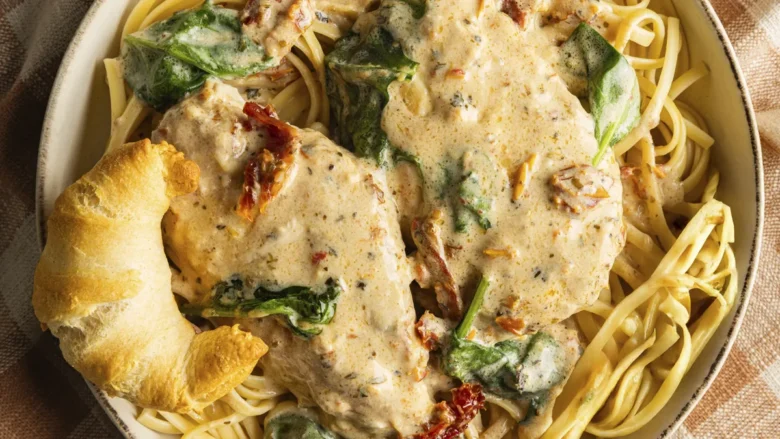
Fettuccine Alfredo in its original Roman form is one of the most elegant dishes in Italian cooking and one of the most radical in its simplicity: pasta, butter, and Parmesan, tossed together in a hot bowl with a small amount of starchy pasta water until the three combine into a smooth, glossy, intensely savory sauce that requires no cream, no garlic, no additional fat beyond the butter. Alfredo di Lelio, who invented the dish at his trattoria in Rome in the early twentieth century, made it at the table with theatrical flourish using a golden fork and spoon, and the result was so good that Hollywood actors visiting Rome in the 1920s brought the recipe back to America, where it immediately acquired cream, chicken, and everything else that Rome would never put near it.
The American chicken Alfredo — cream, Parmesan, garlic, butter, and chicken over fettuccine — is not the original dish. It is also not a lesser dish. It is a different dish: rich, indulgent, deeply satisfying, and thoroughly American in its generous approach to cream and cheese. It is the dish that defines a certain category of weeknight comfort food — the kind that involves a cream sauce of some thickness and enough Parmesan to satisfy the portion that always wants more Parmesan.
The slow cooker version is the one that makes this dish available on a Tuesday night with minimal active cooking. The chicken braises in the sauce base for three to four hours on LOW, emerging tender and well-seasoned. The cream and Parmesan go in at the end — not at the beginning, because cream and Parmesan both require careful handling in a slow cooker that an eight-hour cook would not provide. The pasta is cooked separately, as always. The result is a creamy, deeply flavored chicken Alfredo that takes fifteen minutes of active preparation and produces something considerably better than a weeknight food expectation suggests it should.
Why Chicken Alfredo Works in the Slow Cooker
Chicken Alfredo is not, on its surface, an obvious slow cooker dish. The original preparation — pasta tossed in butter and Parmesan at the table — requires speed and heat. The American cream-sauce version is typically made in a skillet in under thirty minutes. Neither suggests the slow cooker as the natural vessel.
What makes the slow cooker version work is the chicken. Boneless, skinless chicken breasts or thighs, cooked in the sauce base for three to four hours on LOW, develop a tenderness and a depth of flavor that the quickly pan-seared-and-sliced chicken in a restaurant Alfredo does not have. The chicken braises in a mixture of chicken broth, garlic, Italian seasoning, and a small amount of cream cheese, which provides the base’s richness and acts as an emulsifier during the cook. When the chicken is shredded or sliced at the end of the cook, it is deeply seasoned, moist, and specifically flavored by the braising liquid in a way that a chicken breast cooked in a pan for six minutes is not.
The sauce — heavy cream and Parmesan — goes in at the very end, after the slow cooker has switched to KEEP WARM, because both are sensitive to sustained high heat. Cream added at the start of a four-hour slow cook can separate; Parmesan added too early can become grainy and clumped. Added together at the end, off the high heat, they produce the smooth, glossy cream sauce that Alfredo requires.
The pasta — fettuccine, always — is cooked separately and tossed with the finished sauce. This is not optional.
The Chicken
Boneless, skinless chicken breasts are the most commonly used chicken for Alfredo — they shred or slice cleanly into the sauce and their mild flavor allows the cream and Parmesan to be the primary flavors. The primary risk in a slow cooker is overcooking: chicken breasts overcooked in moist heat become dry and fibrous. Check at three hours on LOW and remove promptly when the internal temperature reaches 165°F (74°C).
Boneless, skinless chicken thighs are the more forgiving and more flavorful option. Dark meat’s higher fat content means it stays moist through the full cook and beyond, and its more assertive chicken flavor holds its own alongside the cream and Parmesan. Thighs are also harder to overcook — the fat and connective tissue protect the meat from drying out. For the most reliable, most flavorful slow cooker Alfredo, thighs are the correct choice.
The preparation. Season the chicken generously on both sides with salt, black pepper, and garlic powder before adding to the slow cooker. The seasoning applied directly to the chicken provides the baseline flavor that the braising liquid supplements.
Shredded or sliced. Both formats work equally well in a finished Alfredo, and the choice is aesthetic. Shredded chicken distributes through the sauce more evenly — every forkful of pasta encounters chicken. Sliced chicken is more visually dramatic — identifiable pieces of chicken alongside the pasta. Shred with two forks directly in the slow cooker; slice on a cutting board after the chicken has rested briefly.
The Sauce Base
The sauce builds in two stages: the braising base that goes into the slow cooker at the start, and the cream-and-Parmesan finish that goes in at the end.
Chicken broth — one cup — is the braising liquid base. It provides moisture for the braise and becomes part of the finished sauce, so its quality is detectable. Good quality broth or a teaspoon of chicken Better Than Bouillon dissolved in water produces the best result.
Cream cheese — four ounces, cut into cubes — is the key ingredient that makes the slow cooker Alfredo work. Cream cheese melts slowly into the braising liquid over three to four hours, enriching the base, contributing fat and a slight tang, and acting as an emulsifier that keeps the sauce stable when the cream and Parmesan are added at the end. Full-fat cream cheese is the correct form — reduced fat versions melt less cleanly and can become grainy.
Garlic — four to five cloves, minced — is the aromatic backbone. Italian-American Alfredo uses garlic assertively; the slow cook mellows its sharpness into a rounded, sweet garlic note.
Italian seasoning — one teaspoon — provides the herbal blend that gives the sauce its characteristic Italian-American character.
White pepper or black pepper — white pepper is more traditional in cream sauces and less visually intrusive; black pepper is more commonly available and adds its own flavor note.
The cream and Parmesan — added at the end. One cup of heavy cream, stirred in after the slow cooker switches to KEEP WARM. One cup of freshly grated Parmesan — not pre-shredded, which contains anti-caking agents that prevent smooth melting — stirred in alongside the cream. Both are folded into the hot braising liquid gradually, stirring continuously, until the sauce is smooth and creamy. This process takes two to three minutes of stirring and is the step that produces the finished Alfredo sauce.
The Parmesan Question
Parmesan is the defining ingredient of Alfredo sauce — more than the cream, more than the butter, the aged, salty, nutty depth of Parmigiano-Reggiano is what makes Alfredo taste like Alfredo rather than like cream-sauced pasta.
Freshly grated Parmigiano-Reggiano from a wedge, using a Microplane or fine grater, is the correct and only Parmesan for this recipe. It melts smoothly into the cream and broth, distributes evenly through the sauce, and contributes the specific flavor of aged Italian hard cheese that makes the finished dish taste specifically excellent.
Pre-shredded Parmesan in a bag contains cellulose and potato starch as anti-caking agents — these prevent the cheese from clumping in the bag and also prevent it from melting cleanly into the sauce. Pre-shredded Parmesan stirred into a cream sauce produces grainy, slightly separated results where the cheese sits in chunks rather than melting smoothly. Use freshly grated.
The green can Parmesan — the shelf-stable, dried, pre-grated product — is so far from genuine Parmesan that it should not be used in a recipe specifically designed to showcase the cheese. It will not melt properly and its flavor is a pale approximation.
The quantity. One cup of freshly grated Parmesan for a full batch is the starting point. More produces a thicker, more intensely cheesy sauce. Less produces a lighter, more broth-forward result. Add the cup, stir thoroughly, taste, and add more by the tablespoon if the cheese flavor needs more presence.
The Heavy Cream
Heavy cream is the fat component of the sauce — the thing that produces the smooth, coating, specifically indulgent texture of Alfredo sauce.
Heavy cream (36 percent fat or higher) is the correct form. It contains enough fat to remain stable in the sauce and to coat the pasta in the specific way that makes Alfredo sauce what it is.
Half-and-half produces a thinner, less rich sauce that is adequate but not what the recipe is designed for. If used, increase the Parmesan quantity slightly to compensate for the reduced fat content.
Whole milk is too thin and too low in fat for a proper Alfredo sauce. It produces a watery result that separates easily and lacks the body of a cream-based sauce.
The timing. Heavy cream added to the slow cooker at the start of a four-hour cook on LOW can separate — the sustained heat drives off some of the water fraction and can produce a slightly greasy result. Added at KEEP WARM temperature at the end of the cook, it produces a smooth, stable cream sauce. Always add cream at the end.
The Pasta
Fettuccine is the pasta for Alfredo. This is not a preference — it is a structural decision. Fettuccine’s broad, flat surface area is specifically designed to carry cream sauce, to absorb it and hold it in the slight curve of the noodle’s center and along its wide edges. Narrower pasta carries less sauce per bite; tube pasta catches sauce differently. Fettuccine with Alfredo is a combination so specifically correct that departing from it requires justification.
Fresh fettuccine — available at most grocery stores in the refrigerated pasta section — cooks in two to three minutes and produces a silkier, more tender result than dried. For a dish with a cream sauce this rich, fresh pasta is worth seeking.
Dried fettuccine is entirely correct and the practical everyday choice. Cook to just al dente — slightly firm in the center — as it will continue to cook slightly from the heat of the sauce.
Reserve the pasta cooking water. A quarter cup of starchy pasta cooking water stirred into the Alfredo sauce before tossing with the pasta is the technique that produces a restaurant-quality sauce coating rather than a sauce that pools at the bottom of the bowl. The starch in the pasta water emulsifies the sauce and helps it cling to every strand of fettuccine.
Toss in the sauce before serving. The most important pasta technique: drain the fettuccine, add it directly to the slow cooker insert with the Alfredo sauce, and toss to coat every strand before plating. Pasta served with sauce poured over the top rather than tossed through it produces an uneven result where the first forkfuls have too much sauce and the last have none.
Tips for Perfect Slow Cooker Chicken Alfredo
1. Add cream and Parmesan only at the end — at KEEP WARM. This is the single most important technique instruction in the recipe. Cream and Parmesan added during the slow cook separate, become grainy, and produce a broken sauce. Added at KEEP WARM temperature after the cook, stirred continuously, they produce the smooth, glossy Alfredo sauce the dish requires.
2. Use full-fat cream cheese. The cream cheese in the braising base is the emulsifier that keeps the final sauce stable. Reduced-fat versions melt less cleanly and produce a grainier texture. Full-fat is the correct ingredient.
3. Grate your own Parmesan. Pre-shredded Parmesan with anti-caking agents does not melt cleanly into cream sauce. A block of Parmigiano-Reggiano and a fine grater or Microplane produces the smooth, integrated sauce that makes Alfredo what it is.
4. Cook the chicken to the correct temperature, then remove. Check the chicken at the three-hour mark on LOW. At 165°F (74°C) internal temperature, remove and shred or slice immediately. Chicken breast left in the slow cooker past doneness becomes dry and fibrous — the timing is the most important variable in the dish.
5. Reserve pasta cooking water. A quarter cup of starchy pasta water stirred into the sauce before tossing with the pasta emulsifies the sauce and helps it coat the fettuccine evenly. This is the step most worth adding if it is not already habitual.
6. Toss the pasta in the sauce before plating. Every strand of fettuccine should be coated with the Alfredo sauce before it reaches the bowl. Pasta poured into a bowl and sauce ladled over the top produces an uneven, poorly integrated result.
7. Serve immediately. Alfredo sauce thickens as it cools — the cream and Parmesan firm into something closer to a coating than a sauce. Serve immediately after tossing with the pasta. If the sauce has thickened waiting for serving, stir in a splash of warm pasta water or broth to loosen.
8. Season at the end. The cream cheese and Parmesan both contain significant salt. Taste the finished sauce before adding additional salt — it may not need any, or may need only a small amount. Parmesan in particular is very salty and the sauce can become over-seasoned quickly if salt is added without tasting first.
Serving the Chicken Alfredo
The plate. A generous mound of fettuccine already tossed with the Alfredo sauce and the shredded or sliced chicken distributed through it — every fork-load should encounter both pasta and chicken and sauce simultaneously. Extra Parmesan grated generously over the top. Freshly cracked black pepper. Fresh flat-leaf parsley, finely chopped, for the herbal brightness that cuts through the cream.
Portion size. Chicken Alfredo is rich. A standard restaurant portion — four ounces of dried pasta — is the correct amount. Smaller portions feel inadequate; larger portions become heavy by the end. The richness of the cream and Parmesan is what provides satiety, not volume.
The bread. Garlic bread alongside is mandatory — for the sauce that pools on the plate, for the enjoyment of dipping something crusty into cream and Parmesan, and for the specific pleasure of garlic bread as the partner to a cream-sauced pasta dish.
The Complete Table
Sides:
- Garlic bread or a crusty baguette — mandatory
- Caesar salad — the Italian-American classic alongside a cream-sauced pasta
- Simple arugula salad with lemon and Parmesan — bitter and bright against the richness
- Roasted broccolini with olive oil — green and clean alongside the cream
- Roasted cherry tomatoes — acidic and sweet, specifically good with Alfredo
Garnishes:
- Freshly grated Parmigiano-Reggiano — over the top of every serving
- Fresh flat-leaf parsley — finely chopped, scattered over
- Freshly cracked black pepper — a generous crack
- Red pepper flakes for those who want a heat note
Drinks:
- A crisp, unoaked Chardonnay or Pinot Grigio — cuts through the cream
- A light Pinot Noir — for those who prefer red
- Sparkling water with lemon — a clean, non-competing pairing
The Day-After Chicken Alfredo Uses
Leftover slow cooker chicken Alfredo requires one adjustment: the sauce thickens significantly overnight in the refrigerator, and it needs to be loosened before reheating. Add a splash of chicken broth or heavy cream to the leftovers, stir, and reheat gently over low heat on the stovetop or in the microwave at 60 percent power in 60-second bursts. The cream and Parmesan will come back together with gentle heat and the additional liquid. Beyond reheating as-is: leftover chicken Alfredo sauce with the pasta removed becomes the base for a chicken pot pie filling — add frozen peas, diced carrots, and top with puff pastry and bake. The shredded chicken from leftover Alfredo is excellent in a chicken and vegetable soup — the Alfredo seasoning having already flavored the chicken deeply. Stirred through steamed rice rather than pasta, it becomes chicken Alfredo rice — an unusual and specifically comforting leftover treatment.
Easy Variations
- Broccoli chicken Alfredo. Add two cups of fresh or frozen broccoli florets to the slow cooker in the final thirty minutes of cooking. They soften into the sauce and provide the green vegetable that Alfredo specifically benefits from. Roasted broccoli added at serving, rather than slow-cooked, provides more texture and a slightly caramelized flavor that is superior.
- Cajun chicken Alfredo. Season the chicken with one tablespoon of Cajun seasoning rather than Italian seasoning. Add half a teaspoon of cayenne to the sauce base. The heat of the Cajun seasoning against the cream and Parmesan is specifically excellent and produces a dish that is popular enough to be a staple at New Orleans-influenced restaurants.
- Sun-dried tomato chicken Alfredo. Add a quarter cup of oil-packed sun-dried tomatoes, drained and roughly chopped, to the sauce base. The concentrated tomato flavor and slight sweetness cuts through the cream and adds a specifically Italian depth that is excellent.
- Mushroom chicken Alfredo. Add eight ounces of sliced cremini mushrooms to the slow cooker at the start of the cook. They release their moisture into the braising base and absorb the cream cheese and garlic flavors during the braise — by the end of the cook, the mushrooms are deeply flavored and contribute an earthy depth to the Alfredo sauce.
- Spinach and artichoke Alfredo. Add one cup of frozen spinach (thawed and squeezed dry) and half a cup of canned artichoke hearts (drained and quartered) in the final thirty minutes. The combination references the classic spinach artichoke dip and produces a vegetable-enriched Alfredo that is substantial enough to stand alone or to be served with less chicken.
Make-Ahead and Storage
Make-ahead: The chicken and braising base can be cooked up to two days ahead and refrigerated. On the day of serving, reheat in the slow cooker on LOW for one hour, add the cream and Parmesan at KEEP WARM temperature, cook fresh pasta, and toss and serve. This approach is specifically good for a dinner party where timing the pasta to ready guests is challenging.
Refrigerator: Leftover chicken Alfredo keeps for three days. Store the pasta and sauce together or separately — separately preserves the pasta texture better. Reheat gently with a splash of broth or cream added before heating.
Freezer: Alfredo sauce does not freeze well — cream sauces typically separate during freezing and thawing, becoming grainy and split. Freeze the chicken in a portion of the braising liquid (without cream and Parmesan) for up to two months. Thaw overnight in the refrigerator, reheat, and make fresh cream and Parmesan sauce at serving.
Shopping List
The Chicken
- 2 lbs (900g) boneless, skinless chicken thighs or breasts
- Salt, black pepper, garlic powder (for seasoning)
The Sauce Base
- 1 cup (240ml) chicken broth
- 4 oz (115g) full-fat cream cheese, cubed
- 4–5 garlic cloves, minced
- 1 tsp Italian seasoning
- ½ tsp salt
- ¼ tsp white or black pepper
The Alfredo Finish (added after cooking)
- 1 cup (240ml) heavy cream
- 1 cup (100g) Parmigiano-Reggiano, freshly grated, plus more for serving
The Pasta
- 12 oz (340g) fettuccine
- Salt for pasta water
For Serving
- Fresh flat-leaf parsley, finely chopped
- Freshly cracked black pepper
- Extra freshly grated Parmesan
- Garlic bread alongside
Slow Cooker Chicken Alfredo (Creamy & Easy)
Boneless, skinless chicken thighs or breasts seasoned with salt, pepper, and garlic powder and slow-cooked on LOW for three to four hours in a base of chicken broth, cubed cream cheese, minced garlic, and Italian seasoning — the cream cheese melting slowly into the broth and acting as the emulsifier that makes the finished Alfredo sauce stable. The chicken shredded or sliced, the slow cooker switched to KEEP WARM, and one cup of heavy cream and one cup of freshly grated Parmigiano-Reggiano stirred in gradually until the sauce is smooth and glossy. Tossed with al dente fettuccine and a quarter cup of starchy pasta cooking water. Plated with extra Parmesan grated generously over the top, fresh parsley scattered, and black pepper cracked. The slow cooker Chicken Alfredo that is both creamy and easy — and better than what the Tuesday night expectation suggested it would be.
- Total Time: 3 hours 25 minutes
- Yield: 4–6 servings 1x
Ingredients
The Chicken
- 2 lbs (900g) boneless, skinless chicken thighs or breasts
- ½ tsp salt
- ¼ tsp black pepper
- ½ tsp garlic powder
The Sauce Base
- 1 cup (240ml) good quality chicken broth
- 4 oz (115g) full-fat cream cheese, cut into 1-inch cubes
- 4–5 garlic cloves, minced
- 1 tsp Italian seasoning
- ½ tsp salt
- ¼ tsp white or black pepper
The Alfredo Finish
- 1 cup (240ml) heavy cream — added after cooking
- 1 cup (100g) Parmigiano-Reggiano, freshly grated — added after cooking
The Pasta
- 12 oz (340g) fettuccine
- Generously salted boiling water
For Serving
- Additional freshly grated Parmigiano-Reggiano
- Fresh flat-leaf parsley, finely chopped
- Freshly cracked black pepper
- Garlic bread
Instructions
- Season the chicken. Pat the chicken dry with paper towels. Season on both sides with salt, black pepper, and garlic powder.
- Build the sauce base. Place the seasoned chicken in the slow cooker in a single layer. Add the cubed cream cheese, minced garlic, Italian seasoning, salt, and pepper. Pour the chicken broth around the chicken.
- Cook. Set to LOW and cook for 3 to 4 hours, checking at the 3-hour mark. The chicken is done when it reads 165°F (74°C) internally and shreds easily when pressed with a fork. Do not overcook — chicken breast specifically becomes dry and fibrous beyond 165°F.
- Shred or slice the chicken. Transfer the chicken to a cutting board. Shred into pieces with two forks or slice into strips. Return to the slow cooker.
- Add the cream and Parmesan. Switch the slow cooker to KEEP WARM. Pour in the heavy cream and stir to combine with the braising liquid. Add the freshly grated Parmesan in three additions, stirring continuously after each addition until completely melted and smooth before adding the next. The sauce should become creamy, glossy, and thick enough to coat a spoon.
- Season. Taste the sauce and adjust salt and pepper. The Parmesan contributes significant salt — the sauce may not need additional seasoning.
- Cook the pasta. Bring a large pot of generously salted water to a boil. Cook the fettuccine according to package directions until just al dente. Reserve ¼ cup of pasta cooking water before draining. Drain — do not rinse.
- Toss. Add the drained fettuccine directly to the slow cooker with the Alfredo sauce. Add the reserved pasta cooking water. Toss thoroughly until every strand of pasta is coated with the sauce. Taste one final time for seasoning.
- Plate and serve. Divide into warmed bowls or plates. Grate additional Parmesan generously over each portion. Scatter fresh parsley over the top. Crack black pepper over each serving. Serve immediately with garlic bread alongside.
Notes
- Cream and Parmesan go in after the cook — at KEEP WARM. This is the most important technique note in the recipe. Heavy cream and freshly grated Parmesan added to a slow cooker running on LOW or HIGH during the braise separate, become grainy, and produce a broken sauce. Added at KEEP WARM temperature at the very end — after the chicken is cooked and the slow cooker has switched off from the cooking temperature — they produce the smooth, glossy Alfredo sauce the dish requires. The two to three minutes of continuous stirring at this stage are the technique that makes the recipe work.
- Grate your own Parmesan — the one step worth the effort. Pre-shredded Parmesan in bags contains anti-caking agents that prevent smooth melting. Pre-grated Parmesan in a green can is not genuinely Parmesan and produces nothing close to the correct result. A wedge of Parmigiano-Reggiano and a fine grater takes three minutes and produces a sauce that is categorically better than any processed Parmesan alternative. This is the one step in an otherwise genuinely easy recipe that cannot be shortcut.
- Check the chicken at three hours. Chicken breast overcooked in the slow cooker becomes dry and fibrous — the window between perfectly cooked and overdone is narrower for breast meat than for thighs. Check with a thermometer at the three-hour mark. Thighs are more forgiving and can go the full four hours without quality loss.
- Reserve pasta cooking water. The starchy water from the pasta pot is the sauce’s emulsifier — it helps the cream and Parmesan coat every strand of fettuccine rather than pooling at the bottom of the bowl. This is the technique used in every Italian restaurant kitchen and the one most worth adding to the home kitchen routine.
- Serve immediately after tossing. Alfredo sauce thickens quickly as it cools. The window between perfectly creamy sauce and slightly-too-thick sauce is about five minutes. Serve the moment the pasta is tossed.
- Cream cheese is the stability ingredient. The cream cheese in the braising base provides fat for the braise and acts as an emulsifier that stabilizes the sauce when the cream and Parmesan are added at the end. Without it, the final sauce is less stable and more prone to the cream and Parmesan separating slightly. Full-fat cream cheese is the correct ingredient — reduced-fat versions melt less cleanly.
- This is the American version. The original Roman Alfredo — pasta, butter, Parmesan, no cream — is an extraordinary dish that is different from this recipe. This is the American chicken Alfredo: cream, garlic, chicken, Parmesan. Both are correct. They are different dishes.
- Prep Time: 10 minutes
- Cook Time: 3–4 hours (on LOW)
- Category: Dinner, Main Dish
- Method: Slow Cooking
- Cuisine: American, Italian
Frequently Asked Questions
Why did my Alfredo sauce turn out grainy? Grainy Alfredo sauce in a slow cooker has one of three causes. Most commonly: the Parmesan was added while the slow cooker was still on LOW or HIGH rather than at KEEP WARM temperature. The higher heat causes the cheese proteins to seize and separate rather than melt smoothly. Second: pre-shredded Parmesan was used, which contains anti-caking starches that prevent clean melting. Third: the cream was added too quickly without stirring — adding it gradually and stirring continuously allows the cream cheese’s emulsifying properties to hold the sauce together as the new fat is introduced. For a sauce that has already become grainy: switch to KEEP WARM, add a splash of warm broth, and stir vigorously — gentle heat and agitation can sometimes bring a slightly broken sauce back together. Significantly grainy sauce cannot be fully recovered; preventing it through the correct technique is always preferable.
Can I use half-and-half instead of heavy cream? Yes — half-and-half produces a thinner, lighter sauce that is less indulgent than the heavy cream version but still creamy and satisfying. The fat content of half-and-half (approximately 12 percent) compared to heavy cream (36 percent or higher) means it produces less of the coating richness that defines Alfredo sauce, and it is slightly more prone to separating when Parmesan is added. If using half-and-half, increase the Parmesan quantity by a quarter cup to compensate for the reduced fat’s ability to carry the cheese flavor, and add the Parmesan very gradually with continuous stirring. Whole milk should not be used — it is too thin and too low in fat for a stable Alfredo sauce.
Can I make this gluten-free? Yes — substitute a good quality gluten-free fettuccine or wide rice noodles. Everything else in the recipe is naturally gluten-free, including the sauce base (check the Italian seasoning label to confirm no wheat fillers). For a rice noodle version, be aware that rice noodles absorb the sauce differently than wheat fettuccine and may produce a slightly different texture. Corn pasta fettuccine is the most similar to wheat pasta in texture and is a good gluten-free alternative.
My sauce is too thick. How do I thin it? Add warm chicken broth or heavy cream, one tablespoon at a time, stirring after each addition until the consistency is correct. The sauce naturally thickens as it cools — if it thickens between the finish and serving, a splash of warm pasta cooking water (if reserved) or warm broth brings it back to the right consistency quickly. Alfredo sauce should coat a spoon and fall in a thick ribbon rather than poured in a thin stream — thicker than gravy, thinner than a spread. If it cannot be spooned easily, it is too thick and needs thinning.
Can I add vegetables and which work best? Broccoli is the most popular and most natural addition — two cups of fresh or frozen florets added in the final thirty minutes of the cook, or roasted separately and added at serving. Roasted broccoli is significantly better than slow-cooked broccoli for this recipe — the caramelization from the oven’s dry heat is a better textural partner for the cream sauce than the softness of slow-cooked broccoli. Asparagus tips, added in the final fifteen minutes, retain some crunch. Sun-dried tomatoes — oil-packed, drained — added at the start contribute a concentrated, slightly sweet tomato note that cuts the richness of the cream. Spinach stirred in at the KEEP WARM stage wilts immediately into the sauce. Mushrooms, added at the start and cooked for the full duration, become deeply flavored and contribute earthy depth.
Is this recipe suitable for meal prep? The chicken component is excellent for meal prep — cook the chicken in the braising base ahead of time, shred, and refrigerate for up to three days. When ready to serve, reheat the chicken and base in the slow cooker on LOW for thirty to forty-five minutes, then add the cream and Parmesan at KEEP WARM and cook fresh pasta. The complete assembled dish — pasta and sauce combined — is less ideal for meal prep because the pasta absorbs the sauce during refrigeration and the fettuccine can become swollen and soft by the next day. For best results, meal prep the chicken and sauce separately from the pasta.
What is the difference between this recipe and the original Alfredo? The original Alfredo di Lelio recipe — invented in Rome in the early 1900s — contains no cream, no chicken, and no garlic. It is fettuccine tossed vigorously at the table with an enormous amount of high-quality butter and freshly grated Parmigiano-Reggiano, with a small amount of hot starchy pasta water to emulsify the sauce. The butter and cheese and starchy water form a smooth, glossy coating on the pasta through emulsification — no cream required. What the American version has done over a century of evolution is add cream (which makes the sauce easier to produce and more stable), chicken (which makes it a complete protein-and-pasta dish), and garlic (which adds the assertive aromatic note that Italian-American cooking favors). This slow cooker recipe is the American version — indulgent, creamy, chicken-forward — and it is excellent on its own terms.