
Brisket has a reputation that it has earned slowly and at considerable cost — the cost being the hours required to produce it correctly and the equipment required to do it the way the people who understand brisket best believe it should be done. Texas-style smoked brisket, which is the benchmark by which all other brisket is measured in American barbecue culture, requires a specific combination of things that very few home cooks have access to simultaneously: a whole packer brisket of twelve to fifteen pounds, a properly maintained offset smoker, oak or hickory wood, a twelve to sixteen hour cook at precisely controlled temperatures, and the patience and skill to manage all of that through a day and possibly a night. The result — a brisket with a smoke ring, a mahogany bark, and a fat cap rendered to buttery softness — is one of the great achievements of American cooking. It is also one of the most demanding.
The slow cooker brisket is not that. Let this be stated clearly and without apology, because the most important thing about slow cooker brisket is understanding what it is rather than what it is trying to be.
Slow cooker brisket is braised brisket — a completely different cooking tradition with its own history, its own specific qualities, and its own devoted following. Jewish-American braised brisket, served at Passover and Rosh Hashanah tables for generations, is not a compromise on smoked Texas brisket. It is a different and excellent dish: beef that has cooked for hours in its own juices and a flavored liquid until it is fork-tender, deeply savory, and surrounded by a rich, concentrated braising liquid that becomes the sauce. The slow cooker is the ideal vessel for this preparation — it produces the most consistently tender, most evenly braised brisket of any method available to the home cook, and it does it without attention, without equipment, and without the skill gap that separates good barbecue from great.
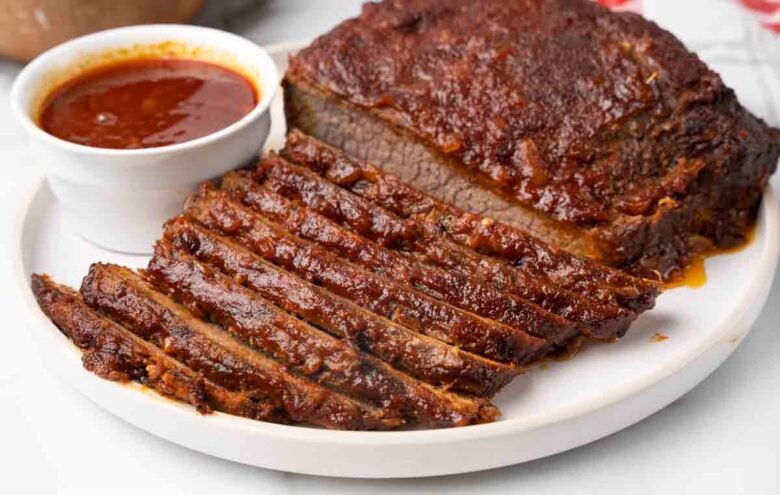
The BBQ sauce in this recipe bridges the two traditions. The braised brisket gets a coat of good BBQ sauce and five minutes under the broiler at the end — producing a caramelized, lacquered exterior that owes something to the barbecue tradition while remaining what it is: beautifully braised beef in a glossy sauce, made in a slow cooker, on a Tuesday.
The History of Two Briskets
Brisket has two distinct and equally valid American histories, and understanding both makes the slow cooker version more interesting to cook and more interesting to talk about.
The Texas tradition. Brisket became the dominant cut of Texas barbecue through a specific historical path: German and Czech immigrant butchers in Central Texas sold smoked meats to their customers in the late nineteenth and early twentieth centuries, and brisket — the tough, inexpensive, heavily worked pectoral muscle of the steer — was one of the cuts that benefited most dramatically from the low-and-slow smoking method. The connective tissue that made brisket tough when cooked quickly converted over twelve-plus hours of smoke and indirect heat into the gelatin that produces the characteristic unctuous, yielding texture of great smoked brisket. Lockhart, Lubbock, and Austin became the epicenters of a brisket culture that has since spread across the country and generated a devoted following that takes its brisket seriously in the way that other cultures take their wine seriously.
The Jewish-American tradition. Brisket arrived in Jewish-American cooking through a different path: it was an inexpensive, widely available cut that Jewish butchers sold, and it suited the braised preparations of the Ashkenazi Jewish kitchen — long, slow cooking in liquid with onions and sometimes tomatoes or wine, producing a pot roast-style dish that was served at the Sabbath table and at the major Jewish holidays. The Jewish braised brisket is the direct ancestor of the slow cooker version: same cut, same low-and-slow principle, same outcome of tender, deeply flavored beef. It is a dish of profound comfort and specific occasion.
The slow cooker version draws on the Jewish-American braised tradition with a nod to the barbecue tradition through the BBQ sauce finish — a combination that is not historically rooted in either tradition but is specifically excellent in the modern home kitchen.
Choosing Your Brisket
Brisket selection is more important in this recipe than in most slow cooker beef dishes because the cut itself — its fat content, its size, its which section of the brisket it represents — directly determines the texture and the richness of the finished dish.
The flat cut is the leaner, more uniform section of the brisket — rectangular in shape, with a thin fat cap on one side. It slices cleanly and beautifully, producing elegant, uniform slices that fan across a platter. Its leanness means it is more susceptible to drying out if overcooked and produces a less rich braising liquid than the point cut. The flat cut is the right choice for a platter presentation where clean slices matter.
The point cut is the fattier, more irregular section — thicker, more marbled, with more connective tissue and collagen. It produces richer braising liquid, more deeply flavored meat, and a yielding, slightly shredding texture rather than the clean slices of the flat. It is the better eating brisket for a slow cooker application where the braising liquid is the sauce — the collagen it releases enriches everything around it. The point cut is the right choice for maximum flavor and richness.
A full packer brisket — the whole brisket with both flat and point — is the best option when it can be found and when the slow cooker is large enough to accommodate it. Typically eight to twelve pounds for a manageable home-cooking size, a full packer provides the best of both cuts and produces a braising liquid of extraordinary richness from the point’s collagen while giving the flat’s cleaner slices for presentation.
The size. A three to four pound brisket fits in a 6-quart slow cooker. A four to six pound brisket requires a large oval slow cooker. The brisket should lie flat or close to flat — a brisket bent significantly to fit in the cooker cooks unevenly, with the bent sections overcooking while the thicker areas remain underdone.
Trimming. A fat cap of approximately a quarter inch is ideal — thick enough to baste the meat during the long cook and render into the braising liquid, thin enough not to produce a greasy final result. Trim any fat cap thicker than a half inch. Leave some fat — a completely trimmed brisket in a slow cooker produces a drier result and a thinner braising liquid.
The Dry Rub
The dry rub applied to the brisket before it goes into the slow cooker is the seasoning that penetrates the meat during the long cook and provides the flavor from the inside out.
Salt is the most important component and the one applied most generously. Salt penetrates the brisket during the cook, seasoning the interior, drawing out moisture that then reabsorbs carrying dissolved spices with it, and acting on the protein structure in ways that produce a more tender, more evenly seasoned result. Apply more than feels comfortable.
Black pepper — coarsely ground — is the other essential component. In Texas-style brisket, salt and black pepper are the only two ingredients in a proper rub — the “dalmatian rub” that Aaron Franklin and similar pitmasters use because they believe in the beef enough to not obscure it. The slow cooker version benefits from a more elaborate rub because it lacks the smoke, but salt and pepper remain the foundation.
Smoked paprika — a tablespoon — approximates some of the smoky depth that the slow cooker cannot produce through cooking method. It adds color to the rub and a subtle smokiness to the surface of the meat.
Garlic powder and onion powder — a teaspoon each — add aromatic depth that the braising liquid’s aromatics complement.
Brown sugar — a tablespoon — contributes to the caramelization under the broiler at the end and adds a slightly sweet crust that suits the BBQ sauce finish.
Cayenne — a quarter teaspoon — adds background warmth.
Application. Mix the rub ingredients, apply generously to every surface of the brisket, and if time allows, refrigerate uncovered overnight. The overnight rest allows the salt to penetrate deeply, drawing moisture to the surface and then reabsorbing it along with the dissolved spices — effectively dry-brining the brisket. This produces noticeably more evenly seasoned, more flavorful meat than applying the rub immediately before cooking. If overnight rest is not possible, apply and cook immediately.
The Braising Liquid
The braising liquid does two jobs in this recipe: it provides the moisture for the slow braise and it becomes the sauce that the brisket is served with and lacquered in.
Beef broth — one cup — is the liquid base. A good quality broth or bone broth starts the braising liquid from a strong foundation.
BBQ sauce — a half cup, added to the braising liquid — gives the sauce its character from the start. This is the ingredient that connects the braised tradition to the barbecue tradition: the braising liquid is not plain broth but BBQ sauce-infused broth, so the brisket spends eight hours in a liquid that already has the smoky, sweet, tangy character of the finished sauce. More BBQ sauce is applied after the cook and finished under the broiler.
Worcestershire sauce — two tablespoons — adds the umami depth that beef braising liquids require.
Apple cider vinegar — two tablespoons — adds acidity and brightens the braising liquid. Vinegar is a characteristic component of Southern barbecue tradition — its role here is both flavoring and tenderizing.
Brown sugar — a tablespoon — adds sweetness that balances the vinegar and complements the BBQ sauce.
Garlic — four to five cloves, smashed — adds aromatic depth.
Onion — one large, halved and placed cut side down — caramelizes during the cook and contributes sweetness to the braising liquid. Remove before making the finishing sauce.
Liquid smoke — half a teaspoon, optional — is the controversial pantry ingredient that approximates a fraction of the smoke the slow cooker cannot provide through cooking. Used sparingly, it adds a genuine smoky note. Used too heavily, it produces an acrid, artificial result that ruins everything. Half a teaspoon in a full batch of braising liquid is the correct quantity — present but not identifiable as liquid smoke.
The BBQ Sauce Finish
The BBQ sauce finish is what makes this slow cooker brisket specifically this recipe rather than a generic braised brisket.
The sauce selection. The BBQ sauce used for the finish should be a sauce you genuinely enjoy eating on its own — its flavor is concentrated and intensified under the broiler and is directly detectable in every bite. A Kansas City-style sauce — thick, dark, smoky, with a vinegar tang — is the most natural pairing with brisket. A Texas-style sauce, which is thinner and more beef-forward, suits the tradition more historically but may drip off the brisket under the broiler. A hickory BBQ sauce adds smokiness that complements the meat’s braised depth. Avoid very sweet or very thin sauces — caramelized thick sauce under the broiler is the goal, and thin sweet sauces burn before they caramelize.
The method. Transfer the brisket to a foil-lined baking sheet after the slow cook. Spoon some of the braising liquid over the surface — this forms the first layer of glaze. Apply a coat of BBQ sauce with a pastry brush. Slide under a preheated broiler 5 to 6 inches from the element for 3 to 5 minutes, watching constantly, until the sauce is bubbling, beginning to char at the thinnest edges, and caramelized across the surface. Apply a second coat of BBQ sauce and return to the broiler for 1 to 2 more minutes. The result is a lacquered, mahogany-colored surface that is the slow cooker brisket’s answer to bark.
The braising liquid as sauce. While the brisket is under the broiler, strain the remaining braising liquid, skim the fat, and reduce briefly in a saucepan. The result is a rich, deeply flavored sauce that combines the braising liquid’s beef depth with the BBQ sauce already incorporated — serve it warm alongside the sliced brisket for spooning over the top.
Slicing the Brisket
Brisket, more than almost any other beef cut, is transformed by how it is sliced. The grain of brisket runs clearly and prominently through the flat and changes direction in the point — understanding and respecting the grain is the technique that separates tender slices from tough ones.
Rest before slicing. Transfer the brisket to a cutting board and allow it to rest, tented loosely with foil, for twenty minutes before cutting. The proteins relax and the juices redistribute during this rest — sliced immediately, the brisket bleeds excessively and the internal structure is less coherent.
Identify the grain. Look at the surface of the brisket and find the direction of the long muscle fibers — the grain. They are usually visible as parallel lines running the length of the flat. Slicing against the grain — perpendicular to those lines — shortens every fiber and produces tender slices. Slicing with the grain produces tough, chewy results regardless of how well the brisket was cooked.
The grain change. In a full packer brisket, the grain of the flat and the point run in different directions — they meet at an angle. When you reach the point section, rotate the brisket and adjust the slicing angle to continue cutting against the grain of the point.
The slice thickness. Approximately a quarter to a half inch — thin enough to show the tenderness of the meat, thick enough to have presence on the plate. Thinner slices fall apart; thicker slices can seem tough even when the meat is perfectly cooked.
Tips for Perfect Slow Cooker Beef Brisket
1. Apply the rub the night before — dry-brining matters. Overnight rest with the dry rub is the single most impactful optional step. The salt draws moisture to the surface, dissolves the spices, and reabsorbs the dissolved seasoning throughout the meat. Morning-rubbed brisket is good. Night-before-rubbed brisket is noticeably more evenly seasoned throughout.
2. Fat cap up. Place the brisket fat side up in the slow cooker. The fat cap renders slowly during the long cook, basting the meat from above continuously. Fat cap down produces a drier, less self-basted result.
3. Do not add too much liquid. The braising liquid should reach approximately halfway up the sides of the brisket — enough to create a braising environment without submerging the meat. Too much liquid produces a boiled brisket rather than a braised one and dilutes the braising liquid’s flavor.
4. Cook on LOW — always. Eight to ten hours on LOW produces the collagen conversion and the even, deep tenderness that brisket requires. HIGH produces a cooked brisket but with less complete collagen conversion, tighter muscle fibers, and a less rich braising liquid. LOW is non-negotiable for great slow cooker brisket.
5. Do not lift the lid. The slow cooker’s sealed environment maintains temperature and bastes the brisket from the steam. Every lid lift drops the temperature and extends the cook time.
6. Rest before slicing. Twenty minutes of rest is mandatory, not optional. Sliced immediately from the slow cooker, the brisket bleeds its juices onto the cutting board. Rested and then sliced, it holds its juices and slices cleanly.
7. Slice against the grain — both sections. The most important technique in brisket service. Identify the grain direction in both the flat and the point. Slice perpendicular to the fibers. In a packer brisket, rotate the cutting angle when you transition from flat to point.
8. Two coats of BBQ sauce under the broiler. The first coat sets and caramelizes. The second coat adds another layer of glaze and prevents the first layer from drying out. Two coats under the broiler — applied mid-broil — produces the lacquered, mahogany exterior that makes slow cooker brisket look and taste like something made with considerably more effort.
Serving the Brisket
The platter. Sliced brisket fanned across a large wooden board or serving platter — the flat slices arranged in overlapping rows, the point section broken into larger chunks if it has shredded slightly during the cook — with the warm braising sauce poured into a small pitcher alongside. Fresh flat-leaf parsley scattered over the top. This is the presentation.
The sandwich. Thick slices of brisket piled onto a toasted brioche bun or a split hoagie roll, topped with a drizzle of the braising sauce and a spoonful of coleslaw. Brisket sandwiches made from slow cooker brisket, with the sauce from the braising liquid, are among the best sandwiches that can come from a home kitchen.
On a plate. Two to three slices of brisket alongside mashed potatoes or mac and cheese, with the braising sauce spooned generously over the top. The most comforting possible plate of food on the most appropriate kind of evening.
The Complete Table
Sides:
- Creamy mashed potatoes — the sauce is the gravy
- Mac and cheese — the Southern barbecue accompaniment
- Classic coleslaw — cool and acidic against the richness
- Baked beans — smoky, sweet, and complementary
- Cornbread — for the sauce
- Pickles and pickled onions — essential acidity for a fatty, rich brisket
- Roasted corn or elote
Condiments:
- Extra BBQ sauce alongside — always
- The braising liquid sauce — warm, spooned over everything
- Prepared horseradish — for those who want it
- Hot sauce
Drinks:
- A cold lager or amber ale — the definitive brisket drink
- A full-bodied red — Zinfandel, Syrah, or Cabernet
- Sweet iced tea — for the Southern table
The Day-After Brisket Uses
Leftover slow cooker brisket is one of the most valuable refrigerator assets in this collection. Cold brisket, thinly sliced and layered onto rye bread with mustard and pickled onions, produces a sandwich that rivals any deli in the neighborhood. Shredded into the braising liquid and served over egg noodles, it becomes a brisket stroganoff of specific excellence — the braising liquid is already halfway to a beef sauce. Diced and combined with diced potato, onion, and a knob of butter in a cast-iron skillet until everything is crispy and golden, it becomes brisket hash with a fried egg on top that is the best possible weekend breakfast. Sliced and layered into a brisket taco with pickled red onion, crumbled queso fresco, and salsa verde, it becomes a brisket taco that is specifically worth planning ahead for. The braising liquid, reduced to a thick glaze, is a sauce for everything — drizzled over roasted vegetables, brushed onto grilled chicken, stirred into mashed potatoes.
Easy Variations
- Texas-style brisket rub. Use only salt, coarse black pepper, and a small amount of garlic powder — the “dalmatian rub” of Central Texas barbecue. Skip the smoked paprika and brown sugar. Add half a teaspoon of liquid smoke to the braising liquid. The result is the most stripped-down, most beef-forward version of the dish.
- Jewish-style braised brisket. Omit the BBQ sauce from both the braising liquid and the finish. Replace with one cup of crushed tomatoes, half a cup of red wine, two tablespoons of brown sugar, and a tablespoon of tomato paste. Add two to three sliced carrots and two celery stalks to the slow cooker. The result is the traditional Jewish braised brisket — no BBQ sauce finish, just deeply braised beef in a rich tomato-wine sauce. Specifically correct for a Passover or holiday table.
- Honey chipotle brisket. Add two chipotle peppers in adobo sauce and two tablespoons of honey to the braising liquid alongside the BBQ sauce. Use a honey-chipotle BBQ sauce for the final glaze. The result combines the braised brisket format with the chipotle-beef flavors of the taco recipe — excellent and versatile.
- Brisket burnt ends. After the slow cook, cut the point section of the brisket (if using a full packer) into one-inch cubes. Toss with BBQ sauce and additional brown sugar. Spread on a baking sheet and broil for 8 to 10 minutes, turning once, until caramelized and slightly crispy on all sides. Brisket burnt ends — the most coveted cut at a Kansas City BBQ joint — made in a slow cooker and a broiler.
- Coffee-rubbed brisket. Add two tablespoons of finely ground espresso to the dry rub alongside the smoked paprika and black pepper. Coffee adds a complex bitterness that deepens the rub’s flavor and pairs specifically well with a smoky BBQ sauce. A variation that requires no additional ingredients for anyone who keeps coffee at home.
Make-Ahead and Storage
Make-ahead: Brisket is one of the great make-ahead dishes. Cooked, sliced, and refrigerated in the braising liquid for up to three days, the brisket absorbs more of the liquid during refrigeration and is often better on Day 2 or 3 than on the day it was made. For reheating: arrange slices in a baking dish, ladle braising liquid over the top, cover tightly with foil, and reheat at 300°F (150°C) for 25 to 30 minutes. Add the BBQ sauce glaze and broil for 3 to 4 minutes after reheating.
Refrigerator: Brisket in braising liquid keeps for four to five days. The liquid gels overnight — this is the gelatin from the brisket’s collagen, a sign of quality, not spoilage. Reheat gently.
Freezer: Sliced brisket freezes in portions with braising liquid for up to three months. Thaw overnight in the refrigerator. Reheat as above, in a covered baking dish with the liquid. The BBQ glaze should be applied fresh after reheating rather than frozen with the brisket.
Shopping List
The Brisket
- 3–5 lbs (1.4–2.3kg) beef brisket, flat cut or point cut
- Fat cap trimmed to approximately ¼ inch
The Dry Rub
- 2 tsp salt
- 1 tsp coarse black pepper
- 1 tbsp smoked paprika
- 1 tsp garlic powder
- 1 tsp onion powder
- 1 tbsp brown sugar
- ¼ tsp cayenne pepper
The Braising Liquid
- 1 cup (240ml) beef broth
- ½ cup (120ml) BBQ sauce (your preferred brand and style)
- 2 tbsp Worcestershire sauce
- 2 tbsp apple cider vinegar
- 1 tbsp brown sugar
- 4–5 garlic cloves, smashed
- 1 large onion, halved
- ½ tsp liquid smoke (optional)
The BBQ Finish
- ½ to ¾ cup (120–180ml) BBQ sauce for glazing — same or different sauce as braising liquid
For Serving
- Fresh flat-leaf parsley
- Mashed potatoes, coleslaw, baked beans, pickles
Slow Cooker Beef Brisket with BBQ Sauce
A three to five pound beef brisket rubbed generously with a blend of salt, smoked paprika, garlic powder, brown sugar, and cayenne — ideally overnight for maximum salt penetration — then placed fat side up in the slow cooker on a bed of halved onion, smashed garlic, and a braising liquid of beef broth, BBQ sauce, Worcestershire, and apple cider vinegar. Cooked on LOW for eight to ten hours until fork-tender, the collagen fully converted and the braising liquid rich and deeply flavored. Rested for twenty minutes, then transferred to a baking sheet and glazed with two coats of BBQ sauce under the broiler until the surface is caramelized, lacquered, and mahogany-dark. Sliced against the grain and served on a platter with the reduced braising liquid alongside. Braised brisket and barbecue tradition, together in a slow cooker.
- Total Time: 9–11 hours (plus overnight rest if applicable)
- Yield: 6–8 servings 1x
Ingredients
The Brisket
- 3–5 lbs (1.4–2.3kg) beef brisket, flat or point cut, fat cap trimmed to ¼ inch
The Dry Rub
- 2 tsp kosher salt
- 1 tsp coarse black pepper
- 1 tbsp smoked paprika
- 1 tsp garlic powder
- 1 tsp onion powder
- 1 tbsp brown sugar
- ¼ tsp cayenne pepper
The Braising Liquid
- 1 cup (240ml) beef broth
- ½ cup (120ml) BBQ sauce
- 2 tbsp Worcestershire sauce
- 2 tbsp apple cider vinegar
- 1 tbsp brown sugar
- 4–5 garlic cloves, smashed
- 1 large onion, halved
- ½ tsp liquid smoke (optional)
The BBQ Glaze
- ½ to ¾ cup (120–180ml) BBQ sauce, for finishing
For Serving
- Fresh flat-leaf parsley, roughly chopped
- Warm braising sauce alongside
Instructions
- Make the dry rub. Combine all dry rub ingredients in a small bowl. Mix well.
- Apply the rub. Pat the brisket completely dry with paper towels. Apply the rub generously to every surface — top, bottom, and sides — pressing it firmly into the meat. For best results, refrigerate uncovered on a rack overnight. If cooking immediately, proceed to the next step.
- Build the slow cooker. Place the halved onion cut side down in the slow cooker. Add the smashed garlic cloves. In a small bowl, whisk together the beef broth, BBQ sauce, Worcestershire sauce, apple cider vinegar, brown sugar, and liquid smoke (if using). Pour into the slow cooker.
- Add the brisket. Place the brisket fat side up in the slow cooker. The braising liquid should reach approximately halfway up the sides of the brisket. Add a small amount of additional broth if needed.
- Cook. Set the slow cooker to LOW and cook for 8 to 10 hours, until the brisket is completely tender — a fork or skewer inserted into the thickest part should meet no resistance, and the meat should yield when pressed gently. Do not lift the lid during cooking.
- Rest. Carefully transfer the brisket to a cutting board. Tent loosely with foil and rest for 20 minutes.
- Prepare the braising sauce. While the brisket rests, pour the braising liquid through a fine mesh strainer into a small saucepan, discarding the solids. Skim the fat from the surface. Bring to a boil and reduce for 5 to 8 minutes until slightly thickened. Taste and adjust seasoning.
- BBQ glaze and broil. Preheat the broiler to HIGH. Line a rimmed baking sheet with foil. Transfer the rested brisket to the baking sheet. Spoon two tablespoons of the braising sauce over the surface, then brush a generous coat of BBQ sauce over the top and sides. Broil 5 to 6 inches from the element for 3 to 4 minutes until bubbling and caramelized. Apply a second coat of BBQ sauce and broil for a further 1 to 2 minutes until the glaze is dark, sticky, and lacquered. Watch constantly.
- Slice and serve. Identify the grain direction of the brisket — the parallel muscle fibers running through the flat. Slice against the grain in ¼ to ½-inch slices, perpendicular to the fibers. In a full packer brisket, rotate the cutting angle when transitioning from flat to point. Arrange slices on a platter or board. Garnish with fresh parsley. Serve with the warm braising sauce in a small pitcher alongside.
Notes
- Overnight dry rub — worth planning for. The single most impactful optional step. Salt applied the night before penetrates deeply into the brisket, seasoning the interior throughout, tenderizing the protein structure, and producing a more evenly flavorful result than a last-minute rub. If overnight rest is not possible, apply and cook immediately — but plan for the overnight version when the occasion allows.
- Fat side up — always. The fat cap renders during the long cook, continuously basting the brisket from above. Fat side down produces a drier, less self-basted brisket. Place it fat side up, every time.
- Do not drown the brisket. Halfway up the sides of the brisket is the correct liquid level. Too much liquid produces boiled brisket rather than braised brisket — submerged meat cooks differently, produces a thinner, more diluted braising liquid, and lacks the self-basting steam environment of properly braised brisket.
- LOW is the only setting. Eight to ten hours on LOW converts the brisket’s collagen completely to gelatin, producing the unctuous, yielding texture that makes brisket worth eating. HIGH produces a cooked brisket in four to five hours but with less complete collagen conversion, a tighter texture, and a less rich braising liquid. There is no shortcut that produces the same result.
- The resting period is mandatory. Twenty minutes of resting after the slow cook is not optional. Sliced immediately, the brisket loses its accumulated juices onto the cutting board — the slices arrive on the plate drier than the rest-and-slice version. Rest, then slice.
- Slice against the grain — identify it before the first cut. The grain of brisket is visible and prominent. Slicing with the grain produces long, intact muscle fibers in every bite — tough and chewy regardless of how well the brisket cooked. Slicing against the grain shortens every fiber — tender and clean in every bite. Identify the direction before making the first cut and maintain it through the full flat section.
- Watch the broiler. The BBQ sauce caramelizes very quickly under a preheated broiler. Four minutes is often sufficient for the first coat; the second coat needs one to two minutes. Stand at the oven from the moment the brisket goes in. The window between perfectly caramelized and scorched is under sixty seconds.
- Prep Time: 15 minutes
- Cook Time: 8–10 hours (on LOW)
- Category: BBQ, Dinner, Holiday
- Method: Slow Cooking
- Cuisine: American
- Diet: Dairy-Free, Gluten-Free
Frequently Asked Questions
What is the difference between the flat and point cut of brisket? A whole beef brisket consists of two distinct muscles joined together. The flat (also called the first cut) is the larger, leaner, more uniform section — rectangular, with a consistent thickness and a thin fat cap. It slices cleanly and beautifully, producing neat, even slices ideal for platter presentations and sandwiches. The point (also called the second cut, the deckle, or the cap) sits on top of the flat and is fattier, thicker, more marbled, and less uniform in shape. It has more connective tissue and collagen, which produces a richer braising liquid and a more yielding, slightly shredding texture. The point is the more flavorful cut for braising; the flat is the more presentable. In a slow cooker with BBQ sauce finish, the point cut produces the most satisfying result — but the flat is the most widely available and most practical. Both produce excellent slow cooker brisket.
How do I know when the brisket is done? Insert a fork or a thin skewer into the thickest part of the brisket. It should slide in and out with essentially no resistance — as if pushing into warm butter. Press gently on the surface with tongs; it should yield completely and feel soft throughout. A thermometer reading of 195°F to 205°F (90°C to 96°C) at the thickest point indicates that the collagen has fully converted and the brisket is at its most tender — this is considerably above the food safety minimum of 145°F and is the temperature range at which braised brisket achieves its characteristic yielding texture. If there is any firmness or resistance, replace the lid and cook for another thirty to sixty minutes.
Can I cook this on HIGH to save time? Yes, with significant caveats. HIGH produces a cooked, sliceable brisket in four to five hours. The texture is noticeably different: tighter, less yielding, with less complete collagen conversion. The braising liquid is less rich. The brisket is less forgiving of any overcooking and can dry out at the edges while the center is still cooking. LOW for eight to ten hours is the method that produces the specific texture and richness that makes brisket worth the time. For a weeknight where eight hours is not available, consider making it overnight on LOW — start it before bed, wake up to finished brisket.
My brisket is tough even after eight hours. What happened? Tough brisket after eight hours on LOW is either undercooked or sliced incorrectly. If it is tough throughout — even yielding to pressure but still clearly resistive — it needs more time. The collagen conversion that produces tenderness happens over time at temperature; some thicker or denser briskets need nine to ten hours, and a few outliers need eleven. Continue cooking, check every thirty minutes. If the brisket seems cooked through but the slices are chewy, it was sliced with the grain rather than against it. Slicing with the grain preserves long, intact muscle fibers that produce a chewy, rope-like texture in the mouth regardless of how tender the brisket actually is. Re-examine the grain direction and adjust the slicing angle.
Can I make this for a holiday table — Passover, Rosh Hashanah, Christmas? Yes — slow cooker brisket is specifically appropriate for holiday tables, for two reasons. First, it can be made two to three days ahead and actually improves in flavor during refrigeration — the meat absorbs more braising liquid, the flavors integrate, and the day-before brisket is reliably better than the just-made version. For a holiday where the host is managing many dishes simultaneously, a make-ahead brisket is the gift of timing control. Second, brisket is the traditional Jewish holiday meat — braised brisket has been on Passover and Rosh Hashanah tables for generations. The BBQ sauce finish is a modern adaptation; for a strictly traditional presentation, use the Jewish-style braised brisket variation in the easy variations section.
How much brisket do I need per person? Raw brisket loses approximately thirty to forty percent of its weight during the long slow cook — water evaporates, fat renders, collagen converts. A three-pound raw brisket produces approximately one and three-quarter to two pounds of cooked meat. Allow approximately a third of a pound of raw brisket per person for a main course — so three pounds serves eight people at dinner (as one of several dishes), or four to five people when brisket is the centerpiece. For a sandwich-focused meal, where portions are larger, allow a half pound of raw brisket per person.
Can I use liquid smoke and how much is too much? Liquid smoke is produced by burning wood and capturing the resulting smoke in water — it is a concentrated, genuine smoke flavor that is genuinely useful in small quantities in slow cooker applications where the cooking method provides no smoke. The problem is its concentration: a half teaspoon in a full batch of braising liquid provides a perceptible but not identifiable smoky note. A full teaspoon begins to taste specifically of liquid smoke rather than simply of smoke. Two teaspoons or more produces an acrid, artificial result that overrides every other flavor in the dish. Use it sparingly or not at all — the smoked paprika in the dry rub provides some smokiness independently. If using liquid smoke, add it to the braising liquid (never directly to the meat surface) and use the minimum amount that produces the result you want.