
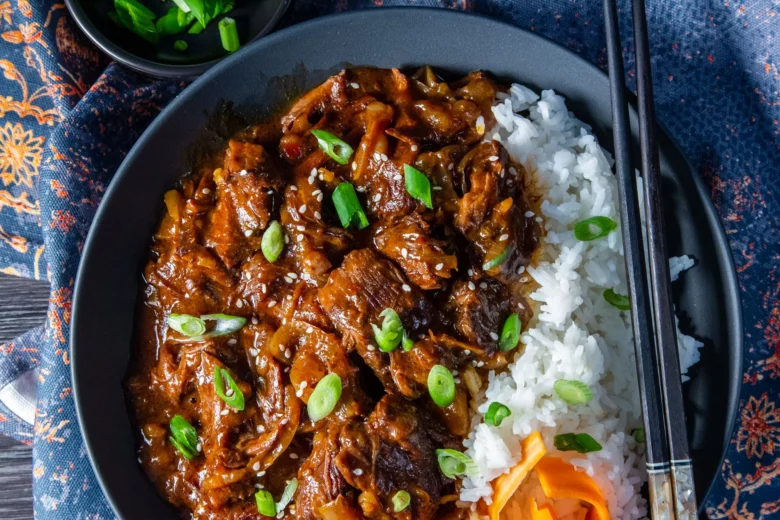
Bulgogi is one of Korea’s most beloved dishes and one of the most misunderstood outside of it. The name translates directly as “fire meat” — bul for fire, gogi for meat — and the dish in its most traditional form is thin slices of highly marbled beef, soaked in a marinade of soy sauce, pear or Asian pear, sesame oil, garlic, and ginger, then cooked over charcoal or a table grill in seconds at high heat, the sugars in the marinade caramelizing against the hot surface into the slightly charred, deeply savory, subtly sweet edges that make the dish extraordinary. It is a dish of fire. It is a dish of speed. It is the precise opposite of what a slow cooker does.
And yet slow cooker Korean beef — bulgogi style — is one of the most popular and most consistently excellent dishes in the entire slow cooker canon. The reason is that the slow cooker takes everything that makes bulgogi’s marinade brilliant — the fruit enzymes that tenderize the beef, the soy and sesame and garlic that flavor it, the sugar that caramelizes — and instead of applying it over seconds at high heat, applies it over hours at low heat, producing a different but genuinely excellent result: beef that is impossibly tender, deeply infused with the marinade flavors throughout rather than just on the surface, sitting in a reduced sauce that has the sweet-savory-sesame character of bulgogi condensed into something even more concentrated and integrated than the grilled original.
It is not bulgogi. It is slow cooker Korean beef in the style of bulgogi — and on its own terms, served over steamed rice with the traditional accompaniments, it is one of the best things a slow cooker can produce from beef.
The Honesty About Slow Cooker Bulgogi
This recipe comes with the same honesty as the Mongolian beef, the warm sangria, and the slow cooker cheesesteak: the slow cooker version is not the same dish as the traditional version, and pretending otherwise does the recipe a disservice.
Traditional bulgogi requires three things that the slow cooker cannot provide: ultra-thin slices of beef (cut to order at a Korean butcher, often frozen and shaved on a meat slicer), a very high-heat cooking surface (charcoal grill or cast-iron table grill), and a cooking time measured in seconds rather than hours. The charred edges, the caramelized surface, the speed — these define the sensory experience of great bulgogi in a way that no low-and-slow method can replicate.
What the slow cooker can provide is the marinade’s flavor — fully developed over hours rather than hours of marinating followed by seconds of cooking — in a beef that is tender beyond what the grilled version achieves, sitting in a sauce that is more concentrated and more complex than the juices of quickly grilled meat. The slow cooker Korean beef is a braised, sauced dish where the bulgogi is a grilled, lightly sauced one. Both are Korean beef. They are different expressions of the same ingredient and the same flavor tradition.
The slow cooker version suits weeknight cooking in a way the traditional version does not — no marinating time required, no special equipment, no technique beyond combining ingredients in the slow cooker and returning to dinner. And it suits serving over rice in a bowl, with all the accompaniments, in the specific format of the bibimbap-adjacent rice bowl that has become one of the most beloved dinner formats of the past decade.
The Marinade and Sauce
The bulgogi marinade is the heart of this dish — the five to six ingredient combination that produces the specific sweet-savory-sesame-garlic character that makes Korean beef immediately recognizable. In the slow cooker version, the marinade functions as both the marinade and the braising sauce simultaneously — it is not applied to the beef for hours and then discarded, it is added to the slow cooker with the beef and reduces during the long cook into the sauce the finished dish is served in.
Soy sauce — a half cup — is the salt and the umami backbone. The fermented depth of soy sauce is foundational to the bulgogi flavor profile. Regular soy sauce is the standard; tamari for gluten-free.
Asian pear or Bosc pear — half a pear, grated on the fine side of a box grater — is the most important and most often omitted ingredient in bulgogi-style recipes outside Korea. Pear contains proteolytic enzymes (specifically actinidin in Asian pear) that break down the proteins in the beef, tenderizing it at a molecular level during the long slow cook in a way that no other marinade component replicates. The pear also contributes a background sweetness and a fruity character that is subtle but present in authentic bulgogi flavor. Asian pear is the most traditional; Bosc pear is the most widely available alternative. Grate rather than chop — the grated pear fully integrates into the sauce. Do not substitute apple, which lacks the same enzymatic action.
Brown sugar — three tablespoons — provides the sweetness that caramelizes at the slow cooker’s low temperature into the slightly sticky, glossy sauce character. Brown sugar’s molasses adds depth beyond plain white sugar.
Sesame oil — one tablespoon, added after cooking — is the aromatic finish. The same late-addition principle as every other recipe in this series: sesame oil’s volatile toasted sesame fragrance evaporates completely during a long slow cook. Added immediately before serving, it is the defining aromatic of the dish. Added at the start, it contributes nothing.
Fresh garlic — five to six cloves, minced or grated — is the aromatic backbone. Grated garlic integrates more smoothly into the sauce than minced.
Fresh ginger — one tablespoon, grated — adds the clean, bright spice note that lifts the soy-sugar base.
Mirin — two tablespoons — is the Japanese sweet rice wine that adds a mellow sweetness and a complexity that plain sugar does not provide. It is available in the Asian foods aisle of most supermarkets. A tablespoon of rice wine vinegar plus a tablespoon of sugar can substitute in a pinch.
Gochujang — one to two tablespoons, optional — is Korean fermented red chile paste: spicy, slightly sweet, deeply savory, and fermented. It is not traditional in all bulgogi recipes but adds a complexity and a Korean-specific depth that significantly elevates the slow cooker version. Start with one tablespoon for a mild heat and a complex sauce; two tablespoons for a more assertive, clearly spiced result.
Green onions — three to four, cut into one-inch pieces — are added to the slow cooker at the start and stir into the sauce. More green onion is scattered raw over the finished dish at serving.
Choosing Your Beef
The beef cut for slow cooker Korean beef is the place where the dish most significantly departs from the traditional bulgogi format — and where the slow cooker has a specific advantage.
Chuck roast, sliced against the grain into thin strips or left as a whole roast and shredded after cooking, is the best choice for the most tender, most deeply flavored result. Chuck’s high collagen content produces a richer sauce and more yielding beef than any other cut after eight hours on LOW. For a shredded presentation — which suits rice bowls and lettuce wraps particularly well — leave the chuck whole, braise for eight hours, and shred directly into the sauce.
Flank steak, sliced thin against the grain, produces a more traditional bulgogi-adjacent presentation — strips of beef rather than shredded chunks. The texture is firmer than chuck, the cook time shorter (four to five hours on LOW for thin strips), and the result closer visually to the grilled version. Partially freeze the flank steak before slicing for cleaner, thinner cuts.
Sirloin, thinly sliced, is the most traditional bulgogi cut outside of ribeye — firmer than chuck, holds its shape, and produces the most recognizably bulgogi-like strips. Cook on LOW for three to four hours for the most tender result without over-softening.
Short ribs, boneless, cut into cubes or left whole and shredded — produce the most indulgent version. Short rib Korean beef has a richness and a fat-forward depth that makes it specifically excellent for special occasions.
The cornstarch coating — optional, borrowed from the Mongolian beef technique — gives the beef a very thin layer of starch that absorbs the sauce during the slow cook, thickening it from the inside and giving it something to cling to. Toss the sliced or cubed beef in two tablespoons of cornstarch before adding to the slow cooker if a thicker, more clingy sauce is desired.
The Finishing Sauce
Slow cooker Korean beef, like Mongolian beef, produces a braising liquid at the end of the cook that needs a final thickening step to reach the glossy, coating consistency that makes the dish look and taste correct when served over rice.
The cornstarch slurry. Two tablespoons of cornstarch mixed with three tablespoons of cold water, stirred into the slow cooker in the final twenty to thirty minutes on HIGH, produces the glossy, slightly clingy sauce that coats the beef and rice beautifully.
The stovetop reduction. Remove the beef, pour the sauce into a saucepan, and reduce over medium-high heat for five to eight minutes. This produces a more controlled, more concentrated sauce and allows for precise consistency adjustment.
The sesame oil finish. Added after thickening, immediately before serving. One tablespoon is the standard quantity. More produces a sauce that reads primarily of sesame rather than Korean beef.
Tips for Perfect Slow Cooker Korean Beef
1. Grate the pear — do not omit it. Grated Asian pear or Bosc pear contains proteolytic enzymes that tenderize beef at a molecular level during the long braise. The pear also contributes the subtle fruitiness that distinguishes bulgogi-style Korean beef from generic soy-sugar beef. It integrates completely into the sauce — it is not detectable as pear in the finished dish. Do not omit it and do not substitute apple.
2. Add sesame oil after cooking. The toasted sesame fragrance of sesame oil evaporates entirely during a long slow cook. Added immediately before serving, it is the most distinctive aromatic of Korean beef. This is the instruction most worth heeding in the entire recipe.
3. Grate the garlic and ginger rather than mincing. Grated garlic and ginger integrate into the sauce more completely than minced — they dissolve into the liquid rather than appearing as identifiable pieces. A Microplane or the fine side of a box grater produces the correct texture.
4. Thicken the sauce before serving. The slow cooker produces a thinner sauce than the finished dish should have. The cornstarch slurry or stovetop reduction is what produces the glossy, rice-coating sauce that makes Korean beef bowls so satisfying.
5. Serve immediately after thickening. The thickened sauce begins to set as it cools. Korean beef is at its best served hot, immediately after the sauce reaches its correct consistency, over freshly steamed rice.
6. Use gochujang at least once. Even one tablespoon of gochujang in the sauce adds a fermented, slightly spicy complexity that is specifically Korean in character and that significantly elevates the dish beyond a generic soy-sugar beef. It is the ingredient most worth adding if it is not already in the pantry.
7. Taste and adjust the sweet-savory balance before serving. The braising liquid concentrates during the long cook. Taste before serving and adjust: a splash of soy sauce if it is too sweet, a teaspoon of brown sugar if it is too savory, a squeeze of fresh lime or a teaspoon of rice wine vinegar if it needs brightness.
8. Scatter raw garnishes generously. The toasted sesame seeds, sliced green onions, and any other raw garnishes are not decorative — they provide textural contrast, freshness, and aromatic complexity that the long-braised beef cannot provide on its own. Be generous.
Building the Korean Beef Bowl
The rice bowl is the format that best suits slow cooker Korean beef — it showcases the beef and its sauce, accommodates all the traditional accompaniments, and produces the specific satisfaction of a well-built bowl.
The rice. Short-grain Japanese or Korean rice — cooked sticky and slightly dense — is the most specifically correct base. Medium-grain rice works well. Long-grain jasmine rice is the least traditional but entirely acceptable. The rice should be freshly cooked and slightly warm, absorbing the sauce from the beef.
The bowl assembly. Rice in the base, a generous portion of Korean beef and its sauce spooned over one section of the rice, the accompaniments arranged in sections around the bowl. This is the bibimbap-influenced presentation — everything visible, each component contributing a different flavor and texture to the spoonful that gathers a bit of everything.
The accompaniments. A fried or soft-boiled egg — the yolk, broken over the bowl, enriches the sauce and the rice in a way that makes the entire bowl taste more complete. Kimchi — fermented, spicy, deeply sour — is the essential Korean accompaniment that provides the fermented tang and heat that cuts through the beef’s sweetness. Steamed spinach or blanched bean sprouts, dressed with sesame oil and a small amount of soy sauce, contribute freshness and a vegetable note. Sliced cucumber with rice vinegar and sesame — cool, acidic, and refreshing. Shredded carrots, sesame seeds, sliced green onions.
The Complete Table
Bowl accompaniments:
- Short-grain white rice — the definitive base
- Fried or soft-boiled egg — essential
- Kimchi — the defining Korean accompaniment
- Sesame spinach or blanched bean sprouts
- Sliced cucumber with rice vinegar and sesame
- Shredded carrots
- Sliced avocado — for richness and creaminess
Garnishes:
- Toasted sesame seeds — essential
- Thinly sliced green onions — essential
- Toasted nori strips — for a seaweed note
- Gochujang or sriracha alongside for extra heat
- Drizzle of sesame oil over the finished bowl
Sides:
- Japchae (Korean glass noodles with vegetables) — for a more elaborate spread
- Korean pickled vegetables (namul)
- Steamed edamame
- Miso soup — for warmth alongside the bowl
Drinks:
- Cold Korean barley tea (boricha) — the traditional pairing
- Japanese lager or Korean Hite/OB beer
- Sparkling water with yuzu or citrus
The Day-After Korean Beef Uses
Leftover slow cooker Korean beef is one of the most versatile leftovers in this collection. Cold from the refrigerator, it is excellent as the filling for Korean beef tacos — a specific and excellent fusion format, in corn or flour tortillas with kimchi slaw and sliced avocado. Reheated with a splash of water in a skillet, it becomes the filling for Korean beef fried rice — the most satisfying possible use of day-old rice. Stirred into ramen noodles with their broth, a soft-boiled egg, and toasted nori, it becomes a Korean beef ramen of exceptional quality. Used as the filling for Korean beef lettuce cups with shredded carrots, sliced cucumber, and hoisin sauce, it produces the freshest possible weekday lunch. The sauce, reserved separately, is a deeply flavored dipping sauce for dumplings, a marinade for grilled chicken, or a glaze for roasted vegetables.
Easy Variations
- Korean beef with gochujang and honey. Add two tablespoons of gochujang and one tablespoon of honey to the sauce. The honey amplifies the gochujang’s sweetness while the gochujang’s heat adds complexity. The resulting sauce is specifically excellent — spicy, sweet, smoky, deeply Korean in character.
- Korean beef lettuce wraps. Serve the shredded Korean beef in butter lettuce leaves with rice, shredded carrots, sliced cucumber, and a drizzle of gochujang mixed with a small amount of sesame oil and rice vinegar. The lettuce wrap format is cooler, lighter, and specifically excellent for warmer weather or when a lighter meal is preferred.
- Korean beef sliders. Pile the slow cooker Korean beef onto brioche slider buns with quick kimchi slaw (shredded cabbage, rice vinegar, gochujang, sesame oil) and a smear of gochujang aioli. The Korean beef slider is one of the best fusion sandwiches in this series.
- Korean beef with daikon. Add one cup of daikon radish, cut into half-inch cubes, to the slow cooker in the final two hours of cooking. The daikon absorbs the sauce beautifully and adds a mildly peppery, slightly sweet radish note that is specifically Korean in character.
- Spicy Korean beef (Yukgaejang style). Add two tablespoons of gochugaru (Korean red pepper flakes) alongside the gochujang. Gochugaru is brighter, fruitier, and less fermented than gochujang — the combination of both produces a layered heat and complexity that is closer to the spicy Korean beef soup tradition.
Make-Ahead and Storage
Make-ahead: The sauce can be mixed up to three days ahead and refrigerated — the flavors improve as the garlic and ginger meld. The beef can be sliced or cubed and combined with the sauce in the slow cooker insert, refrigerated overnight, and cooked directly from the refrigerator the next morning with no additional preparation.
Refrigerator: Korean beef keeps in an airtight container for up to four days. The sauce thickens during refrigeration from the starch and the natural gelatin from the beef. Add a splash of water or broth when reheating and stir to loosen.
Reheating: Gently in a skillet over medium-low heat with a splash of water, or in the microwave at 70 percent power in 60-second bursts, stirring between. Add the sesame oil fresh after reheating — it is heat-volatile and should always be added to warm rather than hot beef.
Freezer: Freezes well for up to two months. Freeze in portions with sauce. Thaw overnight in the refrigerator and reheat as above. The sauce may separate slightly during freezing — stir vigorously while reheating and it will come back together.
Shopping List
The Beef
- 2–2.5 lbs (900g–1.1kg) beef chuck roast (whole, to shred) or flank steak (sliced thin)
- 2 tbsp cornstarch (optional, for coating)
The Marinade/Sauce
- ½ cup (120ml) soy sauce (or tamari for GF)
- 3 tbsp brown sugar, packed
- 2 tbsp mirin
- ½ Asian pear or 1 Bosc pear, grated (approximately 3 tbsp grated)
- 5–6 garlic cloves, grated or minced
- 1 tbsp fresh ginger, grated
- 1–2 tbsp gochujang (optional but strongly recommended)
- 3–4 green onions, cut into 1-inch pieces
The Cornstarch Finish
- 2 tbsp cornstarch + 3 tbsp cold water
The Finish (added after cooking)
- 1 tbsp toasted sesame oil
For the Bowl
- Short-grain or medium-grain rice
- 4–6 eggs (for fried or soft-boiled)
- Kimchi
- Toasted sesame seeds
- Sliced green onions
- Assorted bowl accompaniments (spinach, cucumber, carrots, bean sprouts)
Slow Cooker Korean Beef (Bulgogi Style)
Beef chuck roast or thinly sliced flank steak marinated and braised on LOW for four to eight hours (depending on cut) in a sauce of soy sauce, grated Asian pear, brown sugar, mirin, gochujang, fresh garlic, and fresh ginger — the pear enzymes tenderizing the beef throughout the long cook as the soy-sugar-sesame flavors permeate every fiber. Thickened with a cornstarch slurry to a glossy, coating consistency, then finished with toasted sesame oil added after cooking to preserve its full fragrance. Served over short-grain rice in a bowl with a fried egg, kimchi, sesame spinach, and a generous scatter of toasted sesame seeds and green onions. Slow cooker Korean beef that is not bulgogi but is excellent on its own specific terms.
- Total Time: 8 hours 55 minutes (chuck) / 4 hours 55 minutes (flank)
- Yield: 4–6 servings 1x
Ingredients
The Beef
- 2–2.5 lbs (900g–1.1kg) beef chuck roast OR flank steak, sliced ¼-inch thin against the grain
The Marinade/Braising Sauce
- ½ cup (120ml) soy sauce
- 3 tbsp packed brown sugar
- 2 tbsp mirin
- 3 tbsp grated Asian pear or Bosc pear (about ½ pear)
- 5–6 garlic cloves, grated or finely minced
- 1 tbsp fresh ginger, grated
- 1–2 tbsp gochujang (to taste; optional but recommended)
- 3–4 green onions, cut into 1-inch pieces
- ¼ tsp black pepper
The Cornstarch Slurry (for finishing)
- 2 tbsp cornstarch
- 3 tbsp cold water
The Finish
- 1 tbsp toasted sesame oil — added after cooking, never before
For the Bowl
- Short-grain or medium-grain white rice, freshly steamed
- 1 fried or soft-boiled egg per person
- Kimchi
- Toasted sesame seeds
- Thinly sliced green onions
- Sesame spinach, sliced cucumber, shredded carrots (as desired)
Instructions
For chuck roast (shredded version — 8 hours):
- Combine the sauce. In a bowl, whisk together the soy sauce, brown sugar, mirin, grated pear, grated garlic, grated ginger, gochujang (if using), and black pepper until the sugar is dissolved.
- Build the slow cooker. Place the chuck roast in the slow cooker. Add the green onion pieces around the beef. Pour the sauce over everything, turning the roast to coat.
- Cook. Set to LOW and cook for 8 hours, until the beef is completely tender and falls apart when pressed.
- Shred. Transfer the beef to a cutting board and shred into generous pieces using two forks. Return the shredded beef to the slow cooker.
For flank steak (sliced version — 4 to 5 hours):
- Combine the sauce as above. Toss the thinly sliced flank steak in the sauce in the slow cooker insert, ensuring every piece is coated.
- Cook. Set to LOW and cook for 4 to 5 hours, until the beef is tender and fully cooked through.
Both versions — finishing steps:
- Thicken the sauce. Whisk together the cornstarch and cold water until smooth. Stir into the slow cooker. Switch to HIGH and cook uncovered for 20 to 30 minutes, stirring once or twice, until the sauce is glossy and coats the beef and spoon in a thick layer.
- Add sesame oil. Switch to KEEP WARM. Stir in the toasted sesame oil. Taste and adjust — a splash more soy sauce if needed, a pinch of brown sugar if it needs balancing.
- Build the bowls. Spoon steamed rice into bowls. Ladle the Korean beef and its sauce generously over one section of the rice. Add a fried or soft-boiled egg, kimchi, sesame spinach, sliced cucumber, and shredded carrots in sections around the bowl. Scatter toasted sesame seeds and sliced green onions over everything. Serve immediately.
Notes
- The pear is essential. Grated Asian pear or Bosc pear contains proteolytic enzymes that tenderize beef at a molecular level during the long braise — it is not merely a sweetener. The pear integrates completely into the sauce and is not detectable as pear in the finished dish. Do not omit it and do not substitute apple, which lacks the same enzymatic action.
- Sesame oil goes in after cooking — always. Toasted sesame oil is the most heat-volatile aromatic in this recipe. Added at the start of an eight-hour slow cook, it contributes nothing by the time the lid comes off. Added immediately before serving, it is the defining aromatic note of Korean beef. One tablespoon. After the cook. Every time.
- Gochujang is the upgrade. If gochujang is in the pantry, add it. One tablespoon adds fermented complexity, a hint of heat, and a specifically Korean flavor depth that significantly elevates the dish beyond soy-sugar beef. It is available at most Asian grocery stores, at Whole Foods, and increasingly at standard supermarkets in the international foods aisle.
- Grate the garlic and ginger. Minced garlic produces identifiable pieces in the sauce; grated garlic dissolves into the liquid entirely. The same applies to ginger. Use a Microplane or the fine side of a box grater for both.
- The fried egg is not optional. A fried egg over a Korean beef rice bowl, with the yolk broken and stirred through the rice and sauce, is one of the best things in weeknight dinner cooking. The egg enriches the sauce and the rice together in a way that changes the character of the bowl entirely. Do not omit it.
- Kimchi is the accompaniment. The fermented, spicy tang of kimchi is precisely what the sweet-savory Korean beef needs alongside it — the contrast between the two is central to the dining experience. Store-bought kimchi from the refrigerated section of the grocery store is entirely correct. If kimchi is not available, a quick-pickled cucumber (rice vinegar, sugar, salt, sesame oil, five minutes) provides the necessary acidity.
- Short-grain rice, not long-grain. The sticky, slightly dense texture of short-grain Japanese or Korean rice is what allows the sauce to cling to the bowl and to each spoonful. Long-grain rice absorbs the sauce but does not integrate with it in the same way.
- Prep Time: 15 minutes
- Cook Time: 8 hours on LOW
- Category: Dinner, Main Dish
- Method: Slow Cooking
- Cuisine: American
- Diet: Dairy-Free, Gluten-Free
Frequently Asked Questions
Why is grated pear in a Korean beef sauce? Pear — specifically Asian pear, the most traditional bulgogi ingredient — contains proteolytic enzymes, particularly actinidin and cysteine proteases, that break down beef protein chains at a molecular level. In the traditional grilled bulgogi, the pear works during the marinating period, tenderizing the meat before it hits the grill. In the slow cooker version, the pear works continuously throughout the eight-hour braise, producing beef that is more tender than the same cut would be without it. The pear also contributes a subtle fruitiness and natural sweetness that balances the soy sauce’s saltiness. It dissolves completely into the sauce during the long cook and is not detectable as pear in the finished dish. Do not omit it. Do not substitute apple — Asian pears and Bosc pears have significantly more of the relevant enzymes than apples.
What is gochujang and where do I find it? Gochujang is Korean fermented red chile paste — a thick, deep red condiment made from gochugaru (Korean red pepper flakes), fermented soybeans, glutinous rice, and salt. It is spicy, slightly sweet, deeply savory, and fermented — a complex ingredient with a flavor that has no direct substitute in Western cooking. It is available in Korean or Asian grocery stores in small tubs or squeeze bottles, increasingly at Whole Foods and natural food stores, and at many standard supermarkets in the international foods aisle. If genuinely unavailable, a combination of two teaspoons of sriracha (for heat), one teaspoon of miso (for fermented depth), and one teaspoon of honey (for sweetness) approximates some of its character, though the fermented complexity is difficult to replicate.
Is this actually bulgogi? Not in the traditional sense. Traditional bulgogi uses very thin, marbled ribeye or sirloin, marinated for several hours and cooked over charcoal or a table grill in seconds at extremely high heat, producing charred edges and caramelized surfaces that the slow cooker cannot replicate. This recipe is bulgogi-style — it uses the bulgogi marinade as its sauce and produces Korean beef with the same flavor profile, but through a braising method rather than a grilling method. The result is a different dish: more tender, saucier, less charred, more deeply infused. It is excellent on its own terms. Calling it bulgogi without qualification would be misleading; calling it Korean beef in the style of bulgogi is accurate and honest.
Can I use a different sweetener instead of brown sugar? Yes. Honey produces a similar level of sweetness with a slightly more complex, floral note — two tablespoons of honey for three tablespoons of brown sugar. Maple syrup produces a warmer, more distinctly North American sweetness that is interesting but less specifically Korean in character. Coconut sugar produces a less sweet, more caramel-adjacent result. White sugar works but lacks brown sugar’s molasses depth. In all cases, the balance between sweet and savory — the soy sauce’s saltiness against the sweetener — should be tasted and adjusted before serving. The correct proportion produces a sauce that registers as savory-first with a sweet background note, not sweet-first.
Can I make this without gochujang for a milder version? Yes — the gochujang is optional in this recipe. The sauce without it is sweet, savory, and sesame-forward — excellent and specifically Korean in character from the soy, pear, and sesame combination. The gochujang adds fermented complexity, a hint of heat, and a specifically Korean depth that elevates the dish, but its absence does not make the recipe fail. For children or guests who prefer no heat, omit it and offer gochujang mixed with a small amount of sesame oil as a table condiment for those who want to add it to their individual bowl.
How do I make the perfect fried egg for a Korean beef bowl? Heat a small non-stick skillet over medium heat. Add a teaspoon of neutral oil. Crack one egg into the pan. Cook undisturbed for two to three minutes until the white is fully set and the edges are slightly crispy, but the yolk is still completely liquid — this is the basted or sunny-side-up style. Season with a small pinch of salt. Slide directly onto the rice bowl with the yolk intact. Break the yolk with a spoon or chopstick at the table, stirring it through the rice and sauce. The runny yolk enriches the sauce and the rice in a way that changes the entire character of the bowl. A soft-boiled egg — six to seven minutes in boiling water, immediately transferred to an ice bath, peeled and halved — is the alternative for those who prefer no raw yolk.
What makes this Korean-American rather than traditionally Korean? Traditional Korean bulgogi is made with specific Korean cuts of beef (highly marbled, thinly sliced by a Korean butcher), cooked on traditional equipment (charcoal grill or table grill), and served in the specific Korean meal format of banchan (small side dishes) alongside rice rather than in a single-bowl presentation. The slow cooker method, the use of widely available Western beef cuts, and the rice bowl presentation are all adaptations suited to a Western home kitchen rather than authentic Korean cooking practice. This recipe is a respectful and enthusiastic adaptation of Korean bulgogi flavors in a format accessible to home cooks without access to Korean butchers or traditional cooking equipment — Korean-American in the same sense that many beloved dishes are hyphenated: the flavors are genuinely Korean; the format is adapted for its context.