Every cook has a version of this sauce. It goes by different names in different households — Sunday gravy, meat sauce, Bolognese, red sauce, simply “the pasta sauce” — and it is made from a short list of ingredients that have not changed meaningfully in a hundred years. Ground beef. Tomatoes. Onion. Garlic. Herbs. The details vary by family, by region, by whether the grandmother who taught you the recipe was Italian or Italian-American or simply someone who understood that ground beef and tomatoes, cooked together long enough and properly enough, produce something that tastes like more than the sum of their parts.
The slow cooker version is the weekday cook’s best version of this sauce — not a compromise on the Sunday pot but a different and genuinely excellent result that the slow cooker produces specifically because of its limitations. The slow cooker cannot reduce the sauce aggressively the way a wide, uncovered stovetop pot does. What it does instead is concentrate the flavors within a sealed environment for six to eight hours — the beef and the tomatoes and the herbs and the garlic all intensifying against each other without the moisture escaping, producing a sauce with a depth and a sweetness from the long-cooked tomato that the stovetop version, made in forty minutes, reaches for but cannot fully achieve.
This is the sauce that fills the house with the smell of Sunday while requiring almost nothing. The browning of the beef — ten minutes. The sautéed aromatics — five minutes. Everything into the slow cooker, lid on, six to eight hours of heat. The pasta cooked at the last minute, the sauce ladled over the top, Parmesan grated fresh over everything. It is one of the greatest simple things in home cooking, and the slow cooker makes it available on a Tuesday.
What Makes This Sauce Worth Making From Scratch
The jar of pasta sauce on the shelf is not the enemy of this recipe. It is a reasonable thing on a specific kind of evening. But it is not this sauce, and understanding the difference is worth a moment.
Commercial pasta sauce is made from tomatoes that were processed at industrial speed and seasoned to a middle-point palatability that offends no one and pleases no one specifically. The tomatoes were not allowed to cook long enough to develop the deep, caramelized sweetness that comes from extended cooking — the sauce is heated and bottled, not long-simmered. The herbs are dried and uniform. The beef, if any, is cooked at high speed in industrial conditions and added to a pre-made tomato base. The result is consistent, recognizable, and entirely generic.
Slow cooker ground beef pasta sauce is made from tomatoes and beef that have spent six to eight hours developing a relationship. The beef — browned first for the Maillard browning that commercial sauce skips entirely — breaks down into the tomato during the long cook, its fat rendering into the sauce and enriching it with a body that no amount of jarred tomato achieves. The onion, cooked until sweet and soft, disappears into the sauce and becomes part of its texture. The garlic mellows from sharp to rounded over the hours. The dried herbs — added at the start so they have time to bloom — become part of the sauce’s flavor rather than additions to it. Fresh herbs — basil specifically — are added at the end and taste of fresh basil rather than of cooked seasoning.
The slow cooker does to this sauce what a long Sunday afternoon does to a stovetop sauce — it gives it time. And time, in a tomato-based meat sauce, is the ingredient that no jar can replicate.
The Ground Beef
The fat content of the ground beef is the primary variable in the sauce’s richness, and the choice between fat levels is meaningful.
80/20 ground beef is the correct fat content for slow cooker pasta sauce. The twenty percent fat renders into the tomato during the long cook, enriching the sauce with a body and depth that leaner beef cannot produce. This is the fat content that produces a sauce that coats pasta in the way a good meat sauce should — clinging to the noodle rather than sliding off it.
85/15 is an acceptable alternative and produces a slightly leaner but still excellent sauce. The sauce will be somewhat less rich.
90/10 or leaner is not recommended. Very lean ground beef produces a drier, more granular texture during a long slow cook and contributes less fat to the sauce, resulting in a noticeably thinner, less satisfying result.
The mix. Half beef, half Italian sausage — sweet or hot — is one of the best variations available in the recipe. The sausage adds fennel, more garlic, and a complexity from its additional seasonings that elevates the sauce beyond what straight ground beef produces. Remove the sausage from its casings before browning. The combination is the most common Italian-American upgrade and is specifically excellent.
Browning the beef before it goes in. This point cannot be overstated. Raw ground beef added directly to the slow cooker turns grey, clumps in an unappealing mass, and produces a flat-flavored, visually uninspiring sauce. Ten minutes of browning in a skillet — breaking the beef into small crumbles, cooking until the pink is gone and some browning has begun — produces the Maillard browning that deepens the sauce’s color and flavor. This single step is what most distinguishes a genuinely good slow cooker meat sauce from a mediocre one.
The Tomatoes
The tomatoes are the body and the primary flavor of the sauce, and their quality is directly detectable in the finished dish.
San Marzano whole peeled tomatoes — the DOP-certified Italian variety grown in the volcanic soil near Naples — are the most recommended canned tomato for pasta sauce and for good reason. They are sweeter, less acidic, and more complexly flavored than generic canned tomatoes. Crushed by hand directly into the slow cooker, they produce a sauce with texture and character — partially smooth, with some visible tomato pieces — that is more interesting than uniformly crushed or completely pureed alternatives. The San Marzano label is worth seeking; a good quality substitute in a twenty-eight ounce can is acceptable.
Crushed tomatoes — good quality, not the cheapest available — produce a more uniformly smooth sauce and are the most commonly used form. They require no preparation and dissolve evenly into the sauce during the long cook. Muir Glen and similar mid-tier brands are appropriate.
Tomato paste — two to three tablespoons, cooked with the aromatics before anything goes into the slow cooker — is always included regardless of which tomato form is used. Cooking the paste in the olive oil with the garlic and onion for one to two minutes concentrates its flavor, caramelizes its sugars slightly, and eliminates the raw, slightly metallic edge of uncooked paste. This is the step that deepens the sauce’s color and adds a concentrated tomato backbone.
Diced tomatoes — added alongside crushed tomatoes — contribute tomato pieces that remain partially intact during the long cook and give the finished sauce a chunky, rustic texture. For a chunkier sauce, replace half the crushed tomatoes with a can of diced.
The quantity. One twenty-eight ounce can of crushed or whole tomatoes for a standard batch — enough for four to six generous pasta servings. A double batch uses two cans and serves eight to twelve, making the slow cooker’s capacity worthwhile for large families or meal prep.
The Aromatics
The aromatic base of the sauce — onion, garlic, herbs — is where the sauce’s character beyond tomato and beef is built.
Yellow onion — one large, diced — is the sweet, aromatic foundation. It softens completely during the long cook and becomes part of the sauce’s texture, contributing sweetness that is particularly important in balancing the acidity of the tomatoes. Some cooks grate the onion rather than dice it, producing an onion that dissolves entirely into the sauce and is undetectable as a separate ingredient. Either approach produces a good result.
Garlic — four to six cloves, minced — is the aromatic that does the most work in Italian-American red sauce. A generous quantity. After six to eight hours in the slow cooker, garlic becomes sweet and mellow, losing its raw sharpness completely and contributing a rounded, savory depth.
Dried oregano — one teaspoon — is the defining herb of Italian-American pasta sauce. It blooms slowly in the tomato over the long cook, becoming part of the sauce’s flavor rather than sitting on top of it.
Dried basil — one teaspoon — supplements the fresh basil that goes in at the end. Some long-cooked basil provides the herbal foundation; the fresh basil at serving provides the brightness.
Bay leaves — two — add their quiet, herbal depth to the background of the sauce. Remove before serving.
Red pepper flakes — a quarter teaspoon — add a background warmth that is not identifiable as heat but adds a dimension that makes the sauce taste more complex. Optional but recommended.
Fresh basil — a generous handful, torn, added immediately before serving — is the aromatic finish that makes the sauce smell and taste like a specifically Italian preparation. Added at the start of a six to eight-hour cook, basil loses its aromatic character completely. Added at the end, it provides the bright, herbal, slightly sweet note that is the signature of good Italian red sauce.
The Wine
A half cup of dry red wine added to the skillet after the beef is browned — allowed to bubble and reduce for one minute before everything goes into the slow cooker — is the addition that adds the most complexity for the least effort.
Dry red wine — any inexpensive, drinkable variety — adds acidity, tannin structure, and the specific depth that wine contributes to a tomato sauce. Use the same wine you would drink — the quality of the wine is detectable in the finished sauce. Chianti, Montepulciano, or any Italian-style red is the most appropriate choice. A domestic Merlot or Cabernet works well. Avoid cooking wines — their added salt and inferior quality are detectable.
The reduction. Pouring the wine into the hot skillet after the beef has been transferred to the slow cooker and allowing it to bubble and reduce for one minute captures every remaining flavor compound from the browning process and transfers it to the sauce via the wine. This is the deglazing step that the French dip and cheesesteak recipes use — the same principle applied to pasta sauce.
Without wine. If wine is not available or not wanted, a splash of beef broth performs the deglazing function and a tablespoon of balsamic vinegar adds acidity and depth in compensation. The wine version is better; the without-wine version is entirely good.
Tips for the Perfect Slow Cooker Ground Beef Pasta Sauce
1. Brown the beef before it goes in — always. Raw ground beef in the slow cooker is the primary source of pale, flat, clumped pasta sauce. Ten minutes of browning — breaking into small crumbles, cooking until no pink remains and some browning develops — is the step that produces a dark, richly flavored sauce rather than a grey, flat one. This is not optional.
2. Cook the tomato paste with the aromatics. Tomato paste added raw to the slow cooker contributes a slightly metallic, unintegrated note. Cooked for one to two minutes in olive oil with the garlic and onion, it caramelizes slightly, loses its raw edge, and becomes part of the sauce’s deep, savory foundation.
3. Add fresh basil at serving — not at the start. Fresh basil added to the slow cooker at the beginning of a six to eight-hour cook loses its aromatic character entirely — by the end of the cook it is an unidentifiable dark green leaf contributing nothing. Added immediately before serving, it is the bright, herbal, aromatic finish that makes the sauce taste specifically Italian.
4. Do not open the lid during cooking. Every time the lid comes off, the temperature drops and cooking time extends. The slow cooker’s sealed environment is also responsible for the concentrated, deep flavor of the finished sauce — unnecessary lid-lifting releases the steam that carries those flavor compounds.
5. Stir and taste before adding to pasta. After the long cook, taste the sauce and adjust: a pinch more salt, a small pinch of sugar if the tomatoes are acidic, a crack of black pepper. The sauce should be intensely flavored — the pasta dilutes it slightly on the plate.
6. Season the pasta water properly. The pasta water should taste like the sea — generously salted. Under-seasoned pasta dilutes the sauce’s flavor at the plate. The water is the last opportunity to season the pasta itself, and properly salted cooking water is the most impactful technique note in pasta making.
7. Reserve pasta cooking water. A quarter cup of starchy pasta water stirred into the sauce before serving emulsifies it and helps it cling to the pasta. This is the technique used in every professional Italian kitchen and the step that produces pasta that is coated rather than simply sauced.
8. Finish the pasta in the sauce. For the most integrated result: drain the pasta one minute before it reaches al dente, transfer it to the slow cooker insert (or a wide pan with a portion of the sauce), and toss over low heat for one minute, adding pasta water as needed. The pasta finishes cooking in the sauce, absorbs some of it, and the two become a unified dish rather than pasta with sauce poured over.
Serving the Ground Beef Pasta Sauce
Over spaghetti or rigatoni — the most common and most correct formats. Spaghetti for the most traditional presentation; rigatoni or penne for a tubular pasta that captures sauce inside as well as outside.
The portion. Two to three ladles of sauce per serving, enough to coat and pool slightly at the base of the pasta. More sauce than seems necessary — it absorbs into the pasta and the plate needs the excess.
The Parmesan. Freshly grated Parmigiano-Reggiano over the top — from a wedge, using a Microplane or fine grater. Pre-grated Parmesan in a shaker does not melt the same way and lacks the specific flavor of the real thing. This is the one finishing step that matters enough to be stated categorically.
The presentation. A twist of pasta in the bowl, sauce ladled over, Parmesan grated over the top, two or three torn basil leaves, a drizzle of good olive oil. Nothing else is needed. Everything else is distraction.
The Complete Table
Pasta pairings:
- Spaghetti — the classic
- Rigatoni — sauce fills the tubes and clings to the ridges
- Penne — practical and widely available
- Pappardelle — wide, flat, dramatically sauced
- Bucatini — hollow spaghetti that holds sauce from the inside
- Ziti — specifically correct for a baked pasta version
Sides:
- Garlic bread — the mandatory accompaniment
- Caesar salad — the Italian-American classic alongside pasta
- Simple green salad with vinaigrette
- Roasted broccolini with olive oil and garlic
Garnishes:
- Freshly grated Parmigiano-Reggiano — the only acceptable Parmesan finish
- Torn fresh basil
- A drizzle of good extra virgin olive oil
- Red pepper flakes for those who want heat
Drinks:
- A medium-bodied Italian red — Chianti Classico, Barbera d’Asti, Montepulciano
- Sparkling water with lemon for a clean non-alcoholic pairing
The Day-After Pasta Sauce Uses
Leftover slow cooker ground beef pasta sauce is one of the most versatile leftovers in the home kitchen — and it keeps for five days and freezes for three months, which means a Sunday batch produces a week of dinner solutions. Over pasta again, obviously, but also: as the sauce for a baked ziti — pasta combined with sauce and ricotta, topped with mozzarella, baked until bubbling — which is one of the best uses of leftover meat sauce in existence. As the layer in a lasagna — slow cooker meat sauce is particularly well-suited to lasagna because it is already rich and concentrated enough to not require further reduction. As the filling for stuffed bell peppers with rice and cheese. Spooned over polenta with Parmesan for a quick, deeply satisfying weeknight dinner. Used as the pizza sauce for a homemade pizza — spread thick on the dough, topped with mozzarella and fresh basil. The sauce is the foundation of a week of good eating.
Easy Variations
- Bolognese-style. Replace half the ground beef with ground pork. Add half a cup of whole milk to the slow cooker and a half cup of dry white wine rather than red. Omit the basil and oregano; use thyme and nutmeg. The milk adds a sweetness and a lighter color that distinguishes the Bolognese from the standard red sauce. Cook on LOW for eight hours. The result is closer to a traditional ragù Bolognese than the standard Italian-American version.
- Spicy arrabiata meat sauce. Increase the red pepper flakes to one to one and a half teaspoons and add one tablespoon of Calabrian chile paste or sambal oelek. The heat version of this sauce is specifically excellent over spaghetti with a generous finishing drizzle of good olive oil.
- Sausage and beef sauce. Replace half the ground beef with Italian sausage — sweet, hot, or a combination — removed from casings and browned with the beef. The sausage adds fennel, more garlic, and a complexity from its seasoning blend that elevates the standard sauce into something more specifically Italian-American.
- Sunday gravy. Add bone-in beef short ribs or braised pork ribs directly to the slow cooker alongside the ground beef and sauce. The meat on the bone braises in the sauce for eight hours and enriches it with collagen and deep flavor. Remove the bones before serving and shred the attached meat into the sauce. The result is the dish that Italian-American grandmothers made on Sundays when the pot was on all day.
- Vodka sauce ground beef pasta. In the final thirty minutes of cooking, stir in half a cup of heavy cream and two tablespoons of vodka. The cream enriches the tomato sauce into the characteristic pink-orange of vodka sauce; the vodka contributes volatiles that amplify the tomato’s aromatic compounds. A specifically excellent variation that takes thirty seconds to execute.
Make-Ahead and Storage
Make-ahead: Slow cooker ground beef pasta sauce is the ideal make-ahead sauce. Made on Sunday and refrigerated, it feeds the household through Thursday. Made and frozen in portions, it produces dinner in the time it takes to boil pasta water.
Refrigerator: The sauce keeps in an airtight container for up to five days. It deepens and improves over the first two days as the flavors continue to integrate. Day 3 sauce is often more complex and more balanced than Day 1.
Freezer: Freeze in one-cup or two-cup portions in zip-lock bags or airtight containers for up to three months. Flatten the bags for efficient freezer storage. Thaw overnight in the refrigerator or in a bowl of cold water for a faster thaw. Reheat gently in a saucepan over low heat.
Reheating: Gently in a saucepan over medium-low heat with a splash of water or broth to loosen, stirring frequently. Or in the microwave at 70 percent power in 60-second bursts, stirring between. The sauce is rich — it reheats most evenly and most safely at moderate heat rather than at full power.
Shopping List
The Beef and Aromatics
- 1.5 lbs (680g) ground beef, 80/20
- 2 tbsp olive oil (for browning)
- 1 large yellow onion, diced
- 4–6 garlic cloves, minced
- 2–3 tbsp tomato paste
The Tomatoes
- 1 can (28 oz / 800g) crushed San Marzano tomatoes (or whole peeled, crushed by hand)
The Wine and Liquid
- ½ cup (120ml) dry red wine
The Herbs and Seasoning
- 1 tsp dried oregano
- 1 tsp dried basil
- ¼ tsp red pepper flakes
- 2 bay leaves
- Salt and black pepper to taste
- Pinch of sugar (optional, to balance acidity)
The Finish
- Generous handful fresh basil, torn — added after cooking
For Serving
- 1 lb (450g) spaghetti, rigatoni, or pasta of choice
- Parmigiano-Reggiano wedge for grating
- Good quality extra virgin olive oil for drizzling
Slow Cooker Ground Beef Pasta Sauce
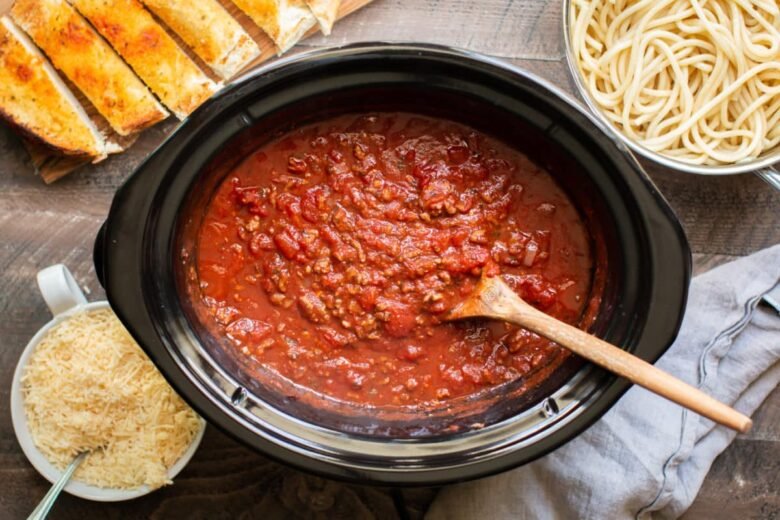
One and a half pounds of 80/20 ground beef browned in batches until deeply caramelized, deglazed with dry red wine, combined with sautéed onion and garlic and cooked tomato paste, then slow-cooked on LOW for six to eight hours with crushed San Marzano tomatoes, dried oregano, basil, bay leaves, and red pepper flakes — the tomatoes sweetening and concentrating over the hours, the beef breaking into the sauce, the herbs blooming fully into the liquid. Fresh basil torn over the top immediately before serving. Ladled generously over properly salted, al dente pasta with freshly grated Parmigiano-Reggiano and a drizzle of olive oil. The sauce that fills the house with the smell of Sunday and asks almost nothing in return.
- Total Time: 6 hours 35 minutes
- Yield: 4–6 servings 1x
Ingredients
The Beef Base
- 1.5 lbs (680g) ground beef, 80/20
- 2 tbsp extra virgin olive oil
The Aromatics
- 1 large yellow onion, finely diced
- 4–6 garlic cloves, minced
- 2–3 tbsp tomato paste
The Tomatoes
- 1 can (28 oz / 800g) crushed San Marzano tomatoes
The Wine
- ½ cup (120ml) dry red wine (or beef broth + 1 tbsp balsamic vinegar)
The Seasonings
- 1 tsp dried oregano
- 1 tsp dried basil
- ¼ tsp red pepper flakes
- 2 bay leaves
- 1 tsp salt, plus more to taste
- ½ tsp black pepper
- Pinch of sugar (optional)
The Fresh Finish
- Large handful fresh basil leaves, torn — added after cooking
For Serving
- 1 lb (450g) spaghetti, rigatoni, or pasta of choice
- Freshly grated Parmigiano-Reggiano
- Extra virgin olive oil for drizzling
Instructions
- Brown the beef. Heat one tablespoon of olive oil in a large skillet over medium-high heat. Add the ground beef and cook, breaking it into small crumbles with a wooden spoon, until no pink remains and the beef is developing some browned color — 8 to 10 minutes. Do not drain all the fat — leave a small amount in the skillet. Transfer the browned beef to the slow cooker.
- Build the aromatics. Reduce heat to medium. Add the remaining tablespoon of olive oil to the same skillet. Add the diced onion and cook for 3 to 4 minutes until softened and translucent. Add the minced garlic and tomato paste and cook for 1 to 2 minutes, stirring constantly, until the tomato paste darkens slightly.
- Deglaze with wine. Pour the dry red wine into the skillet. Stir and scrape up every browned bit from the bottom. Allow to bubble and reduce for 1 minute. Pour the entire contents of the skillet into the slow cooker.
- Add the tomatoes and seasonings. Pour the crushed tomatoes into the slow cooker. Add the dried oregano, dried basil, red pepper flakes, bay leaves, salt, pepper, and sugar if using. Stir everything together thoroughly.
- Cook. Set the slow cooker to LOW and cook for 6 to 8 hours, until the sauce is deeply flavored, slightly thickened, and a rich, dark red. Do not lift the lid during cooking.
- Finish. Remove and discard the bay leaves. Taste the sauce and adjust seasoning — salt, pepper, a pinch more sugar if the tomatoes are acidic. Stir in the torn fresh basil immediately before serving.
- Cook the pasta. Bring a large pot of water to a boil. Season generously with salt — the water should taste of the sea. Cook the pasta according to package directions until 1 minute before al dente. Reserve ½ cup of pasta cooking water before draining.
- Combine and serve. Toss the drained pasta with a ladleful of sauce and a splash of pasta cooking water until the pasta is evenly coated. Divide into bowls. Ladle additional sauce generously over each portion. Finish with freshly grated Parmigiano-Reggiano, torn basil, and a drizzle of good olive oil.
Notes
- Brown the beef — it is not optional. Raw ground beef in the slow cooker is the source of grey, flat, clumped pasta sauce. The browning step produces the Maillard compounds that color and deepen the entire sauce. Ten minutes in a skillet before it goes in is the most impactful single step in the recipe.
- Cook the tomato paste. Tomato paste added raw to the slow cooker contributes a slightly metallic, unintegrated note. One to two minutes in the olive oil with the garlic caramelizes the paste, deepens its flavor, and eliminates its raw edge. This is a thirty-second step with a disproportionate flavor impact.
- Fresh basil always goes in at the end. Six to eight hours of slow cooking destroys every volatile aromatic compound in fresh basil. By the end of the cook, a basil leaf added at the start is a dark, flavorless piece of plant material. Added immediately before serving, fresh basil is bright, herbal, and the aromatic signature of Italian red sauce.
- Do not drain all the beef fat. The fat rendered from the ground beef is flavor. A small amount left in the skillet enriches the aromatics and contributes to the final sauce’s body. Very lean beef produces little to drain; fattier beef may have more — leave a tablespoon or two.
- Reserve pasta cooking water. Starchy pasta water is the sauce’s emulsifier — it helps the sauce cling to the pasta rather than pool at the bottom of the bowl. A quarter cup of pasta water tossed with the pasta and sauce before plating makes a visibly better-coated dish. This is a professional technique that requires no additional ingredients and takes five seconds.
- The sauce improves overnight. This sauce, like every tomato-based meat sauce, is better the next day. If time permits, make it the day before and refrigerate overnight. The flavors integrate and deepen in ways that are immediately detectable. Day 2 pasta sauce is specifically worth planning for.
- Scale up freely. This recipe scales directly — double batch with two pounds of beef and two cans of tomatoes produces eight to twelve servings from the same slow cooker and the same cook time. The slow cooker’s capacity makes large-batch cooking efficient.
- Prep Time: 10 minutes
- Cook Time: 6–8 hours (on LOW)
- Category: Dinner, Main Dish, Meal Prep
- Method: Slow Cooking
Frequently Asked Questions
Why does my slow cooker pasta sauce taste flat and watery? Flat, watery slow cooker pasta sauce has one of three causes. First and most likely: the beef was not browned before going into the slow cooker. Raw ground beef contributes grey color and flat flavor — the Maillard browning from the skillet is the primary source of the sauce’s depth and color. Second: the tomato paste was not cooked with the aromatics, leaving its raw, slightly metallic quality in the finished sauce. Third: the lid was opened repeatedly during cooking, releasing the steam that concentrates flavor and carries aromatic compounds. All three are preventable. If the sauce is already made and tastes flat: reduce it uncovered on the stovetop for ten to fifteen minutes, taste and adjust salt, add a small pinch of sugar and a splash of balsamic vinegar for depth, and stir in a tablespoon of good olive oil at the end for richness.
Can I use fresh tomatoes instead of canned? Yes, in late summer when ripe, flavorful tomatoes are available. Two pounds of ripe plum or Roma tomatoes — cored, roughly chopped, and added to the slow cooker — produce a sauce with a brighter, fresher tomato character than canned. The canned version’s concentrated flavor is an advantage in the slow cooker format specifically — the long cook further concentrates what was already concentrated — making canned tomatoes the year-round default and fresh tomatoes the peak-season variation. If using fresh tomatoes, cook the sauce uncovered on HIGH for the final hour to reduce any excess moisture.
Do I have to use wine? Can I substitute something else? The wine is valuable but not strictly necessary. Its contributions — acidity, tannin structure, the deglazing of the skillet’s browned bits, the depth of flavor from the alcoholic extraction of flavor compounds from the beef and vegetables — can be approximated without it. The best no-wine substitute: use beef broth for deglazing and add one tablespoon of balsamic vinegar and one teaspoon of Worcestershire sauce to the slow cooker. The balsamic provides acidity and depth; the Worcestershire provides umami. The result is a very good sauce. The wine version is a better sauce. If wine is available, use it.
How do I make the sauce less acidic? Tomato acidity is addressed by three approaches: the small pinch of sugar, which suppresses acid perception; the long cooking time, which develops the tomatoes’ natural sugars and reduces their perceived sharpness; and the addition of a small amount of fat — the rendered beef fat or a drizzle of olive oil at the end — which rounds the flavor and makes the acidity feel less prominent. A quarter teaspoon of baking soda added to the sauce in the final thirty minutes of cooking neutralizes some of the acid directly and produces an immediately perceptible softening of the tomato sharpness. Use it sparingly — too much produces a flat, slightly soapy note. If the sauce is consistently too acidic, try San Marzano tomatoes specifically — their lower acid content produces a naturally sweeter, less sharp tomato base.
What is the difference between this and Bolognese? Traditional Bolognese (ragù alla Bolognese) is a very different dish from Italian-American ground beef pasta sauce despite both being meat-and-tomato pasta preparations. Bolognese uses a combination of beef, pork, and sometimes veal; uses wine (both red and white in some versions); uses milk or cream as a softening agent for the meat; uses very little tomato — a small amount of tomato paste or a modest quantity of crushed tomato, far less than the tomato-forward Italian-American version; is cooked for two to four hours on the stovetop; and is served with fresh pasta, specifically tagliatelle, rather than dried spaghetti. Italian-American meat sauce — the sauce in this recipe — is more tomato-forward, simpler in its meat composition, saucier in its final consistency, and served with dried pasta. Both are excellent. They are different dishes made for different purposes, and comparing them as superior or inferior misses the point of each.
Can I add vegetables to this sauce? Yes — a very common and excellent addition. Bell peppers (diced, added at the start), zucchini (diced, added in the final two hours to prevent over-softening), and carrots (finely diced, added at the start as part of the soffritto base alongside the onion and garlic) all work well. A traditional Italian soffritto — onion, carrot, and celery in equal parts — as the aromatic base produces a more complex, more vegetable-forward sauce that is specifically good for the Bolognese-style variation. Mushrooms — cremini, sliced, added at the start — add earthy depth and absorb the meat sauce flavors throughout the long cook.
Why is my sauce too thick after the long cook? Thick sauce after the slow cook is unusual but can occur in slow cookers that run hotter or in slow cookers with less-tight-fitting lids that allow some evaporation. The fix is simple: stir in warm beef broth or pasta cooking water, a quarter cup at a time, until the consistency is correct. Alternatively, stir in an additional half can of crushed tomatoes and cook for another thirty minutes on LOW. For future batches in a fast-running slow cooker, add a quarter cup of additional liquid at the start and check at the six-hour mark before the end of the recommended range.