
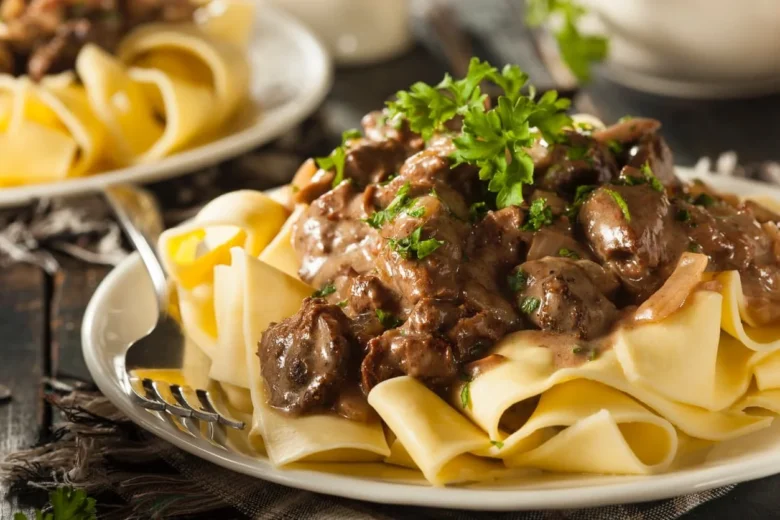
Beef stroganoff is a dish that has traveled farther and changed more than almost any other recipe in the history of European cooking. It began in nineteenth-century Russia — likely in the household of the Stroganov family, wealthy Russian nobility whose chef is credited with the original preparation of beef in a sour cream sauce — and arrived in America after the Second World War in a version that had accumulated cream of mushroom soup, egg noodles, and a distinctly mid-century character that is both charming and genuinely delicious in its own right. The dish that most Americans grew up eating bears limited resemblance to the original Russian preparation, and neither version is wrong, because what stroganoff is, at every point in its evolution, is tender beef in a creamy, tangy, savory sauce served over something starchy.
The slow cooker version is the form of the dish most suited to the beef it uses and the sauce it produces. Beef chuck or stew meat — cuts that the original Russian preparation would never have used — become, after six to eight hours in the slow cooker, exactly the texture that stroganoff requires: falling-apart tender, deeply flavored from the long braise, absorbing the mushroom and onion and broth around them while contributing their own collagen to the sauce base. The sour cream, which goes in at the very end to preserve its freshness and prevent it from curdling, produces the characteristic tang that has defined stroganoff in every iteration of the dish across two centuries of travel. The egg noodles, cooked separately and tossed with butter, are the correct vehicle — wide, slightly chewy, catching the sauce in their folds and curves in a way that rice or plain pasta cannot.
It is a dish that a Russian nobleman’s chef, a 1950s American housewife, and a contemporary slow cooker recipe developer would all recognize as being in the same family, even if they would make it differently. The slow cooker version belongs to all three traditions and to none of them specifically — it is simply beef stroganoff, made well, in the way that best suits the home kitchen.
Why the Slow Cooker Produces Excellent Stroganoff
The defining quality of beef stroganoff is the texture of the beef — and that texture, tender enough to cut with a fork without a knife and yielding enough to break apart with gentle pressure, is the specific outcome of a long, moist braise at low temperature.
The original Russian recipe used beef tenderloin — a cut so naturally tender that it required almost no cooking time, simply a quick sear and a brief sauce. The reason stroganoff’s travel to America involved the substitution of cheaper, tougher cuts is that those cuts — chuck, stew meat, sirloin tips — produce a better result in a braise than tenderloin does. Tenderloin is lean and delicate; it cannot survive hours of low heat without drying out and becoming chalky. Chuck has the fat and the connective tissue that converts to gelatin during a long slow cook, enriching the sauce and keeping the beef impossibly moist through the extended cooking time.
The slow cooker provides exactly the braising environment that makes chuck into great stroganoff beef: enclosed, moist heat at a sustained low temperature, never approaching the boiling point that would tighten the proteins and produce dry, stringy beef. The collagen conversion that produces yielding, gelatinous beef happens at approximately 190°F (88°C) — precisely where the slow cooker on LOW holds the contents for the entire cook.
The sauce is the second argument for the slow cooker. Stroganoff sauce — mushrooms, onion, beef broth, Worcestershire, and sour cream — develops differently over six to eight hours than it does in twenty minutes on the stovetop. The mushrooms release their moisture slowly into the broth, becoming concentrated and deeply savory. The onions caramelize gently. The broth reduces and concentrates. What is added to the sour cream at the end is not raw broth and mushrooms — it is a reduced, concentrated, deeply flavored braising liquid that makes the sour cream sauce richer and more complex than any quick-cooked version.
Choosing Your Beef
The beef decision is the most consequential ingredient choice, and the cut determines both the texture of the finished dish and the richness of the sauce.
Chuck roast, cut into one and a half to two-inch cubes, is the best overall choice — the same reasoning that makes it the best cut for beef tips with gravy and French dip. Chuck’s high collagen content converts to gelatin during the long braise, producing meat that is deeply tender and a sauce base that is silky from the dissolved gelatin. Chuck stroganoff beef shreds slightly into the sauce rather than retaining perfectly distinct cubes — which is not a flaw but a feature. The beef and sauce become part of the same texture.
Stew meat from the grocery store — typically a mix of chuck and round — works well and is the most accessible option. The mixed cut composition means some pieces will be slightly drier (the round) and some richer (the chuck) — overall an excellent result.
Sirloin tips, cut into cubes, produce a slightly leaner result with less collagen contribution to the sauce. The beef holds its shape better than chuck and produces distinct, sliceable cubes in the finished dish. A slightly thinner sauce results — compensate with the cornstarch slurry.
The sear. As with every beef braise in this series, searing the cubed beef in batches before it goes into the slow cooker produces a darker, richer braising liquid. Work in batches, never crowd the pan, and deglaze the skillet with a splash of broth to capture every browned bit. The fond from the sear colors and deepens the finished sauce measurably.
The Mushrooms
Mushrooms are the defining vegetable of beef stroganoff — not an optional addition or a vegetable side, but a structural component of both the sauce’s flavor and its texture.
Cremini mushrooms (also sold as baby bella or baby portobello) are the best all-around choice. They have more flavor than white button mushrooms — an earthier, slightly meatier character — and hold their shape better during the long slow cook. Eight ounces for a full batch is the starting point; twelve ounces for a more mushroom-forward result.
Button mushrooms are the most accessible and the most traditionally American stroganoff mushroom. They soften more completely than cremini during the long cook and contribute a lighter, cleaner mushroom note.
A combination of cremini and dried porcini — an ounce of dried porcini rehydrated in a half cup of warm water, then added to the slow cooker along with the strained soaking liquid — produces the most deeply mushroom-flavored stroganoff sauce in this recipe. The porcini soaking liquid, strained through a fine cloth to remove any grit, adds a concentrated mushroom umami that doubles the depth of the sauce. This is the variation most worth trying for a dinner party version.
Sliced or whole? Sliced mushrooms for a standard batch — they distribute through the sauce evenly and some soften into the braise while others remain identifiable. Whole small mushrooms for a more rustic presentation where the mushrooms are a visible component on the plate rather than woven into the sauce.
The Sauce Base
The stroganoff sauce is built from several components, each contributing to the finished character of the dish.
Beef broth — one and a half cups — is the braising liquid and the sauce base. Use a good quality broth or beef stock. The broth reduces significantly during the six to eight hour cook, concentrating its flavor into the foundation that the sour cream enriches at the end.
Worcestershire sauce — two tablespoons — adds the umami depth and the slightly acidic, fermented character that is one of the defining background notes of American stroganoff.
Dijon mustard — two teaspoons — adds sharpness and a subtle emulsifying quality to the sauce. It does not make the stroganoff taste of mustard; it makes the sauce taste more complete and slightly more complex.
Tomato paste — one tablespoon, cooked briefly with the onion before going into the slow cooker — adds body, color, and a savory depth that is not identifiable as tomato in the finished sauce but that is felt as the sauce tasting more complete.
Onion — one large yellow onion, diced — is the sweet, aromatic base. It softens completely during the long cook and becomes part of the sauce rather than a distinct vegetable.
Garlic — three to four cloves, minced — adds aromatic depth that mellows and sweetens over the long cook.
Thyme — fresh sprigs or half a teaspoon of dried — is the herb note that complements both the beef and the mushrooms.
The Sour Cream: The Critical Finishing Step
Sour cream is the ingredient that defines stroganoff — the tangy, creamy finish that takes the dish from a beef and mushroom braise into something specifically and unmistakably stroganoff. It is also the ingredient most likely to be handled incorrectly, and incorrect handling produces curdled, grainy sauce that ruins an otherwise excellent dish.
Sour cream curdles when added to very hot liquid. The protein structure of sour cream breaks down and separates when exposed to the high temperatures of a boiling or near-boiling sauce. The result is small white curds floating in a greasy liquid — not the smooth, creamy, integrated sauce that stroganoff requires.
The correct method. Remove the slow cooker from heat entirely — switch to KEEP WARM — before adding the sour cream. Temper the sour cream by adding a ladleful of the warm (not boiling) braising liquid to the sour cream in a separate bowl and whisking until smooth. This brings the sour cream up to the temperature of the braising liquid before it goes into the slow cooker. Then stir the tempered sour cream mixture back into the slow cooker and combine thoroughly. The result is smooth, integrated, properly textured stroganoff sauce.
The quantity. One cup of full-fat sour cream for a full batch produces the right richness. Low-fat or non-fat sour cream is significantly more prone to curdling and produces a thinner, less satisfying sauce. Full-fat sour cream is the correct ingredient.
Greek yogurt as a substitute. Full-fat Greek yogurt, used with the same tempering technique, produces an acceptable sour cream substitute with a slightly tangier, slightly lighter result. It is more prone to curdling than sour cream — the tempering step is even more important when using Greek yogurt.
Crème fraîche is the most stable substitute — its higher fat content makes it significantly less likely to curdle and it can be stirred directly into the warm sauce without tempering. The result is less tangy but more silky than the sour cream version. For a dinner party where the risk of curdled sauce is unacceptable, crème fraîche is the safest choice.
The Cornstarch Thickener
Slow cooker beef stroganoff, like every other braised dish in a slow cooker, produces a thinner sauce than the stovetop version — the enclosed environment traps moisture rather than evaporating it. The sour cream adds body, but the full sauce typically needs a cornstarch slurry to reach the clingy, coating consistency that stroganoff should have.
The timing. The cornstarch slurry goes in thirty minutes before the sour cream, not after. Adding cornstarch after the sour cream can break the sauce’s emulsion. The sequence: cornstarch slurry at the thirty-minute mark, cook on HIGH for twenty to thirty minutes until thickened, switch to KEEP WARM, temper and add the sour cream, stir, serve.
The quantity. Two tablespoons of cornstarch mixed with three tablespoons of cold water produces the correct thickness for most batches. More if the sauce is very thin; less if it is already reducing to a reasonable consistency.
The Egg Noodles
Wide egg noodles are the correct pasta for beef stroganoff — not a historical requirement but a textural one. Their broad, flat, slightly wavy form catches sauce in a way that thin spaghetti or smooth penne cannot, and their slightly eggy richness complements the sour cream sauce without competing with it.
Wide egg noodles — the standard grocery store dried variety — are the most common and most practical choice. Cook according to package directions in heavily salted water until just al dente, drain, and toss immediately with a generous knob of butter. The butter keeps the noodles from sticking and adds richness that suits the rich stroganoff sauce.
Fresh egg noodles, if available, cook in two to three minutes and produce a silkier, more tender result than dried. Particularly good for a dinner party version.
Pappardelle — wide, flat pasta from Italy — is an excellent substitute if egg noodles are unavailable. Its broad surface area and slight egg content make it a near-perfect stroganoff vehicle.
The toss. After draining, toss the noodles with butter and a small pinch of salt while still hot. Do not rinse — the starch on the noodle surface helps the sauce cling. Serve immediately — noodles left to sit clump and become gummy. If timing requires a wait, toss with a splash of pasta cooking water to keep them separate.
Tips for Perfect Slow Cooker Beef Stroganoff
1. Sear the beef in batches — do not crowd the pan. The Maillard browning on the beef surface and the deglazed fond color and deepen the entire sauce. Crowded beef steams rather than browns — work in two to three batches for proper caramelization.
2. Temper the sour cream before adding it. Cold sour cream added directly to hot liquid curdles. Temper by whisking a ladleful of warm braising liquid into the sour cream in a separate bowl before stirring the mixture back into the slow cooker. This is the single technique that most determines whether the finished stroganoff sauce is smooth or grainy.
3. Add sour cream at KEEP WARM, not LOW. The sour cream goes in after the slow cooker is switched off from LOW to KEEP WARM. The lower temperature of KEEP WARM is the correct environment for sour cream — warm enough to incorporate, cool enough not to curdle.
4. Thicken before adding sour cream. The cornstarch slurry goes in thirty minutes before the sour cream, while the slow cooker is still on HIGH. Adding thickener after the sour cream risks breaking the sauce.
5. Use full-fat sour cream. Low-fat and non-fat versions curdle more easily, produce a thinner sauce, and contribute less of the richness that makes stroganoff what it is. Full-fat sour cream is the correct ingredient.
6. Season at the end. The broth and Worcestershire reduce significantly during the long cook, concentrating their salt. Season only after tasting the finished sauce — before the sour cream adds its own tang, and after the thickening is complete.
7. Cook the noodles at the last minute. Egg noodles cooked too far in advance sit and clump, absorbing butter and losing the freshness that makes them the right vehicle for the sauce. Start the noodles fifteen minutes before serving.
8. Reserve pasta cooking water. A splash of starchy pasta cooking water stirred into the plated stroganoff loosens the sauce if it has thickened too much while waiting. It emulsifies the sauce more effectively than plain water or broth.
Serving the Beef Stroganoff
Over buttered egg noodles is the correct and definitive serving. A generous mound of wide buttered egg noodles, topped with a ladle of the beef and mushroom stroganoff — enough sauce to coat the noodles and pool slightly on the plate — finished with a spoonful of additional sour cream over the top, a scatter of fresh flat-leaf parsley, and a crack of black pepper. This is the plate.
Over mashed potatoes. Stroganoff over creamy, buttery mashed potatoes is the alternative that rivals the noodle version — the potato absorbs the sauce in a different way and the richness of the two together is deeply satisfying for cold-weather eating.
Over rice. White rice is the most neutral base and lets the stroganoff flavors come forward most clearly. Long-grain rice is the correct choice — fluffy and dry, not sticky.
The garnish. Fresh flat-leaf parsley, finely chopped, is the essential finish — its brightness cuts the richness of the sour cream sauce. A small additional dollop of sour cream over the finished plate is both garnish and indicator of the dish’s defining character. A crack of coarse black pepper. Nothing else is needed.
The Complete Table
Sides:
- Buttered egg noodles — the definitive base
- Steamed green beans with butter and lemon — fresh and bright against the richness
- Roasted asparagus — clean and simple
- A simple cucumber and dill salad with sour cream dressing — Russian-inspired and specifically correct
- Crusty bread for the sauce — the practical addition that no one complains about
Drinks:
- A medium-bodied red wine — Pinot Noir, Côtes du Rhône, or a light Zinfandel
- A crisp, unoaked white — Chablis or Pinot Grigio cuts through the richness
- Sparkling water with lemon for a clean, neutral pairing
The Day-After Stroganoff Uses
Leftover beef stroganoff — refrigerated in its sauce, without the noodles — is one of the best reheatable leftovers in this collection. The sauce thickens overnight into a rich, deeply flavored stew that reheats gently on the stovetop with a splash of broth to loosen. Served over fresh noodles cooked the next day, it is often better than the first serving — the beef has absorbed more of the sauce overnight, the flavors have integrated further, and the sour cream note has mellowed into the dish. Spooned into a baked potato and topped with a small additional spoonful of sour cream and chives, it becomes a loaded baked potato that requires no further justification. Used as the filling for a beef and mushroom pie — poured into a deep baking dish, topped with shortcrust or puff pastry, and baked at 400°F (200°C) until the pastry is golden — it becomes a dinner pie of specific excellence.
Easy Variations
- Stroganoff with porcini mushrooms. Replace one ounce of the cremini mushrooms with dried porcini, rehydrated in warm water. Add the mushrooms and the strained soaking liquid to the slow cooker. The depth of mushroom flavor in the finished sauce is significantly more complex and specifically excellent.
- Stroganoff with brandy or dry sherry. Add two tablespoons of brandy or dry sherry to the skillet with the onion and tomato paste, allowing it to bubble and reduce before adding to the slow cooker. The spirit adds a subtle complexity and a slightly more Russian character to the sauce.
- Chicken stroganoff. Replace the chuck beef with two pounds of bone-in chicken thighs. Cook on LOW for five to six hours until tender and shreddable. The chicken version is lighter, faster, and specifically excellent for those who prefer poultry — the sour cream sauce works equally well with chicken.
- Vegetarian mushroom stroganoff. Omit the beef entirely. Use four cups of mixed mushrooms (cremini, shiitake, portobello) and replace the beef broth with vegetable broth enriched with two tablespoons of soy sauce for umami depth. The mushroom-forward version is remarkably satisfying and is the best-adapted slow cooker vegetarian stroganoff.
- Stroganoff with smoked paprika. Add one teaspoon of smoked paprika to the sauce ingredients. The smoky, slightly sweet paprika adds a specifically Eastern European character that deepens the dish and is historically plausible — paprika is widely used in Russian and Hungarian cooking traditions.
Make-Ahead and Storage
Make-ahead: Stroganoff is an excellent make-ahead dish with one important modification: do not add the sour cream until the day of serving. The beef and sauce (without sour cream) can be made up to two days ahead and refrigerated. On serving day, reheat in the slow cooker on LOW for one to one and a half hours, thicken if needed with a fresh cornstarch slurry, then add the tempered sour cream immediately before serving.
Refrigerator: Stroganoff with sour cream already incorporated keeps for three days. The sauce may appear slightly broken after refrigeration — stir vigorously over gentle heat and it will come back together. Stroganoff without sour cream keeps for four to five days and is more stable for storage.
Reheating: Always gently — low heat on the stovetop, stirring frequently, with a splash of beef broth to loosen. Never boil reheated stroganoff with sour cream already in it — the boiling point will break the sauce. Microwave at 60 percent power in 60-second bursts, stirring between each.
Freezer: Freeze without the sour cream for up to three months. Thaw overnight in the refrigerator, reheat gently, thicken with a fresh cornstarch slurry if needed, and add freshly tempered sour cream before serving. Sour cream does not freeze well and should always be added fresh.
Shopping List
The Beef
- 2–2.5 lbs (900g–1.1kg) beef chuck roast, cut into 1½–2 inch cubes
- 2 tbsp neutral oil (for searing)
- Salt and black pepper
The Vegetables
- 8 oz (225g) cremini mushrooms, sliced
- 1 large yellow onion, finely diced
- 3–4 garlic cloves, minced
The Sauce
- 1½ cups (360ml) beef broth
- 2 tbsp Worcestershire sauce
- 2 tsp Dijon mustard
- 1 tbsp tomato paste
- ½ tsp dried thyme (or 3 sprigs fresh)
- 2 bay leaves
The Thickener
- 2 tbsp cornstarch + 3 tbsp cold water
The Finish
- 1 cup (240ml) full-fat sour cream — added after cooking
- Salt and black pepper to taste
For Serving
- 12 oz (340g) wide egg noodles
- 2 tbsp unsalted butter (for the noodles)
- Fresh flat-leaf parsley, finely chopped
- Additional sour cream for dolloping
Slow Cooker Beef Stroganoff with Egg Noodles
Cubes of beef chuck seared until deeply browned and the skillet deglazed, slow-cooked on LOW for six to eight hours with cremini mushrooms, onion, garlic, beef broth, Worcestershire, Dijon, and tomato paste — emerging as impossibly tender beef in a deeply flavored, concentrated mushroom-beef braising liquid. Thickened with a cornstarch slurry, then finished with full-fat sour cream tempered carefully to prevent curdling and stirred through at KEEP WARM for a smooth, tangy, creamy sauce. Served over wide egg noodles tossed in butter, with fresh parsley and a dollop of sour cream over the top. Beef stroganoff made the slow cooker way — the most tender, most deeply flavored version of a dish that has traveled two centuries and arrived in a better place than it started.
- Total Time: 7 hours 30 minutes
- Yield: 6–8 servings 1x
Ingredients
The Beef
- 2–2.5 lbs (900g–1.1kg) beef chuck roast, cut into 1½–2 inch cubes
- 2 tbsp neutral oil
- 1½ tsp salt
- ½ tsp black pepper
The Vegetables and Aromatics
- 8 oz (225g) cremini mushrooms, sliced
- 1 large yellow onion, finely diced
- 3–4 garlic cloves, minced
- 1 tbsp tomato paste
The Braising Liquid
- 1½ cups (360ml) beef broth
- 2 tbsp Worcestershire sauce
- 2 tsp Dijon mustard
- ½ tsp dried thyme (or 3 fresh sprigs)
- 2 bay leaves
The Thickener
- 2 tbsp cornstarch
- 3 tbsp cold water
The Sour Cream Finish
- 1 cup (240ml) full-fat sour cream, at room temperature
For Serving
- 12 oz (340g) wide egg noodles
- 2 tbsp unsalted butter
- Fresh flat-leaf parsley, finely chopped
- Additional sour cream for dolloping
- Coarsely cracked black pepper
Instructions
- Season and sear the beef. Pat the beef cubes completely dry with paper towels. Season generously on all sides with salt and black pepper. Heat the oil in a large heavy-bottomed skillet over medium-high heat until shimmering. Working in two to three batches — never crowding the pan — sear the beef cubes on all sides until deeply browned, 2 to 3 minutes per side. Transfer each seared batch to the slow cooker.
- Cook the aromatics. Reduce the skillet to medium heat. Add the diced onion to the same skillet and cook, scraping up any browned bits, for 3 to 4 minutes until softened. Add the minced garlic and tomato paste and cook for 1 to 2 minutes, stirring constantly, until the tomato paste darkens slightly.
- Deglaze. Pour a splash of beef broth into the skillet and scrape every remaining browned bit from the bottom. Pour the entire contents of the skillet — onion, garlic, tomato paste, deglazing liquid — into the slow cooker.
- Build the slow cooker. Add the sliced mushrooms to the slow cooker around and over the beef. In a small bowl or measuring jug, whisk together the remaining beef broth, Worcestershire sauce, and Dijon mustard. Pour over the beef and mushrooms. Add the thyme and bay leaves.
- Cook. Set the slow cooker to LOW and cook for 6 to 8 hours, until the beef is completely tender and falls apart when pressed gently with a spoon.
- Thicken. Thirty minutes before serving, whisk together the cornstarch and cold water until smooth. Stir the slurry into the slow cooker. Switch to HIGH and cook, uncovered, for 20 to 30 minutes until the sauce has thickened to a coating consistency. Remove and discard the bay leaves and thyme sprigs.
- Add the sour cream. Switch the slow cooker to KEEP WARM. In a medium bowl, whisk the room-temperature sour cream together with a ladleful (approximately ½ cup) of the warm braising liquid from the slow cooker until completely smooth — this is the tempering step. Stir the tempered sour cream mixture back into the slow cooker and combine thoroughly. Taste and adjust seasoning with salt and black pepper.
- Cook the noodles. Bring a large pot of heavily salted water to a boil. Cook the egg noodles according to package directions until just al dente. Reserve ½ cup of pasta cooking water. Drain and immediately toss with the butter.
- Serve. Divide the buttered noodles among bowls or plates. Ladle the beef stroganoff generously over the top. Finish with a small additional dollop of sour cream, a generous scatter of fresh parsley, and coarsely cracked black pepper. Serve immediately.
Notes
- Temper the sour cream — this step is non-negotiable. Cold sour cream stirred directly into hot slow cooker liquid curdles into white granules floating in a greasy sauce. Tempering — whisking a ladleful of the warm (not boiling) liquid into the sour cream before it goes into the slow cooker — prevents this entirely. Remove the slow cooker from LOW to KEEP WARM first. Take 60 seconds for the tempering step. The smooth, creamy sauce that results is the entire point of the dish.
- Full-fat sour cream only. Low-fat and non-fat sour cream curdle more easily, produce a thinner, less satisfying sauce, and taste noticeably different in the finished dish. Full-fat is the correct ingredient. There is no adequate substitute in this application.
- Thicken before adding sour cream — not after. The cornstarch slurry goes in thirty minutes before the sour cream step. Adding cornstarch to a sour cream-containing sauce risks breaking its emulsion. The sequence matters: thicken first, then temper and add the sour cream.
- Room temperature sour cream tempers more easily. Cold sour cream from the refrigerator tempers less smoothly and is more prone to some graining at the point of contact with the warm liquid. Remove the sour cream from the refrigerator thirty minutes before cooking ends.
- Do not overcook the noodles. Wide egg noodles cooked past al dente become soft and break apart when tossed with the butter and sauce. They should retain some chew — slightly firm at the center — when drained. They will continue to cook very slightly from their own residual heat.
- Keep noodles and sauce separate until serving. If there is a timing gap between the stroganoff being ready and dinner being served, keep the noodles in a warm bowl tossed with butter and the stroganoff in the slow cooker on KEEP WARM. Combine on the plate — never combine in the pot or the noodles will absorb all the sauce and swell past their ideal texture.
- Freeze without the sour cream. Sour cream does not freeze and thaw cleanly — it separates and becomes grainy. Always freeze the beef-and-sauce portion without the sour cream and add freshly tempered sour cream when reheating from frozen.
- Prep Time: 20 minutes
- Cook Time: 6–8 hours (on LOW)
- Category: Comfort Food, Dinner, Main Dish
Frequently Asked Questions
My sour cream curdled and the sauce is grainy. Can I fix it? A curdled stroganoff sauce can be partially recovered. If the curdling is minor — small grains visible throughout — whisk the sauce vigorously over very low heat while adding a splash of warm broth. The agitation and additional liquid can re-emulsify the sauce to an acceptable smoothness. If the curdling is severe — large white curds floating in separated liquid — strain the sauce through a fine mesh strainer to remove the curdled solids. Return the liquid to the slow cooker and stir in fresh, carefully tempered sour cream at KEEP WARM. The flavor of the recovered sauce is essentially unchanged; the texture will be slightly thinner from the loss of the curdled solids. Prevention is far preferable to recovery — the tempering step prevents curdling almost entirely.
Can I add the sour cream at the start instead of the end? No. Sour cream added at the start of a six to eight-hour slow cook will curdle within the first hour as the sauce approaches the temperature at which its proteins break down. By the end of the cook, the sauce will be a separated, greasy liquid with no resemblance to the smooth, creamy stroganoff sauce. Sour cream is always a finishing ingredient — added at the very end, off or on KEEP WARM heat, with tempering. This is not optional.
What pasta can I use instead of egg noodles? Wide egg noodles are the most specifically correct choice for stroganoff — their broad, wavy surface catches and holds the sauce, and their slight egg richness complements the sour cream base. Pappardelle is the most similar alternative and is equally excellent — broad, flat, egg-enriched pasta that suits the rich sauce. Fettuccine works well. Rigatoni’s ridged tubes catch the sauce and hold beef pieces effectively. Regular spaghetti or linguine are less ideal — too thin and smooth to properly carry the stroganoff’s thick sauce. For a gluten-free version, gluten-free wide pasta or rice noodles are acceptable alternatives, though the texture is slightly different.
Can I use cream instead of sour cream? Cream produces a different dish — richer, less tangy, more uniformly smooth. The tang of the sour cream is what defines stroganoff as stroganoff rather than a cream of mushroom beef dish. If cream is substituted, add a tablespoon of lemon juice or a teaspoon of white wine vinegar to the finished sauce to approximate the acidic note. Crème fraîche — more stable than sour cream and less prone to curdling — is the best cream-based substitute, with a slightly less pronounced tang than sour cream but a richer body. Heavy cream alone produces a dish that is very good but is not stroganoff in the way that sour cream makes it.
How do I know when the beef is done? The beef is done when it yields completely to gentle pressure from a spoon — it should break apart without resistance, feeling soft and giving throughout rather than firm at the center. An instant-read thermometer inserted into the largest piece should read above 195°F (90°C) — this is above the food safety threshold and into the temperature range where collagen conversion is complete and the beef is at its most tender. The practical check: press gently with a spoon. If there is any resistance, the beef needs more time. Low and slow means the beef is ready when it is ready — not at a specific hour.
Can I make this on HIGH to save time? Yes — HIGH produces a cooked, shreddable beef in three to four hours. The result is noticeably different from the LOW eight-hour version: the collagen conversion is less complete, the sauce is thinner and less developed, and the beef is slightly tighter in texture. The sour cream finish and the overall technique are identical — only the cook time and the depth of the finished dish differ. For weeknights when six to eight hours is not available, HIGH for three to four hours produces a very good stroganoff. For the weekend version when the best possible result is the goal, LOW for six to eight hours produces a measurably better one.
What is the difference between beef stroganoff and a beef stew? Beef stroganoff and beef stew are closely related dishes — both are long-braised beef with vegetables in a liquid sauce — but they differ in several specific ways. Stroganoff uses mushrooms as its primary vegetable rather than the root vegetables (carrots, potatoes, turnips) of a stew. Stroganoff’s sauce is finished with sour cream, giving it a tangy, creamy character that stew does not have. Stroganoff’s sauce base is thinner and less vegetable-dense than a stew — it is more of a gravy than a chunky sauce. Stroganoff is served over noodles or rice rather than with the vegetables as the primary accompaniment. And stroganoff has a specific seasoning profile — Worcestershire, Dijon, thyme — that is distinct from the more neutral seasoning of a standard beef stew. They share a technique and a comfort food register while being distinctly different dishes.