
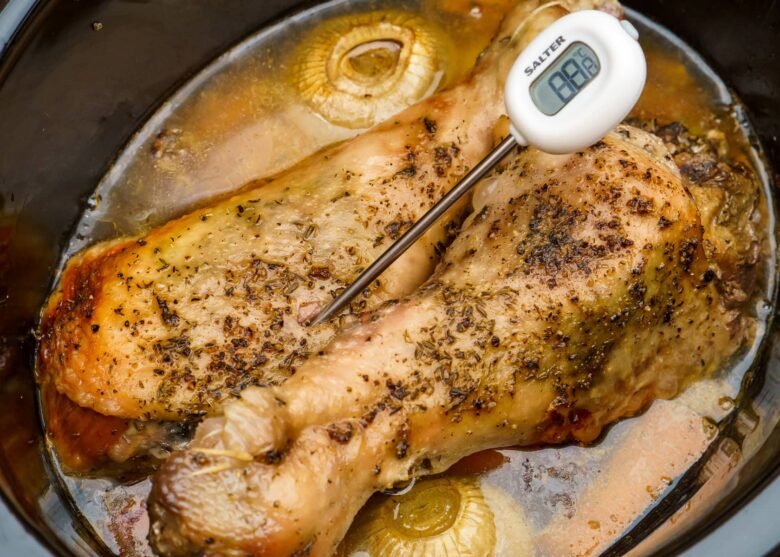
There is something undeniably primal and satisfying about a turkey leg. It is one of the few foods that arrives at the table looking exactly like what it is — a generous, substantial piece of meat that demands to be picked up with both hands and eaten with complete commitment. It has been the iconic food of Renaissance fairs and state fairs and county fairs for generations, and for good reason: a properly cooked turkey leg, tender to the bone and deeply flavored, is one of the most satisfying eating experiences going.
The slow cooker is, without any hesitation, the best way to cook turkey legs at home. Turkey legs are large, muscular, and full of connective tissue — they need long, patient, moist heat to break down that tissue into gelatin and produce the fall-off-the-bone tenderness that makes them so rewarding. An oven at 350°F can get there, but it takes time and vigilance and the legs can dry out at the surface before the interior reaches the right texture. The slow cooker solves all of that. Low, steady, enclosed heat for 6 to 8 hours produces legs that are uniformly tender, deeply flavored all the way through, and practically falling from the bone before you even pick them up.
A quick finish under the broiler adds the golden, caramelized skin that the slow cooker alone cannot produce — and takes about four minutes. The result looks like something that took considerable skill and attention. It did not.
Why Turkey Legs Are Worth Making at Home
The turkey leg has an unfair reputation as a carnival food — fun to eat at an event but not something you’d make at home for dinner. That reputation deserves to be dismantled.
A home-cooked slow cooker turkey leg is a genuinely excellent piece of meat. The dark meat of the turkey leg is richer, more flavorful, and more forgiving of long cooking than the breast. It has a deeper, more pronounced turkey flavor than the thigh — almost game-like in its richness when properly seasoned and slow-cooked. It is economical — turkey legs are often among the least expensive cuts at the butcher counter. And a single large turkey leg is a generous, satisfying serving for one person, making it easy to scale up or down for any number of guests.
For a holiday table where the whole turkey feels like too much or Thanksgiving for two, slow cooker turkey legs are the answer. For a game day spread, a weeknight dinner that wants to be something special, or a meal that needs to cook unattended all day — turkey legs deliver every time.
Choosing Your Turkey Legs
Turkey legs vary considerably in size and the size matters for timing.
Standard turkey legs from a supermarket typically weigh between 1 and 1.5 lbs each. They fit comfortably in a standard 6-quart slow cooker and cook in 6 to 8 hours on LOW.
Large turkey legs — the kind you find at warehouse stores or specialty butchers — can weigh up to 2 lbs or more each. These need the full 8 hours on LOW and may need to be positioned slightly differently in the slow cooker to fit with the lid on.
Fresh vs frozen: Fresh turkey legs are ideal. If using frozen, thaw completely in the refrigerator for 24 to 48 hours before cooking. Never slow cook frozen turkey legs — the low heat is insufficient to bring the meat safely through the temperature danger zone quickly enough from a frozen state.
Bone-in, skin-on is the only way to buy and cook turkey legs. The bone conducts heat to the interior of the meat during cooking and contributes flavor and collagen to the braising liquid. The skin protects the meat from drying out and crisps beautifully under the broiler at the end. Removing either before cooking is a mistake.
The Dry Rub
A good dry rub is the foundation of flavor in this recipe. Applied generously to every surface of the legs and left to penetrate the meat — ideally overnight in the refrigerator, or at minimum 30 minutes at room temperature — the rub seasons the meat deeply and forms the base of the caramelized crust that develops under the broiler.
Smoked paprika is the star of the rub. Its deep, sweet smokiness gives the legs a barbecue-adjacent character and produces a beautiful dark red color on the finished skin. Use at least a full teaspoon per leg.
Garlic powder and onion powder provide savory depth without the sharpness of fresh alliums. They integrate into the rub smoothly and season the surface of the meat evenly.
Brown sugar in the rub caramelizes under the broiler to produce the glossy, slightly sticky exterior that makes slow-cooked turkey legs look so dramatic. It also balances the savory and smoky elements with a touch of sweetness. Do not omit it.
Dried thyme and rosemary add an herbal note that pairs particularly well with turkey’s natural flavor.
Cayenne brings background warmth — just enough to be present without making the legs spicy. ¼ teaspoon is the right amount for most people.
Salt and black pepper — season more generously than you think necessary. Turkey legs are large and the rub needs to season through to the bone over the cooking time.
The Braising Liquid
The braising liquid serves two purposes: it keeps the slow cooker environment moist during the long cooking time, and it produces a cooking liquid at the end that can be strained and reduced into a simple, flavorful pan sauce.
Chicken or turkey broth is the base. Low-sodium, as always with long slow cooker cooking — the liquid reduces and concentrates during cooking and a high-sodium broth will produce an over-salted result.
Aromatics in the liquid. Roughly halved onion, smashed garlic cloves, a sprig of thyme, a bay leaf, and a splash of Worcestershire sauce all contribute to the braising liquid and eventually to the sauce.
A splash of apple cider vinegar brightens the braising liquid and adds a subtle acidity that balances the richness of the dark meat. It is the same technique used in the bone broth recipe — a small amount of acid helps break down collagen and produces a richer, more body-filled liquid.
Do not fill with too much liquid. The slow cooker generates moisture from the meat and the lid seals it all in. One cup of liquid is sufficient — the legs do not need to be submerged. They will braise in the steam and the moisture released from the meat itself.
The Broiler Finish
The broiler finish is what takes these turkey legs from delicious slow cooker food to something genuinely impressive-looking — the kind of food you’d photograph before eating.
After the slow cooker is done, transfer the legs to a foil-lined baking sheet. Pat the skin dry with paper towels — dry skin crisps; wet skin steams. Brush with a thin layer of melted butter or olive oil. Slide under a hot broiler 6 inches from the heat for 4 to 6 minutes, watching carefully, until the skin is golden, caramelized, and slightly charred at the edges.
The transformation happens quickly — from pale, slow-cooked skin to beautifully burnished, crackling exterior in just a few minutes. Do not walk away from the broiler during this step.
The pan drippings and braising liquid left in the slow cooker insert after the legs are removed make an excellent base for a quick pan sauce — strain the liquid, reduce it in a small saucepan for 5 to 8 minutes, and serve alongside.
Tips for the Perfect Slow Cooker Turkey Legs
1. Season the night before. Applying the dry rub and refrigerating the legs uncovered overnight does two important things: the salt begins to penetrate the meat, seasoning it more deeply than a 30-minute rest allows, and the surface of the skin dries out slightly overnight, which makes it significantly easier to crisp under the broiler.
2. Elevate the legs above the liquid. Create a small trivet by placing a few roughly chopped vegetables — onion quarters, carrot pieces — on the bottom of the insert. Rest the legs on top. This keeps the legs in the steaming zone rather than sitting in liquid, which produces better texture and preserves the possibility of crispy skin after broiling.
3. Don’t skip the broiler finish. Slow cooker skin is soft and pale and unappetizing. Broiling transforms it completely in minutes. Even if you are serving the legs informally, the broiler step is worth doing — the color, the crispness, and the caramelized rub make an enormous difference to both appearance and flavor.
4. Pat the skin completely dry before broiling. Moisture is the enemy of crispy skin. Use paper towels to pat every surface of the skin firmly dry before the legs go under the broiler. Any moisture on the surface will steam rather than caramelize.
5. Use a meat thermometer. Turkey legs are done when they register 165°F (74°C) at the thickest part of the meat, away from the bone. At this temperature, the connective tissue has fully broken down and the meat will pull easily from the bone. Below this temperature, the meat can still be tough even if it seems cooked.
6. Rest before serving. Let the broiled turkey legs rest on a board for 5 minutes before serving. This allows the juices to redistribute and makes the meat easier to pull from the bone cleanly.
7. Make the pan sauce. The braising liquid left in the slow cooker after the legs are removed is richly flavored and full of body from the collagen leached from the bones. Strain it, reduce it by half in a small saucepan, taste and adjust seasoning, and serve it alongside. It takes 8 minutes and elevates the whole meal.
Serving Suggestions
Turkey legs are a statement dish — serve them with sides that complement their richness without competing.
- Creamy mashed potatoes — the classic and correct pairing. Buttery, smooth, and perfect for catching the pan sauce.
- Roasted root vegetables — carrots, parsnips, and sweet potato roasted with olive oil and herbs while the turkey legs are broiling.
- Cornbread stuffing — for a Thanksgiving-style spread without cooking the whole bird.
- Braised greens — kale, collard greens, or Swiss chard braised with garlic and a splash of cider vinegar cut through the richness of the dark meat beautifully.
- Cauliflower mash — for a lower-carb alternative to mashed potatoes that pairs equally well with the pan sauce.
- Coleslaw — the cool crunch and acidity of a good coleslaw alongside a smoky, tender turkey leg is a combination that belongs at any summer table.
- Mac and cheese — for a comfort food spread that is deliberately, unapologetically indulgent.
Easy Variations
- BBQ turkey legs. Brush the legs with your favorite barbecue sauce in the last hour of slow cooking and again just before broiling. The sauce caramelizes under the broiler into a sticky, glossy glaze.
- Herb and garlic. Replace the smoked paprika rub with a mixture of fresh rosemary, thyme, sage, garlic, olive oil, lemon zest, and salt. A more elegant, European-inspired flavor profile.
- Cajun spiced. Use a Cajun spice blend — paprika, cayenne, garlic powder, onion powder, dried thyme, dried oregano — as the rub. Serve with dirty rice and hot sauce on the side.
- Asian-inspired. Marinate the legs overnight in a mixture of soy sauce, ginger, garlic, sesame oil, and a little honey. Use chicken broth and a splash of rice wine as the braising liquid.
- Honey mustard glazed. Whisk together Dijon mustard, honey, garlic, and thyme. Brush over the legs before the broiler finish for a tangy, sweet glaze.
Make-Ahead and Storage
Make-ahead: The dry rub can be applied up to 24 hours ahead. The legs can also be fully slow-cooked the day before, refrigerated, and broiled to order before serving — a very practical approach for a dinner party.
Refrigerator: Store cooked turkey legs in an airtight container or wrapped tightly for up to 4 days. Reheat in a 350°F oven covered with foil for 20–25 minutes, or gently in the microwave. The meat can be pulled from the bone and used in soups, sandwiches, tacos, or fried rice.
Freezer: Cooked turkey legs freeze well for up to 3 months. Wrap tightly in plastic wrap and foil. Thaw overnight in the fridge and reheat covered in a low oven.
Shopping List
Simple, short, and satisfying.
The Turkey
- 2–4 turkey legs (1–1.5 lbs each for standard; up to 2 lbs for large)
The Dry Rub
- 2 tsp smoked paprika (per leg)
- 1 tsp garlic powder (per leg)
- 1 tsp onion powder (per leg)
- 1 tsp brown sugar (per leg)
- ½ tsp dried thyme (per leg)
- ½ tsp dried rosemary (per leg)
- ¼ tsp cayenne pepper (per leg)
- 1 tsp salt (per leg)
- ½ tsp black pepper (per leg)
The Braising Liquid
- 1 cup (240ml) low-sodium chicken or turkey broth
- 1 tbsp apple cider vinegar
- 1 tsp Worcestershire sauce
- 1 onion, quartered (for the trivet and braising liquid)
- 4 cloves garlic, smashed
- 2 sprigs fresh thyme
- 1 bay leaf
For the Broiler Finish
- 2 tbsp unsalted butter, melted — OR olive oil
For the Pan Sauce (Optional)
- Strained braising liquid (from the slow cooker)
- 1 tsp cornstarch (optional, for thickening)
- Salt and pepper to taste
Slow Cooker Turkey Legs
Big, deeply seasoned turkey legs slow-cooked for 6 to 8 hours until the meat is fall-off-the-bone tender and the connective tissue has melted into rich, silky gelatin — then finished under the broiler for 4 to 6 minutes until the skin is golden, caramelized, and crackling. Smoky dry rub, aromatic braising liquid, and a quick pan sauce from the drippings make this the most impressive thing you can cook with almost no effort. Renaissance fair flavor, weeknight effort.
- Total Time: 7 hours 25 minutes
- Yield: 2 – 4 servings (1 leg per person) 1x
Ingredients
The Turkey Legs
- 2–4 turkey legs (1–1.5 lbs each), bone-in and skin-on
The Dry Rub
- 2 tsp smoked paprika per leg
- 1 tsp garlic powder per leg
- 1 tsp onion powder per leg
- 1 tsp brown sugar per leg
- ½ tsp dried thyme per leg
- ½ tsp dried rosemary per leg
- ¼ tsp cayenne pepper per leg
- 1 tsp salt per leg
- ½ tsp black pepper per leg
The Braising Liquid
- 1 cup (240ml) low-sodium chicken or turkey broth
- 1 tbsp apple cider vinegar
- 1 tsp Worcestershire sauce
- 1 onion, quartered
- 4 cloves garlic, smashed
- 2 sprigs fresh thyme
- 1 bay leaf
For the Broiler Finish
- 2 tbsp unsalted butter, melted (or olive oil)
For the Pan Sauce (Optional but Recommended)
- All strained braising liquid from the slow cooker
- Salt and pepper to taste
- 1 tsp cornstarch mixed with 1 tbsp cold water (optional, for thickening)
Instructions
- Apply the dry rub. In a small bowl, combine all the dry rub ingredients. Pat the turkey legs completely dry with paper towels. Apply the rub generously to every surface of each leg — top, bottom, and around the knuckle end — pressing it firmly into the skin. For best results, place the rubbed legs on a rack over a tray, cover loosely, and refrigerate overnight or for at least 30 minutes.
- Set up the slow cooker. Place the quartered onion pieces and smashed garlic cloves on the bottom of the slow cooker insert, creating a small vegetable trivet. Add the thyme sprigs and bay leaf. Pour in the chicken broth, apple cider vinegar, and Worcestershire sauce.
- Add the turkey legs. Place the turkey legs on top of the vegetable trivet, skin side up. They can be positioned at an angle if needed to fit under the lid — the key is that the lid sits flat and sealed.
- Cook. Set the slow cooker to LOW and cook for 6 to 8 hours, until the meat is tender, beginning to pull away from the bone, and reads at least 165°F (74°C) at the thickest point away from the bone on an instant-read thermometer.
- Prepare for broiling. Preheat the oven broiler to HIGH. Line a baking sheet with aluminum foil. Carefully remove the turkey legs from the slow cooker using tongs and place them on the prepared baking sheet, skin side up. Pat the skin firmly dry with paper towels — this is critical for crispiness. Brush the skin generously with melted butter or olive oil.
- Broil. Place the baking sheet under the broiler, 6 inches from the heat source. Broil for 4 to 6 minutes, watching closely and continuously, until the skin is deep golden brown, caramelized, and slightly charred at the edges. Do not walk away — the skin can go from golden to burnt in under 60 seconds.
- Rest. Remove the legs from the broiler and let rest on the baking sheet for 5 minutes before serving. This allows the juices to redistribute.
- Make the pan sauce (optional). While the legs rest, strain the braising liquid from the slow cooker through a fine mesh sieve into a small saucepan. Bring to a boil over medium-high heat and reduce for 5–8 minutes until the sauce has thickened and deepened in flavor. If a thicker sauce is desired, whisk in the cornstarch slurry and cook for 1 more minute. Taste and adjust seasoning.
- Serve. Place the turkey legs on a large board or individual plates. Spoon the pan sauce over or serve alongside. Garnish with fresh thyme or rosemary if desired.
Notes
- Season the night before for best results. Overnight dry brining seasons the meat more deeply, firms the skin (making it crisper under the broiler), and produces a noticeably more flavorful result than same-day seasoning.
- Elevate the legs in the slow cooker. The vegetable trivet keeps the legs out of the liquid, which produces a better texture and preserves the skin for broiling. Legs sitting in liquid will have softened, saturated skin that will not crisp no matter how long it spends under the broiler.
- Pat the skin completely dry before broiling. This is the most important step for crispy skin. Even a small amount of surface moisture will steam the skin instead of crisping it. Use paper towels and press firmly.
- Do not leave the broiler unattended. The caramelized rub and the butter on the skin can go from perfectly golden to burnt in under a minute under a hot broiler. Stand at the oven and watch continuously.
- Use a meat thermometer. The size of turkey legs varies and cooking times are a guide rather than a guarantee. The thermometer is the only reliable indicator of doneness — 165°F at the thickest part, away from the bone.
- The braising liquid is liquid gold. Do not pour it down the drain. Strained and reduced, it makes a beautiful pan sauce. If not making sauce, save it as a stock for soup or use it to cook rice or grains.
- One leg per person is a generous serving. A standard turkey leg at 1–1.5 lbs is a substantial, satisfying single portion. Large legs (over 1.5 lbs) can comfortably serve one very hungry person or two lighter eaters with good sides.
- Prep Time: 15 minutes (plus optional overnight dry brine)
- Cook Time: 7 hours (on LOW)
- Category: Dinner, Main Dish
- Method: Slow Cooking
- Cuisine: American
- Diet: Dairy-Free, Gluten-Free
Frequently Asked Questions
How long do turkey legs take in the slow cooker? Standard turkey legs (1–1.5 lbs each) take 6 to 8 hours on LOW or 3 to 4 hours on HIGH. Larger legs (up to 2 lbs) benefit from the full 8 hours on LOW. Always verify doneness with a meat thermometer rather than relying solely on time — the internal temperature should reach 165°F (74°C) at the thickest part of the meat, away from the bone.
Can I cook turkey legs from frozen in the slow cooker? No — and this is important for food safety. Slow cookers heat too gradually to bring frozen poultry through the temperature danger zone (40–140°F) quickly enough to prevent bacterial growth. Always thaw turkey legs completely in the refrigerator (allow 24–48 hours for standard legs) before slow cooking.
Do I need to add liquid to the slow cooker for turkey legs? Yes, but only a small amount — about 1 cup of broth. Turkey legs release a significant amount of their own moisture during cooking in the sealed slow cooker environment. Too much liquid and the legs essentially boil rather than braise, producing a different (and less desirable) texture. One cup of broth, plus the aromatics, is exactly right.
How do I get crispy skin on slow cooker turkey legs? The slow cooker cannot produce crispy skin — its humid, enclosed environment softens skin during cooking. Crispy skin requires the broiler finish described in this recipe: remove the legs from the slow cooker, pat the skin completely dry with paper towels, brush with butter or oil, and broil on HIGH 6 inches from the heat for 4 to 6 minutes until golden and caramelized. The combination of completely dry skin and high, direct heat is what creates the crispiness.
Can I put turkey legs in the slow cooker without browning them first? Yes — unlike beef or pork, turkey legs do not strictly require browning before the slow cooker. The broiler finish at the end serves the purpose that searing would serve for other meats, developing color and caramelization on the finished leg. If you prefer, you can briefly sear the legs in a hot skillet before the slow cooker for additional flavor depth, but it is not necessary with this method.
How do I know when my turkey legs are done? The most reliable method is an instant-read meat thermometer — the leg is done when it reads 165°F (74°C) at the thickest part of the meat, not touching the bone. Visual cues to look for include the meat beginning to pull away from the bone, the skin loosening at the drumstick end, and the leg feeling very tender when pressed with tongs. The connective tissue should feel completely soft with no resistance.
How many turkey legs fit in a slow cooker? A standard 6-quart oval slow cooker comfortably fits 2 standard-sized turkey legs. Positioning them skin-side up at a slight angle usually allows 3 to fit if needed. A larger 7 or 8-quart oval slow cooker can accommodate 4 standard legs. The key requirement is that the lid must sit flat and sealed for the slow cooker to function correctly.
Can I use this recipe for turkey drumsticks vs turkey thighs? Turkey thighs can be substituted and will cook slightly faster — check for doneness at 5 hours on LOW. Thighs are boneless-available but bone-in is recommended for the same reasons as the legs — better flavor, richer braising liquid, and more tender meat. Turkey thighs have a higher fat content than legs and produce a slightly richer, more unctuous result.
What do I do with the leftover braising liquid? The braising liquid is deeply flavored and full of collagen from the turkey bones — it should never be discarded. Options include: reducing it into a pan sauce to serve alongside (as described in the recipe); using it as a stock base for turkey soup or gravy; cooking rice or grains in it for extra flavor; or refrigerating and freezing for future use. It will gel when cold, confirming its richness.
Can I make turkey legs ahead of time? Yes — turkey legs are excellent made ahead. Slow cook them fully the day before, refrigerate, and broil to order before serving. The broiler finish takes only 5 minutes and effectively reheats and crisps the skin at the same time. Fully cooked legs can also be reheated covered in a 350°F oven for 20–25 minutes before the broiler finish.
Why do my turkey legs turn purple-pink near the bone? This is completely normal and safe. Turkey legs have a high myoglobin content in the dark meat that can produce a pink or purple hue near the bone even when the meat is fully cooked to 165°F. This is not the same as the pink of undercooked meat — always use a meat thermometer to confirm safety rather than relying on color alone.
Can I double the recipe? You can slow cook as many turkey legs as fit in your slow cooker with the lid sitting flat, typically 3–4 in a 6–7-quart model. The cooking time remains the same regardless of the number of legs, as long as the insert is not overly crowded. For the broiler finish, work in batches if needed — all legs will need to go under the broiler separately for the skin to crisp evenly.