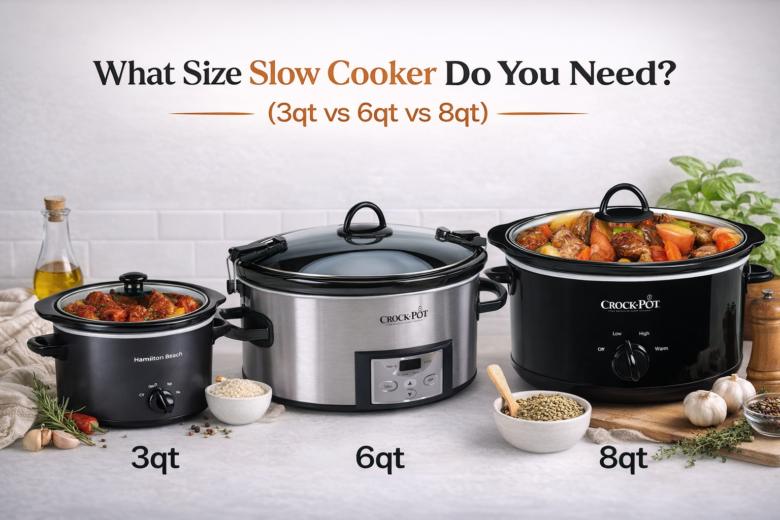
What Size Slow Cooker Do You Need?
3qt vs 6qt vs 8qt — the complete guide to choosing right
Introduction
Choosing the right slow cooker size is a pivotal decision for any home cook. The capacity of your slow cooker dictates everything from portion control to energy consumption — and getting it wrong is one of the most common kitchen appliance mistakes made.
A pot that’s too small leaves you cramped and underserved. A pot that’s too large leads to uneven cooking, faster drying out, and wasted energy. This guide cuts through the confusion by focusing on the three most popular sizes: the compact 3-quart, the versatile 6-quart, and the expansive 8-quart.
Quick Size Comparison
| Size | Servings | Best For | Typical Meals |
|---|---|---|---|
| 3-Quart | 1–3 people | Singles & couples | Soups, dips, small chili, side dishes, desserts |
| 6-Quart ★ | 4–6 people | Most households | Stews, roasts, whole chickens, pulled pork |
| 8-Quart | 6–10 people | Large families & meal prep | Big batches, bulk cooking, entertaining |
3-Quart Slow Cooker — Best for Small Households
The 3-quart is an excellent choice for individuals or small households where cooking for one or two is the norm. Its compact footprint makes it ideal for kitchens with limited counter or storage space, and its energy efficiency is a genuine advantage for those conscious of utility costs.
Who Should Buy It?
What Fits Inside?
- Creamy dips — spinach artichoke, queso, buffalo chicken dip for a small group
- Small chili batches — enough for 2–3 dinner servings
- Side dishes — baked potatoes, mashed potatoes, mac and cheese
- Desserts — small cakes, custards, fruit crumbles
- Individual soup portions — tomato soup, lentil soup for 2
- Compact and easy to store
- Most energy-efficient option
- Easiest to clean
- Most affordable price point
- Perfect as a secondary cooker
- Cannot fit whole chickens or large roasts
- Not suitable for batch cooking
- Too restrictive for family cooking
6-Quart Slow Cooker — Best for Most Households
The 6-quart is the undisputed champion of slow cooker sizes — the “goldilocks” option that’s just right for most households. It strikes the optimal balance between capacity and counter space, making it the go-to choice for families and regular slow cookers alike.
Who Should Buy It?
What Fits Inside?
- 4–5 lb whole chicken — fits perfectly, yields fall-off-the-bone results
- Medium pot roast — substantial cuts of beef or pork, enough for several meals
- Full batch of chili or stew — generous portions for the family plus freezer servings
- Pulled pork or brisket — large cuts slow-cooked for sandwiches or tacos
- Pasta dishes, soups, curries — all everyday slow cooker favourites
- Most versatile size — adapts to almost any recipe
- Perfect balance of capacity and counter space
- Great for leftovers and freezer batches
- Widest selection of brands, features, and prices
- Handles everything from weeknights to entertaining
- Can feel oversized for single-portion cooking
- Heavier and bulkier than the 3-quart
- Requires more storage space
8-Quart Slow Cooker — Best for Large Families & Meal Prep
For substantial cooking needs, the 8-quart is the ultimate workhorse. Built for volume — designed to cater to large families, dedicated meal preppers, and anyone who frequently hosts gatherings where a generous, crowd-pleasing pot is non-negotiable.
Who Should Buy It?
What Fits Inside?
- 7–8 lb pork shoulder or beef roast — substantial cuts made for a crowd
- Larger whole chickens — comfortably accommodates bigger birds for family dinners
- Enormous soup and stew batches — enough for days of meals or multiple freezer portions
- Bulk meal prep components — large batches of shredded chicken, beans, or grains all at once
- Largest capacity — ideal for big culinary tasks
- Effortlessly feeds a large gathering
- Maximum efficiency for batch cooking
- Reduces cooking frequency — one batch lasts days
- Significant counter and storage footprint
- Less energy-efficient for small meals
- Small portions dry out and cook unevenly
- Heavier and more cumbersome to clean
How to Choose the Right Size
Beyond the numbers, consider how you actually use your kitchen day to day. Three questions will get you to the right answer quickly:
1. How many people do you cook for?
This is the single most important factor. Match the cooker to your typical household meal — not your largest occasional gathering. You can always scale up a recipe; you can’t shrink a pot.
2. How often do you slow cook?
Occasional dips and side dishes? A 3-quart is sufficient. A few times a week for main dinners? The 6-quart is your workhorse. Batch cooking and freezing every Sunday? The 8-quart earns its keep.
3. How much storage space do you have?
Measure before you buy. Slow cookers — especially the 6-quart and 8-quart models — can be bulky. A unit you can’t store comfortably will end up on the counter permanently or used less often than it should be.
The Fill Rule — Critical for Every Size
Can You Cook Small Meals in a Large Slow Cooker?
Technically yes, but it’s not recommended without adjustments. The extra empty space increases heat intensity around the food, causing it to cook faster and dry out more readily than intended.
- It will cook faster — monitor closely and reduce your expected cooking time.
- Use the pot-in-pot method — place a smaller oven-safe dish inside the larger cooker with water around it to create a controlled cooking environment.
- Scale up the recipe — the most effective solution. Make a larger batch, freeze the extra, and take full advantage of the pot’s capacity.
Most Common Slow Cooker Size Mistakes
-
Buying too small for your household. Constantly needing to cook two batches, or supplementing with other methods, defeats the entire purpose of a slow cooker. Always consider your average meal size — not just the smallest occasion.
-
Ignoring storage space. Many buyers overlook measuring available counter and cabinet space. A bulky 8-quart that has no home will end up unused. Measure first.
-
Not checking recipe capacity requirements. Many recipes are written for a specific slow cooker size. Failing to check means overflow or underfilling — both compromise results.
-
Choosing by price alone. A smaller, cheaper model that doesn’t fit your needs is a false economy. The inconvenience of the wrong size will outlast any initial savings.
Quick Recommendation Guide
3qt
Choose this if…
- You cook for 1–2 people
- Kitchen space is limited
- You mostly make dips, sides, or small portions
- You want a second cooker for warm-keeping
6qt
Choose this if…
- You cook for 3–5 people
- You use your slow cooker regularly
- You want full meals with leftovers
- You want the most versatile option
- You’re a first-time buyer
8qt
Choose this if…
- You cook for 6+ people regularly
- You batch cook and freeze
- You host gatherings frequently
- You need very large cuts of meat
Frequently Asked Questions
Can I put a smaller dish inside a larger slow cooker?
Yes — this is called the “pot-in-pot” method. Place a smaller, oven-safe dish inside the larger slow cooker and add water in the bottom around it to facilitate heat transfer. It reduces the effective cooking volume and prevents smaller meals from overcooking in a too-large pot.
How full should a slow cooker be?
Between ½ and ¾ full — this is the golden rule for all sizes. Underfilling causes food to cook too quickly and dry out. Overfilling risks spills and uneven cooking, potentially leaving food undercooked.
Does slow cooker size affect cooking time?
Yes. A slow cooker that’s too large for the food being cooked has more empty space, which concentrates the heat around less food — causing it to cook faster and dry out. Conversely, an overfilled cooker takes longer to reach temperature. Always aim for the recommended fill level.
Can I use a slow cooker without liquid?
No — a slow cooker always needs some liquid to generate steam and prevent burning. Even for roasts, at least a small amount of broth, water, or another liquid is essential to create the moist cooking environment that defines slow cooking.
What is the average lifespan of a slow cooker?
Most slow cookers are designed to last 5–10 years depending on brand, quality, and frequency of use. Proper care — gentle cleaning, avoiding thermal shock to the ceramic insert, and storing carefully — extends lifespan significantly.
⚡ Final Verdict
For the vast majority of households, the 6-quart slow cooker is the best all-around choice — versatile enough for family weeknight dinners, generous enough for leftovers and small gatherings, and compact enough to live comfortably in most kitchens. If you’re a single or couple with limited space, go 3-quart. If you regularly cook for six or more or are a committed batch cook, go 8-quart. But if in doubt — always go 6-quart.
The right slow cooker size transforms your kitchen routine — fewer decisions, better meals, and a pot that actually fits your life. Choose once, choose well, and let it work for you every single week.