Eggnog occupies a peculiar position in the canon of holiday drinks. It is one of the most anticipated beverages of the Christmas season and one of the most frequently purchased in its worst possible form — the shelf-stable carton version, thick with gums and stabilizers, flavored with artificial vanilla, served cold from the refrigerator and drunk because it is December and eggnog is what December demands. That version is not bad, exactly. It is simply not what eggnog is.
Real eggnog — homemade eggnog, made from egg yolks whisked with sugar until thick and pale, combined with warm cream and milk spiced with nutmeg and cinnamon, cooked gently until the custard thickens and the eggs are safe, then cooled and finished with vanilla — is one of the great holiday drinks. Rich in a way that only a properly made custard can be. Warm and spiced with the nutmeg that is eggnog’s signature. Sweet enough to feel festive without overwhelming. Thick enough to coat the inside of the mug in the way that means it is the real thing.
The slow cooker version of homemade eggnog solves the most intimidating part of making it from scratch: the tempering. Traditional eggnog requires carefully whisking hot cream into egg yolks in a thin stream — too fast and the eggs scramble, too slow and the cream cools before it can do its job. The slow cooker eliminates this entirely. The egg yolk mixture goes directly into the warm dairy in the slow cooker insert, which holds a gentle, even, controlled heat that brings the custard up to temperature slowly and safely — no tempering, no risk of scrambling, no moment of precise timing required. It is the most forgiving method for making a cooked egg-based custard that exists, and it produces eggnog of extraordinary quality.
Why Homemade Eggnog Is Worth Making
The argument for making eggnog from scratch is straightforward when you know what store-bought eggnog contains and what homemade eggnog is.
Store-bought eggnog is a dairy product stabilized with carrageenan, guar gum, and other thickeners so that it can sit on a shelf or in a refrigerated section without separating for weeks. It is sweetened with high fructose corn syrup in many formulations. The eggs in it are a fraction of the proportion that homemade eggnog contains — the law requires only one percent egg yolk solids in commercial eggnog — and the nutmeg is a powder added in quantities calibrated for mass market palatability. It is pasteurized at a high enough temperature that any egg flavor is largely cooked away. The result is a thick, sweet, dairy product with vaguely eggy flavor that is consistent but not particularly interesting.
Homemade eggnog is a custard — a genuine egg-yolk-and-cream custard that carries the richness, the body, and the flavor of properly cooked eggs in warm dairy. The egg yolks provide a depth that no stabilizer replicates. The nutmeg, freshly grated and added in generous quantity, is the aromatic that makes the drink smell like Christmas rather than like a flavoring. The vanilla, added after cooking to preserve its aromatic character, adds a warmth that integrates with the egg and cream in a way that artificial vanilla does not. The sugar, dissolved into the egg yolks before the dairy goes in, produces a sweetness that is part of the custard’s structure rather than a syrup added afterward.
The difference is significant and immediately apparent to anyone who has tasted both on the same occasion. Make it once and the store-bought carton becomes difficult to return to.
The Food Safety Question
Homemade eggnog raises a question that homemade eggnog recipes frequently sidestep: egg safety. Traditional recipes for eggnog often call for raw eggs — egg yolks and whites not cooked at all, simply whisked with sugar and dairy and served. Raw egg-based eggnog is genuinely delicious. It is also the version that carries a real risk of salmonella, particularly for vulnerable populations: pregnant women, young children, elderly people, and anyone immunocompromised.
The slow cooker version in this recipe addresses this directly and completely: the custard is cooked. The egg yolks are heated to 160°F (71°C) — the temperature at which salmonella is eliminated — in the slow cooker’s gentle, controlled heat. The finished eggnog is safe for every person at the table.
The trick to a cooked eggnog that does not taste like overcooked eggs is the same trick as for any good custard: gentle heat, slow cooking, and constant monitoring as the custard approaches temperature. The slow cooker’s LOW setting provides that gentle heat automatically. A thermometer is the only tool needed to confirm the custard has reached the safe temperature before serving.
The target temperature. 160°F (71°C) at the thickest point of the custard is the food safety threshold. At this temperature the custard also has a specific texture — it should coat the back of a spoon thickly enough that a line drawn through the coating holds its shape. This is the traditional test for a finished custard and it coincides with the food safety temperature range. When both the thermometer confirms 160°F and the spoon test confirms the right consistency, the eggnog is done.
The Ingredients
Eggnog has a short ingredient list, and every item on it does essential work.
Egg yolks are the defining ingredient — the source of the custard’s richness, its body, its color, and the egg flavor that makes eggnog different from spiced cream. Six egg yolks for a full batch is the correct quantity — enough to produce a genuinely custard-like eggnog rather than a thin, barely-egg-flavored dairy drink. The whites are not used in the cooked version and can be reserved for meringues, macarons, or a whisked-in addition if the lighter raw-white foam is desired for presentation.
Whole milk and heavy cream are the dairy base — a combination of both produces the correct richness. All cream produces eggnog that is too thick and too heavy to drink comfortably. All milk produces a thinner result that lacks the body of proper eggnog. The ratio of two cups milk to one cup heavy cream is the standard starting point — richer versions use equal parts, lighter versions use more milk. Adjust based on preference.
Granulated sugar sweetens the custard and, critically, is whisked with the egg yolks before any heat is applied. The sugar dissolves into the yolks during whisking, which raises the coagulation temperature of the eggs slightly — a small but meaningful food science detail that helps prevent the yolks from scrambling when they encounter the warm dairy in the slow cooker.
Freshly grated nutmeg is the defining spice of eggnog and the one place in this recipe where the difference between fresh and pre-ground is most dramatic. A whole nutmeg grated on a fine microplane produces an aromatic, warm, slightly sweet spice that is unrecognizable as the same ingredient as the pale, flat powder in a jar. Pre-ground nutmeg is acceptable — it is what most people have available — but freshly grated nutmeg is one of the two or three sensory upgrades in any kitchen that costs almost nothing and transforms the result entirely.
Ground cinnamon adds a warm, complementary spice note that deepens the nutmeg without competing with it.
Vanilla extract — added after cooking, not before — is the aromatic finish. The same late-addition principle that applies throughout this series: vanilla’s aromatic compounds cook off during sustained heat and should be added to the finished custard immediately before serving. One teaspoon for a full batch produces a clearly vanilla-scented eggnog that smells as good as it tastes.
Salt — a small pinch — sharpens the flavor of every other ingredient. Unsalted eggnog tastes slightly flat. A quarter teaspoon balances the sweetness and makes the egg, cream, and nutmeg flavors more vivid.
Building the Custard: The Slow Cooker Method
Traditional eggnog requires a double boiler or careful stovetop work to temper eggs into hot cream without scrambling them. The slow cooker replaces that process with a gentler, more forgiving approach that produces the same result with significantly less skill required.
Step one: whisk the yolks and sugar. Before anything goes into the slow cooker, whisk the egg yolks and sugar together in a large bowl until the mixture is thick, pale, and the sugar is completely dissolved — approximately two to three minutes of vigorous whisking. This step does three things: it dissolves the sugar into the yolks, it incorporates air that gives the finished eggnog a slightly lighter body, and it raises the eggs’ coagulation temperature through the action of the dissolved sugar.
Step two: warm the dairy in the slow cooker. Combine the milk, cream, and spices in the slow cooker and heat on LOW for approximately 45 minutes to one hour until the mixture is warm — not hot, not steaming aggressively, but comfortably warm to the touch when the lid is lifted. This is approximately 140°F (60°C). The precise temperature is not critical — the goal is warm dairy, not hot dairy.
Step three: whisk in the yolk mixture. Ladle approximately one cup of the warm dairy into the bowl with the whisked egg yolks, whisking constantly as you add it — this is a minimal tempering step that brings the egg yolks closer to the temperature of the dairy before they go into the slow cooker. Then pour the tempered yolk mixture back into the slow cooker and whisk thoroughly to combine.
Step four: cook to temperature. Set the slow cooker to LOW and cook, stirring every 15 to 20 minutes, until the custard reaches 160°F (71°C) and coats the back of a spoon thickly. This takes approximately one to one and a half additional hours. Do not rush — HIGH heat causes the eggs to scramble.
Step five: finish and cool. Remove from heat. Stir in the vanilla extract. Strain through a fine mesh strainer into a large pitcher or bowl to remove any cooked egg particles. Cool to room temperature, then refrigerate until cold — at least four hours, ideally overnight.
The Consistency Question: Thick or Thin
Eggnog preferences vary significantly — some people want a thick, almost spoonable custard; others prefer a lighter, more drinkable consistency. The slow cooker method produces a moderately thick eggnog that sits between these extremes. Adjustments in either direction are straightforward.
For thicker eggnog. Increase the heavy cream to one and a half cups and reduce the milk to one and a half cups. Add an additional egg yolk (seven total). Cook until the custard is slightly thicker on the spoon test — a line drawn through the coating on the back of a spoon should hold very clearly.
For thinner, more drinkable eggnog. Increase the milk to two and a half cups and reduce the cream to half a cup. The result is lighter and more refreshing — more like a spiced custard drink than a thick seasonal indulgence.
For eggnog that closely resembles the store-bought carton consistency. After the cooked custard has cooled and been refrigerated overnight, whip half a cup of additional heavy cream to soft peaks and fold it gently through the cold eggnog. This technique — folding in whipped cream — is what produces the light, airy-but-rich consistency of the best commercial eggnogs and is worth trying at least once.
The Nutmeg Finish
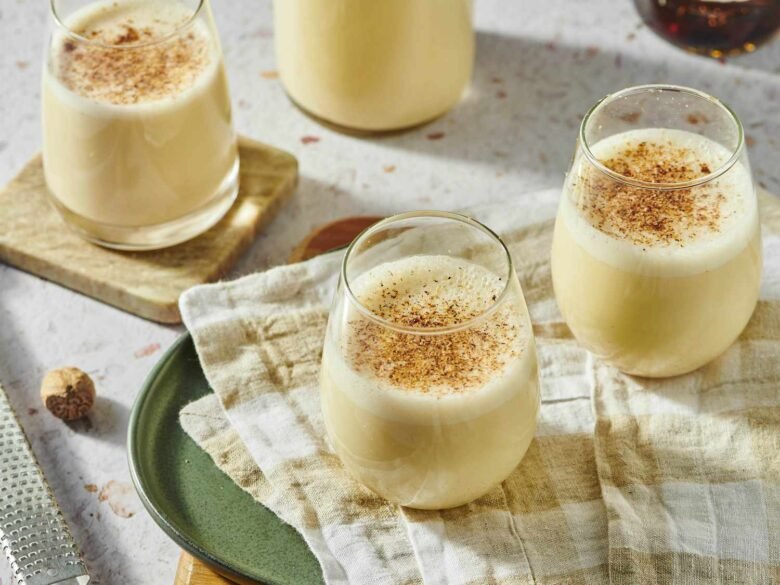
Freshly grated nutmeg over the top of a poured glass of eggnog is not optional garnish — it is part of the drink. The aromatic oils released by freshly grated nutmeg at the moment of grating are the most volatile and most intensely aromatic compounds in the spice. They are exactly what you smell when a well-made eggnog is placed in front of you and exactly what is absent when pre-ground nutmeg powder is shaken over the top from a jar.
A small whole nutmeg and a fine microplane kept alongside the serving vessel for grating directly over each cup as it is poured — this is the presentation detail that elevates the serving of homemade eggnog from the merely good to the specifically excellent. It costs nothing. It takes three seconds per cup. It is the single most impactful finishing touch in this recipe.
The Spiked Version
Eggnog has been a fortified drink throughout most of its history — the original American colonial versions contained substantial quantities of rum or bourbon or rye whisky, which both contributed flavor and served as a preservative in an era before refrigeration. The modern tradition of spiking eggnog per glass at serving preserves the colonial instinct while keeping the batch accessible to all guests.
Bourbon is the most popular and most complementary spirit — its vanilla, caramel, and oak notes pair naturally with the egg, cream, and nutmeg of the eggnog. One and a half ounces per serving is the standard measure.
Dark rum is the historically most accurate addition — Caribbean rum was the spirit most commonly used in colonial American eggnog, and its molasses and caramel notes pair exceptionally well with the custard base.
Brandy or Cognac adds a French character that is more refined and more wine-forward than bourbon or rum. One ounce per serving is sufficient.
Rye whisky — the spirit most common in early American eggnog recipes — adds a spicier, more assertive character that is excellent and increasingly appreciated as rye whisky has returned to popularity.
The batch fortification option. Adding spirits directly to the full batch after cooking and cooling is the traditional approach — a cup of bourbon or rum stirred into the cold eggnog before refrigerating. The alcohol acts as a light preservative and allows the flavors to integrate over the refrigeration period. A batch fortified with good bourbon and left to rest overnight develops a depth and integration of flavor that per-glass additions cannot replicate.
Tips for Perfect Slow Cooker Eggnog
1. Whisk the yolks and sugar until thick and pale — do not rush this step. The sugar must be completely dissolved into the yolks before the dairy goes in. Undissolved sugar produces a slightly grainy texture in the finished custard. Two to three minutes of vigorous whisking produces the thick, pale, ribbon-stage mixture that is the correct starting point.
2. Temper minimally — ladle one cup of warm dairy into the yolks first. Even with the slow cooker’s gentle heat, a one-cup tempering ladle of warm dairy added to the egg yolks before they go into the slow cooker dramatically reduces the risk of scrambling. This is a 30-second step that prevents the most common eggnog failure.
3. Stir every 15 to 20 minutes during the final cooking stage. The custard builds from the bottom and sides of the insert inward — the edges cook faster than the center. Stirring every 15 to 20 minutes distributes the heat evenly, prevents the edges from overcooking while the center is still thin, and allows the entire batch to reach temperature uniformly.
4. Use a thermometer. The spoon test is a useful secondary confirmation but a thermometer is the definitive check. 160°F (71°C) is both the food safety threshold and the temperature at which eggnog has the correct consistency. Do not guess — use a thermometer.
5. Strain before chilling. Any eggnog will contain some cooked egg particles — very small bits of white that set before the yolk mixture could fully incorporate. Straining through a fine mesh strainer before chilling removes these and produces a silky, uniformly smooth custard. This step takes two minutes and is worth doing every time.
6. Chill completely before serving. Warm eggnog is good but cold eggnog is correct. The custard firms and thickens during refrigeration and the flavors integrate and deepen overnight. A minimum of four hours of chilling is required — overnight is better.
7. Add vanilla after cooking — and fresh nutmeg at serving. Vanilla added before the long cook contributes almost nothing aromatic to the finished eggnog. Added after, it transforms the custard’s aromatic profile completely. Fresh nutmeg grated directly over each cup at the moment of serving is the presentation detail that signals the eggnog is homemade and worth the effort.
8. Do not cook on HIGH. HIGH heat scrambles eggs. The entire point of the slow cooker method is the gentle, controlled heat of the LOW setting that brings the custard up to temperature without curdling. If scrambling occurs — small white particles appearing throughout the custard — it cannot be reversed. Strain out what can be strained and adjust the consistency with additional cold cream. Prevent it by staying on LOW.
Serving the Eggnog
Homemade eggnog, served properly, is one of the most impressive things that can come out of a home kitchen at Christmas.
The vessel. A small, stemmed glass — a coupe, a punch cup, or a small rocks glass — is the traditional eggnog vessel. The smaller size suits the richness of the drink. A ceramic mug is equally appropriate for a warm serving (see variations). The glass allows the color of the eggnog — deep ivory, slightly golden — to be visible, which is part of the presentation.
The garnish. Freshly grated nutmeg directly over the top of each poured glass, with a dusting of ground cinnamon alongside. A cinnamon stick for stirring in glasses that will receive a spirit. A light tuft of softly whipped cream, if the eggnog is served without the folded-cream variation.
The self-serve station. A pitcher of cold eggnog, a small bowl of freshly grated nutmeg, a fine microplane, a bottle each of bourbon and dark rum for adults, and a pitcher of cold eggnog without spirits for those who prefer it non-alcoholic. The setup tends itself through the party.
Warm eggnog. Eggnog served warm — heated gently in the slow cooker on KEEP WARM or in a small saucepan over very low heat, never boiled — is an underappreciated serving format that suits cold evenings particularly well. The warm version is slightly thinner than the cold version as the custard loosens with heat, and it carries the nutmeg and vanilla aromatics most intensely. A warm eggnog with a shot of bourbon or brandy in a heavy ceramic mug is a specific and excellent Christmas evening drink.
The Complete Table
Food pairings:
- Gingerbread — the warm spice in the cookie mirrors the nutmeg in the eggnog
- Pecan pie or pecan bars — rich, sweet, and naturally complementary
- Christmas shortbread — buttery, simple, correct
- Fruit cake or stollen — the classic pairing of the holiday season
- Sugar cookies with royal icing — for a Christmas cookie exchange spread
- Spiced nuts — the warm spice note runs through both
Occasions:
- Christmas Eve — the centerpiece drink of the night
- Christmas morning — warm eggnog before presents
- Holiday cookie exchange — the drink no one expects and everyone appreciates
- Christmas party — batch-fortified with bourbon and served from a punch bowl
- New Year’s Eve — as a rich, warming alternative to Champagne for those who prefer it
Spiked variations for adults:
- Bourbon eggnog — 1.5 oz bourbon per glass, the most popular
- Dark rum eggnog — 1.5 oz dark rum, the most historically correct
- Brandy eggnog — 1 oz brandy or Cognac per glass
- Rye eggnog — 1.5 oz rye whisky for a spicier, more assertive version
- Batch-fortified eggnog — 1 cup bourbon stirred into the full cold batch
The Day-After Eggnog Uses
Leftover eggnog — which keeps refrigerated for three to four days — is a baking and cooking ingredient of real value. Poured over bread in place of the custard in French toast, it produces the most indulgent, most Christmas-morning French toast in existence. Used as the liquid in a bread pudding recipe, it produces a custard-soaked pudding that needs no additional spicing. Stirred into pancake batter in place of the milk, it produces eggnog pancakes that are seasonally absurd and specifically delicious. Churned in an ice cream maker, it produces eggnog ice cream — spiced, eggy, deeply flavored — that is one of the best seasonal ice cream flavors that most people never think to make. Blended with ice cream and a splash of milk, it produces an eggnog milkshake that needs no further recommendation.
Easy Variations
- Chocolate eggnog. Whisk two tablespoons of good quality cocoa powder and two tablespoons of dark chocolate chips into the warm dairy before adding the egg yolk mixture. The chocolate melts completely into the custard and produces a mocha-adjacent eggnog that is particularly popular with chocolate lovers and pairs well with dark rum.
- Pumpkin spice eggnog. Add two tablespoons of pure pumpkin puree and half a teaspoon of pumpkin pie spice to the dairy in the slow cooker alongside the nutmeg and cinnamon. The pumpkin adds color, a subtle earthiness, and extends the autumn flavor profile into the Christmas season in a way that is genuinely excellent.
- Dairy-free eggnog. Replace the whole milk with full-fat oat milk and the heavy cream with full-fat canned coconut cream. The egg yolks, sugar, and spices remain identical. The result is slightly less rich than the dairy version but carries the same custard character — the egg yolks do their work regardless of the dairy alternative used.
- Warm spiced eggnog latte. Add a shot of espresso to a mug of warm eggnog — the coffee bitterness cuts through the richness of the custard and produces a seasonal latte that is the most indulgent possible morning coffee drink during the holiday season.
- Eggnog with cardamom. Add half a teaspoon of ground cardamom alongside the nutmeg and cinnamon. The floral, citrusy note of cardamom lifts the spice blend and gives the eggnog a slightly more aromatic, Middle Eastern-spiced character that is sophisticated and unexpected.
Make-Ahead and Storage
Make-ahead: Homemade eggnog is one of the best make-ahead holiday drinks. Made two to three days before Christmas, refrigerated in a sealed pitcher or jar, it develops and deepens in flavor as the spices and vanilla continue to integrate into the custard. Day 3 eggnog is meaningfully better than Day 1. Batch-fortified eggnog improves even further with time — three days in the refrigerator with bourbon or rum allows the spirit to mellow and integrate completely.
Refrigerator: Cooked, strained eggnog keeps for three to four days in an airtight container. Unfortified eggnog keeps for three days; batch-fortified eggnog (with spirits added to the batch) keeps for up to five days, as the alcohol acts as a mild preservative. Stir before serving — the custard may thicken slightly at the bottom during storage.
Freezer: Eggnog freezes in an airtight container for up to three months. The custard may separate slightly after freezing — thaw overnight in the refrigerator and blend briefly or whisk vigorously before serving. The texture after thawing is slightly less silky than fresh but the flavor is fully intact.
Raw fortified version (traditional). The traditional colonial method of preserving eggnog was to add a very generous quantity of spirits to the raw egg and dairy mixture — enough that the alcohol itself prevented bacterial growth. This method produces a very different drink from the cooked version and requires a two-week rest period in the refrigerator for the alcohol to fully cure the eggs. This recipe does not use the raw method — the cooked version is the safe and recommended approach.
Shopping List
The Custard Base
- 6 large egg yolks
- ½ cup (100g) granulated white sugar
- 2 cups (480ml) whole milk
- 1 cup (240ml) heavy cream
The Spices
- ½ tsp freshly grated nutmeg (plus more for serving)
- ¼ tsp ground cinnamon
- ¼ tsp salt
The Finish
- 1 tsp vanilla extract — added after cooking
For Serving
- Whole nutmeg and a fine microplane for grating at serving
- Ground cinnamon for dusting
- Softly whipped cream (optional)
- Bourbon, dark rum, or brandy alongside for adults
Slow Cooker Eggnog (Homemade, Creamy)
Six egg yolks whisked with sugar until thick and pale, combined with warm whole milk, heavy cream, nutmeg, cinnamon, and a pinch of salt in the slow cooker and cooked on LOW — stirred every 15 to 20 minutes — until the custard reaches 160°F (71°C) and coats the back of a spoon in a thick, silky ribbon. Strained, finished with vanilla extract, chilled overnight, and served cold in small stemmed glasses with freshly grated nutmeg over the top and bourbon alongside for those who want it. The homemade eggnog that makes the carton version impossible to return to.
- Total Time: 7 hours (including chilling)
- Yield: 6–8 servings 1x
Ingredients
The Custard
- 6 large egg yolks, at room temperature
- ½ cup (100g) granulated white sugar
- 2 cups (480ml) whole milk
- 1 cup (240ml) heavy cream
The Spices
- ½ tsp freshly grated nutmeg (from a whole nutmeg if possible)
- ¼ tsp ground cinnamon
- ¼ tsp salt
The Finish
- 1 tsp vanilla extract — added after cooking, not before
For Serving
- Freshly grated nutmeg, directly over each glass
- Ground cinnamon for dusting
- Softly whipped cream (optional)
- Bourbon, dark rum, or brandy alongside (optional, 1.5 oz per glass)
Instructions
- Whisk yolks and sugar. In a large bowl, whisk the egg yolks and granulated sugar together vigorously for 2 to 3 minutes until the mixture is thick, pale yellow, and the sugar is completely dissolved. The mixture should fall from the whisk in a thick ribbon. Set aside.
- Warm the dairy. Add the whole milk, heavy cream, nutmeg, cinnamon, and salt to the slow cooker insert. Stir briefly to combine. Set to LOW and heat for 45 minutes to 1 hour, until the dairy mixture is warm — approximately 140°F (60°C) — but not boiling or steaming aggressively.
- Temper the yolks. Using a ladle, transfer approximately 1 cup of the warm dairy mixture from the slow cooker into the bowl of whisked egg yolks, whisking constantly as you pour. This gradually warms the egg yolks to the dairy’s temperature. Pour the tempered yolk mixture back into the slow cooker, whisking as you go to combine thoroughly.
- Cook to temperature. Keep the slow cooker on LOW. Cook the custard, lifting the lid and stirring thoroughly every 15 to 20 minutes, for 1 to 1.5 hours, until the eggnog reaches 160°F (71°C) on an instant-read thermometer and coats the back of a spoon thickly — a line drawn through the coating with your finger should hold its edges cleanly.
- Strain and finish. Remove the insert from the slow cooker. Stir in the vanilla extract. Pour the finished eggnog through a fine mesh strainer into a large pitcher or bowl, pressing gently to remove any cooked egg particles. Discard the solids.
- Cool and refrigerate. Allow the strained eggnog to cool to room temperature — approximately 30 minutes. Cover and refrigerate for a minimum of 4 hours, ideally overnight. The eggnog thickens further as it chills and the flavors deepen and integrate.
- Serve. Stir the chilled eggnog before serving. Pour into small stemmed glasses or rocks glasses. Grate fresh nutmeg generously over the top of each glass. Add a dusting of cinnamon and a small dollop of softly whipped cream if desired. Offer bourbon, dark rum, or brandy alongside for adults.
Notes
- Room temperature egg yolks incorporate more smoothly. Cold egg yolks from the refrigerator are more viscous and whisk less completely with the sugar. Remove the eggs from the refrigerator 30 minutes before making the eggnog or run them briefly under warm water.
- Do not skip the tempering step. One cup of warm dairy whisked into the egg yolks before they go into the slow cooker brings the eggs toward the dairy’s temperature and dramatically reduces the risk of scrambling. It takes 30 seconds and is the step that most determines whether the custard is smooth or curdled.
- Stir on a schedule. The custard builds from the edges of the insert inward during the slow cook. Without stirring, the edges overcook and scramble while the center is still thin. Set a timer for every 15 minutes and stir thoroughly from the bottom and sides each time. This is the most hands-on this recipe gets, and it is not demanding.
- 160°F is the number. Use an instant-read thermometer. The food safety threshold and the correct custard consistency coincide at 160°F — when the thermometer reads 160°F and the spoon test confirms a thick coating, the eggnog is simultaneously safe and perfectly cooked.
- Strain every time. Even a perfectly made eggnog contains some fine cooked egg particles. Straining takes two minutes and produces a silky, smooth custard without any graininess. Line the strainer with cheesecloth for the clearest possible result.
- Overnight chilling is not optional. The eggnog needs time in the refrigerator to thicken, set, and integrate its flavors. A four-hour minimum produces a good eggnog. An overnight rest produces a noticeably better one. Make it the day before Christmas for the best version.
- Freshly grated nutmeg at serving is not a garnish. It is the aromatic finish of the drink. The essential oils in freshly grated nutmeg released at the moment of grating are the most volatile and most intensely aromatic compounds in the spice — and they are what make eggnog smell like Christmas. Pre-ground nutmeg from a jar produces a fraction of the same effect. Keep a whole nutmeg and a fine microplane beside the serving vessel.
- Prep Time: 15 minutes
- Cook Time: Total Active Time; 1 hour 45 minutes, Cooling + Chilling; 4 hours minimum (overnight preferred)
- Category: Drinks, Holiday
- Method: Slow Cooking
- Cuisine: American
- Diet: Gluten-Free, Vegetarian
Frequently Asked Questions
Is slow cooker eggnog safe to drink? Yes — when made with the cooked method in this recipe, completely. The custard is heated to 160°F (71°C), which is the temperature at which salmonella and other pathogens in eggs are eliminated. The slow cooker’s gentle heat is ideal for bringing egg-based custards to this temperature safely and evenly. The critical tool is an instant-read thermometer — confirm the custard has reached 160°F before removing it from the slow cooker. Without a thermometer, there is no reliable way to confirm food safety. If you do not have one, an inexpensive instant-read thermometer is the one kitchen tool most worth acquiring for this recipe.
My eggnog curdled — there are white bits floating through it. What happened? The eggs scrambled — they were exposed to heat too quickly or at too high a temperature. This is the most common failure in homemade eggnog and it can be partially recovered: strain the eggnog immediately through a fine mesh strainer lined with cheesecloth. The strained result will have lost some of its body but will be smooth and drinkable. For future batches: ensure the dairy was warm (not hot) before the egg yolks were added, do not skip the tempering step, stay on LOW throughout, and stir every 15 minutes to distribute heat evenly. The slow cooker method is significantly more forgiving than the stovetop — if scrambling occurred, the slow cooker was likely on HIGH or the tempering step was skipped.
Can I make this ahead of time for Christmas? Yes — and it is specifically recommended. Homemade eggnog made two to three days before Christmas and refrigerated develops a noticeably better flavor than the same recipe served on the day it was made. The spices continue to infuse into the custard during refrigeration, the vanilla integrates completely, and the custard thickens and smooths. Batch-fortified eggnog — with bourbon or rum stirred into the cold finished batch — improves even further with three to four days of refrigeration as the spirit mellows into the custard. Make it early. The refrigerator does its own finishing work.
How do I make the dairy-free version? Replace the whole milk with full-fat oat milk and the heavy cream with full-fat canned coconut cream (not coconut milk, which is thinner). The egg yolks, sugar, spices, and vanilla remain identical and follow the same method exactly. The result is slightly less thick than the dairy version — coconut cream has a different fat structure from heavy cream and the custard does not set as firmly during chilling. Adding one additional egg yolk (seven total instead of six) compensates for this and produces a dairy-free eggnog with very close to the same body and richness. The coconut flavor is subtle — the egg, nutmeg, and vanilla flavors dominate and the coconut note reads more as additional richness than as a specific flavor.
Can I skip the tempering step and just whisk the yolks directly into the warm slow cooker? Technically you can, and the slow cooker’s gentle heat makes it more forgiving than the stovetop in this regard. However, cold egg yolks added directly to warm dairy in a slow cooker can scramble at the point of contact before the stirring distributes them evenly. The tempering step — one ladle of warm dairy whisked into the yolks before they go in — closes the temperature gap between the cold yolks and the warm dairy and takes 30 seconds. It is the shortest and most consequential step in the recipe. Include it every time.
Can I make a non-egg eggnog for people with egg allergies? What is made without eggs is not technically eggnog — it is spiced cream, which is a different drink. That said, spiced cream (whole milk and heavy cream heated with sugar, nutmeg, cinnamon, and vanilla) is a very good drink in its own right. For a convincing eggnog-like non-egg version, combine full-fat oat milk, coconut cream, a tablespoon of cashew butter (for richness and a subtle eggy note), nutmeg, cinnamon, vanilla, and sugar in the slow cooker and heat on LOW for two hours. The result does not taste like egg custard but it tastes like the spiced, creamy holiday drink that eggnog evokes. It is a reasonable option for egg-allergic guests at a Christmas gathering.
How much bourbon is the right amount in eggnog? The honest answer is that eggnog tolerates and rewards a generous pour more than almost any other drink — its richness and fat content absorb and soften the alcohol in a way that a light-bodied drink cannot. The standard measure of 1.5 oz (one shot) per glass produces a pleasantly spiked result that is detectable but not dominant. Traditional recipes from the colonial and early American period used far more — the equivalent of two to three shots per serving in some formulations. For a batch-fortified version, one cup of bourbon or rum stirred into a six-to-eight serving batch produces approximately the 1.5 oz per serving ratio. Start with the standard measure, taste, and adjust according to the occasion and the preference of the people being served.
Why does my eggnog taste eggy rather than creamy? Two possible causes. First, the ratio of egg yolks to dairy — six yolks in two cups of milk and one cup of cream is the standard and produces the right balance. More yolks than this, or less dairy, shifts the flavor toward a more aggressively eggy result. Second, the cooking temperature — overcooked egg yolks develop a more pronounced egg flavor. If the custard was cooked past 165°F or above, the egg character intensifies. The vanilla added at the end is the primary aromatics that shift the perception from “eggy” to “creamy and spiced” — ensure it is added after cooking when its full aromatic impact is preserved. A pinch of additional salt, an extra half teaspoon of vanilla, and a more generous grating of fresh nutmeg at serving can rebalance a batch that reads as overly eggy.