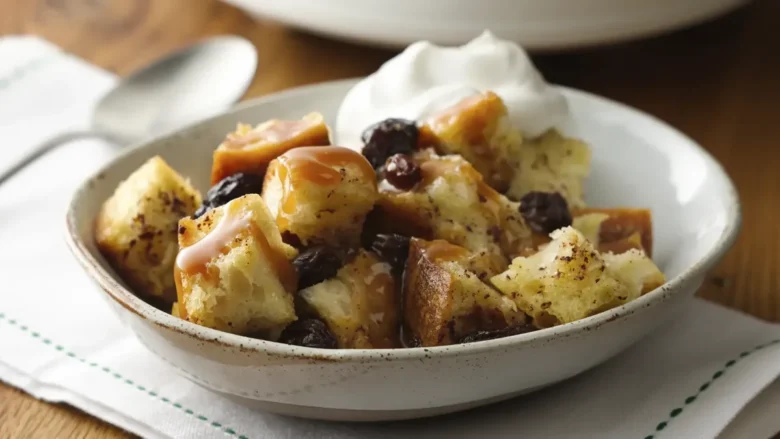
There is a particular genius to bread pudding that reveals itself the moment you understand what it actually is: a way of transforming stale, otherwise-unwanted bread into one of the most satisfying desserts imaginable. It is the kind of cooking that speaks to resourcefulness and ingenuity — the kind that stretches humble ingredients into something genuinely luxurious through patience and technique.
The French call it pain perdu — lost bread — reclaimed. And reclaimed it is. What goes into the slow cooker as cubed day-old bread and a simple custard mixture emerges several hours later as something soft, rich, custardy, and deeply flavored — the bread having absorbed every bit of the vanilla-scented egg and cream mixture and transformed into a dessert that is greater than the sum of its parts in the most satisfying way.
The vanilla sauce that accompanies it is the finishing touch that makes the whole thing sing. Poured warm over each serving — a silky, buttery, vanilla-laced sauce that pools around the bread pudding and soaks into every crevice — it turns a humble dessert into something that belongs at a fine dining table just as comfortably as it does at a family kitchen table.
The slow cooker makes the whole process nearly effortless. No water bath, no oven temperature management, no risk of overbaking. Just assembled, cooked, and served — beautiful and simple and exactly right.
What Makes a Great Bread Pudding
Bread pudding at its best is a study in contrasts and balance. The exterior of the bread cubes develops a slight golden caramelization. The interior is soft, almost melting, with the custard fully absorbed and set. There are pockets of richness throughout. The overall texture sits somewhere between a baked custard and a soft, dense cake — not quite either one, entirely its own thing.
Getting there requires attention to three variables: the bread, the custard ratio, and the cooking method.
The bread must be stale enough to absorb the custard without falling apart, but not so dry that it becomes hard and resistant. It must have enough structure to hold its shape in cubes during soaking and cooking. And it must have enough flavor of its own to contribute something to the finished pudding rather than simply acting as a neutral sponge.
The custard ratio determines whether the pudding is dry and cakey or wet and sloppy. Too little custard and the bread dominates — dry, bready, dense. Too much and the pudding never fully sets, staying wet and mushy in the center. The right ratio produces a pudding where the custard has been completely absorbed into the bread and set into a cohesive, sliceable mass.
The cooking method determines texture. Oven-baked bread pudding develops a crust on top and caramelized edges but risks drying out if left even slightly too long. Slow cooker bread pudding develops gentle, even heat throughout, produces a softer, more uniformly custardy result with no dry edges, and is considerably more forgiving of timing variations.
Choosing the Right Bread
The bread is the foundation of the pudding and its selection deserves serious thought. Not every bread produces the same result, and the best bread puddings are made with intention rather than whatever happens to be on the counter.
Brioche is the gold standard for bread pudding. Rich with butter and eggs, brioche produces a pudding that is deeply flavored, silky, and luxurious — the buttery bread and the egg-cream custard melding into something indulgent and rich. It is widely available at most grocery stores and bakeries and worth seeking out when making bread pudding for a special occasion.
Challah is an equally excellent choice — similar to brioche in its richness from egg yolks, with a slightly less buttery flavor that produces a lighter but still very rich pudding. The braided structure means it dries beautifully and absorbs custard evenly.
French bread or baguette is the everyday option and the one most commonly used. Its open, airy crumb absorbs custard readily and its crust adds textural interest. Not as rich as brioche or challah but perfectly good and considerably more economical.
Croissants produce an exceptional bread pudding — their layers of buttered, laminated pastry absorb the custard in a unique way, creating pockets of almost pastry-cream richness throughout the pudding. Day-old croissants are ideal; even slightly stale ones work beautifully. This is one of the best things you can do with croissants that have gone past their prime.
What to avoid: Whole wheat bread is too dense and earthy-flavored. Sourdough’s strong flavor competes with the custard. Sandwich bread is too soft and collapses into mush. Raisin bread can work but the pre-existing sweetness needs to be accounted for in the recipe.
Stale vs fresh: The bread should be stale — at minimum a day old, ideally two or three days. Fresh bread is too moist and will produce a soggy pudding. If you only have fresh bread, cut it into cubes and dry it in a 300°F oven for 10–15 minutes until the exterior is dry to the touch but the interior is not yet toasted.
The Custard
The custard is the heart of the pudding — the medium through which the bread transforms from stale pieces into a unified, rich dessert.
Eggs provide the structure that sets the custard during cooking. Whole eggs give body and richness; adding extra yolks deepens the color and richness further. This recipe uses a combination of whole eggs and additional yolks for a custard that is richly golden, deeply flavored, and sets beautifully.
Heavy cream and whole milk together produce a custard that is rich without being cloying. Using all heavy cream produces a pudding that is almost too rich — lovely but more confection than dessert. A combination of two parts cream to one part milk gives the right balance.
Sugar sweetens the custard and helps it caramelize at the contact points with the slow cooker insert. Brown sugar adds a molasses note that complements vanilla beautifully and gives the pudding depth that white sugar alone cannot provide.
Vanilla is the defining flavor of the custard. Use a generous amount of pure vanilla extract — a full two teaspoons — or better yet, use a whole vanilla bean, split and scraped, for a custard studded with fragrant black specks that tastes noticeably more complex and floral than extract alone.
A pinch of nutmeg added to the custard is one of the oldest bread pudding traditions and still one of the best — its warm, slightly sweet depth amplifies the vanilla and cream in the custard in a way that is immediately familiar and comforting.
The soaking time is critical. After pouring the custard over the bread cubes, the mixture needs time to fully absorb before cooking begins. A minimum of 30 minutes at room temperature or, better, overnight in the refrigerator. The bread cubes should be fully saturated — no dry white spots remaining on any surface — before the slow cooker is turned on.
The Vanilla Sauce
The vanilla sauce — sometimes called crème anglaise, sometimes simply “vanilla custard sauce” — is what transforms a good bread pudding into a great one. It is silky, warm, deeply flavored with vanilla, and has a consistency that is exactly right for pooling around and soaking into the served pudding.
It is also the kind of sauce that people spoon extra of onto their plate when they think no one is watching.
The sauce is made on the stovetop in the final few minutes before serving — simple enough to prepare while the bread pudding rests — and consists of nothing more than egg yolks, sugar, heavy cream, butter, and vanilla. The egg yolks thicken the cream over gentle heat into a pourable, coating sauce with a richness that is unmistakable.
A few techniques ensure success:
Temper the egg yolks. Hot cream poured directly onto raw egg yolks will scramble them. Tempering — whisking a small amount of the hot cream into the yolks first to gradually raise their temperature before adding them to the pot — prevents this completely.
Cook over medium-low heat and stir constantly. The sauce thickens gradually and can go from perfectly silky to curdled and broken in under a minute if the heat is too high or attention lapses. Medium-low, constant stirring, and patience produce a perfect sauce every time.
The coating test. The sauce is ready when it coats the back of a spoon and a line drawn through it with a finger holds its shape rather than running back together. This is the classic test for crème anglaise and it is the correct endpoint for this sauce.
Add the vanilla at the end. Just as in the rice pudding, vanilla’s aromatic compounds dissipate with heat — stir in the vanilla extract off the heat for the most fragrant, flavorful sauce.
Tips for the Best Slow Cooker Bread Pudding
1. Soak the bread thoroughly and patiently. Every surface of every bread cube should be saturated with custard before cooking begins. Press the cubes down gently after pouring the custard to ensure full contact. Give it at least 30 minutes — overnight in the fridge is better. Dry spots in the finished pudding trace back directly to insufficient soaking.
2. Use the paper towel trick. Two sheets of paper towels under the lid absorb condensation and prevent it from dripping onto the surface of the bread pudding during cooking. This technique has appeared consistently throughout this dessert series because it is consistently essential.
3. Grease the insert generously. The custard caramelizes against the insert and will stick. Use butter rubbed into every surface of the insert, including up the sides, before adding the bread mixture.
4. Cook on LOW for a more custardy result, HIGH for a firmer set. Unlike most other slow cooker baked desserts in this series, bread pudding has flexibility here. LOW produces a softer, more custardy, almost pudding-like result. HIGH produces a firmer, more structured pudding that slices cleanly. Both are wonderful — choose based on your texture preference.
5. Do not lift the lid during cooking. Temperature consistency is important. Leave the slow cooker completely undisturbed until the minimum cooking time has elapsed.
6. Rest before serving. Allow the bread pudding to rest for 15 minutes after cooking is complete. The custard continues to set slightly during resting, making the pudding easier to scoop or slice cleanly.
7. Make the vanilla sauce just before serving. The sauce is quick to make but does not hold well over extended time — it continues to thicken and can develop a skin if left to sit. Make it in the last 5–10 minutes before serving while the bread pudding rests.
Easy Variations
- Bourbon bread pudding. Add 2 tablespoons of good bourbon to the custard and 1 tablespoon to the vanilla sauce. The bourbon adds a warm, smoky sweetness that is the classic New Orleans variation and arguably the best version of bread pudding in existence.
- Chocolate bread pudding. Stir 3 tablespoons of Dutch-process cocoa powder and 2 oz of chopped dark chocolate into the warm custard before pouring over the bread. Serve with a chocolate ganache sauce instead of vanilla sauce.
- Apple cinnamon bread pudding. Toss 1 cup of peeled, diced apple with 1 tablespoon of brown sugar and ½ teaspoon of cinnamon. Layer the apple pieces between the bread cubes before adding the custard. Serve with caramel sauce in addition to or instead of the vanilla sauce.
- Raisin and rum bread pudding. Soak ½ cup of raisins in 3 tablespoons of dark rum for 30 minutes, then scatter throughout the bread cubes before adding the custard.
- Croissant bread pudding. Use 6–8 day-old croissants torn into rough pieces. Reduce the custard slightly as croissants are already very rich. Serve with a Cointreau-spiked vanilla sauce.
- Berries and cream. Scatter 1 cup of fresh or frozen blueberries, raspberries, or blackberries through the bread cubes before custard. The berries burst during cooking and create jammy pockets throughout the pudding.
What to Serve Alongside
Bread pudding is a generous, sharing dessert — it feels right on a big table with people around it.
- The warm vanilla sauce — essential, non-negotiable, pour it generously
- Vanilla ice cream — for those who want both warm pudding and cold ice cream together
- Fresh whipped cream — lighter than ice cream, a good alternative
- Caramel sauce — particularly good with the apple variation or the bourbon version
- Fresh berries — their tartness and freshness cuts through the richness beautifully
- A dusting of powdered sugar — for presentation, particularly at a dinner party
- A strong espresso or café au lait — the New Orleans tradition and the correct one
Make-Ahead and Storage
Make-ahead (best practice): Assemble the bread pudding — cubed bread soaked in custard — the night before. Cover and refrigerate. In the morning or before serving, transfer the insert to the slow cooker and cook. The overnight soak produces an even more thoroughly saturated, deeply flavored pudding.
Vanilla sauce: Can be made up to 2 days ahead and stored in an airtight container in the fridge. Reheat gently in a small saucepan over low heat, stirring constantly, until just warm. Do not boil.
Refrigerator: Leftover bread pudding keeps covered in the fridge for up to 4 days. Reheat individual portions in the microwave for 60–90 seconds with a spoonful of vanilla sauce drizzled over before reheating to restore moisture.
Freezer: Bread pudding freezes reasonably well for up to 2 months — the texture softens slightly but is still good. Freeze without the vanilla sauce. Thaw overnight in the fridge and reheat covered in a 325°F oven for 20 minutes. Make fresh vanilla sauce when serving.
Shopping List
Everything you need, organized by category.
The Bread
- 1 loaf (about 12–14 oz / 340–400g) brioche, challah, or French bread — stale, cut into 1-inch cubes (about 8–10 cups)
Dairy & Eggs
- 2 cups (480ml) heavy cream (for custard)
- 1 cup (240ml) whole milk
- 4 large eggs
- 2 additional egg yolks
- 2 tbsp unsalted butter (for greasing and custard)
- Optional: 1 vanilla bean
For the Vanilla Sauce
- 3 large egg yolks
- ½ cup (100g) granulated sugar
- 1 cup (240ml) heavy cream
- 2 tbsp unsalted butter
- 1 tsp pure vanilla extract
Pantry
- ½ cup (100g) granulated sugar
- ¼ cup (50g) packed brown sugar
- 2 tsp pure vanilla extract
- ¼ tsp freshly grated nutmeg
- Pinch of salt
Spices & Finishing
- Ground cinnamon (for dusting before serving)
- Powdered sugar (for serving presentation, optional)
Optional Add-Ins
- 2 tbsp bourbon (for bourbon variation)
- ½ cup raisins soaked in rum
- 1 cup fresh berries
- 1 cup diced apple
Equipment
- Paper towels (for the condensation lid trick)
Slow Cooker Bread Pudding with Vanilla Sauce
A rich, custardy slow cooker bread pudding made with day-old brioche or challah soaked overnight in a vanilla bean egg-and-cream custard, slow-cooked to a silky, golden perfection — and served warm with a poured vanilla sauce so silky and fragrant it deserves a recipe of its own. The ultimate humble-ingredients, extraordinary-results dessert. Simple enough for a weeknight, impressive enough for a dinner party, and deeply, genuinely comforting in every single bite.
- Total Time: 5 hours (or overnight + 4 hours 35 minutes)
- Yield: 8–10 servings 1x
Ingredients
The Bread Base
- 8–10 cups (about 340–400g) brioche, challah, or French bread — cut into 1-inch cubes, stale or oven-dried
The Custard
- 2 cups (480ml) heavy cream
- 1 cup (240ml) whole milk
- 4 large eggs
- 2 additional egg yolks
- ½ cup (100g) granulated sugar
- ¼ cup (50g) packed brown sugar
- 2 tsp pure vanilla extract (or 1 vanilla bean, split and scraped)
- ¼ tsp freshly grated nutmeg
- Pinch of salt
- 2 tbsp unsalted butter, melted
The Vanilla Sauce
- 3 large egg yolks
- ½ cup (100g) granulated sugar
- 1 cup (240ml) heavy cream
- 2 tbsp unsalted butter
- 1 tsp pure vanilla extract
- Pinch of salt
For Serving
- Powdered sugar for dusting (optional)
- Ground cinnamon for dusting
- Vanilla ice cream or whipped cream (optional)
Instructions
For the Bread Pudding:
- Prepare the bread. If the bread is fresh, spread the cubes on a baking sheet and dry in a 300°F (150°C) oven for 10–15 minutes until the exterior is dry but not toasted. If using genuinely stale (1–2 day old) bread, proceed without drying. The cubes should feel dry to the touch.
- Make the custard. In a large bowl, whisk together the heavy cream, whole milk, eggs, egg yolks, granulated sugar, brown sugar, vanilla extract (or vanilla bean seeds and pod), nutmeg, salt, and melted butter until smooth and fully combined.
- Soak the bread. Add the bread cubes to the custard bowl. Gently press all the cubes down to ensure every surface is in contact with the custard. Let soak for a minimum of 30 minutes at room temperature, pressing down occasionally. For the overnight method — the recommended approach — cover the bowl and refrigerate for 8–12 hours.
- Prepare the slow cooker. Generously grease the slow cooker insert with butter, covering the bottom and sides completely. Remove the vanilla bean pod from the custard if using. Transfer the soaked bread mixture to the slow cooker insert, spreading evenly. Pour any remaining custard from the bowl over the top.
- Set up the slow cooker. Lay 2 full sheets of paper towels flat across the top of the slow cooker opening. Place the lid on top, securing the paper towels between the lid and the rim to absorb condensation.
- Cook. For a softer, more custardy result: cook on LOW for 3.5 to 4.5 hours. For a firmer, more structured pudding: cook on HIGH for 2 to 2.5 hours. The pudding is done when the custard is fully set — a knife inserted in the center comes out clean rather than wet — and the edges are golden and beginning to pull away from the sides.
- Rest. Turn off the slow cooker. Remove the lid and allow the bread pudding to rest for 15 minutes before serving. This allows the custard to finish setting and makes it easier to scoop or slice.
For the Vanilla Sauce:
- Prepare the base. In a medium bowl, whisk together the egg yolks and sugar until pale and slightly thickened, about 1–2 minutes.
- Heat the cream. Pour the heavy cream into a small saucepan and heat over medium heat until just simmering — small bubbles at the edges, not a full boil.
- Temper the eggs. Very slowly pour about ¼ cup of the hot cream into the egg yolk mixture, whisking constantly and quickly. This gradually raises the temperature of the eggs without scrambling them. Then slowly pour the tempered egg mixture back into the saucepan with the remaining hot cream, whisking constantly.
- Cook the sauce. Return the saucepan to medium-low heat. Cook, stirring constantly with a wooden spoon or heat-proof spatula, until the sauce thickens enough to coat the back of the spoon and a finger drawn through it leaves a clean line, about 4–6 minutes. Do not let it boil.
- Finish the sauce. Remove from heat immediately. Stir in the butter until melted and glossy. Stir in the vanilla extract and salt. Strain through a fine mesh sieve into a warm jug for the smoothest result.
- Serve. Scoop or slice the warm bread pudding into bowls or onto plates. Pour the warm vanilla sauce generously over each serving. Dust with a little ground cinnamon and powdered sugar if desired. Serve immediately.
Notes
- Stale bread is not negotiable. Fresh bread is too moist and will produce a soggy, dense pudding that never fully sets. Use genuinely stale bread or oven-dry fresh bread before starting.
- Overnight soaking is the single best upgrade. The difference between 30-minute soaked and overnight soaked bread pudding is significant — the overnight version is more uniformly saturated, more deeply flavored, and produces a more cohesive final result.
- Tempering the eggs for the vanilla sauce is essential. Hot cream poured too quickly into raw eggs will scramble them instantly. Pour slowly, whisk constantly, and take your time — it only takes about 30 seconds done correctly.
- The paper towel trick prevents a soggy top. Without it, condensation from the lid drips back onto the surface of the pudding and prevents the top from setting properly. Two sheets of paper towels between the lid and the rim — every time.
- LOW vs HIGH cooking. LOW heat produces a pudding that is custardy, soft, and almost pudding-like in texture. HIGH heat produces a firmer pudding that holds its shape when sliced. Neither is wrong — it is a matter of preference.
- The vanilla sauce waits for no one. Make it in the last few minutes before serving — it thickens as it cools and develops a skin if left to sit. Serve it warm, poured generously.
- Brioche makes the most luxurious result. It is worth the upgrade for a special occasion. For everyday bread pudding, French bread is perfectly excellent and considerably more economical.
- Prep Time: 20 minutes
- Cook Time: 4 hours (on LOW)
- Category: Dessert
- Method: Slow Cooking
- Cuisine: American
- Diet: Vegetarian