Easter dinner has a centerpiece, and that centerpiece is ham. Not turkey, not lamb, not a roast — ham. The glistening, honey-glazed, deeply savory, slightly sweet ham that has been the anchor of Easter tables across America for generations, filling the kitchen with a smell so specific and so good that it becomes part of the memory of the day itself.
This slow cooker version produces that ham with a fraction of the usual effort and a result that is, in the honest assessment of anyone who has made it, better than most oven-baked hams. The slow cooker’s gentle, moist heat penetrates the ham evenly over hours, producing meat that is impossibly tender, deeply flavored, and stays moist long after it comes out of the cooker. The pineapple glaze — brown sugar, pineapple juice, Dijon, cloves, and a touch of ginger — becomes thick and caramelized against the ham during the cooking time and under the broiler at the end.
It is the kind of ham that earns a silence at the table before anyone speaks. Make it once and it becomes the Easter ham forever.
Why the Slow Cooker Produces Better Ham
Ham is already cooked when you buy it — most hams sold at grocery stores are fully cooked, cured, and either bone-in or boneless. The cooking you do at home is technically reheating, but that reheating is where the magic happens or doesn’t.
The conventional oven approach to ham heating has a fundamental problem: ovens dry out ham. The dry, radiant heat of an oven attacks the surface of the ham during the long cooking time, pulling moisture out through evaporation. Glazes and foil tents help, but a ham cooked for 3 to 4 hours in a conventional oven is almost always drier than it should be, particularly toward the outer layers.
The slow cooker solves this completely. Its enclosed, steam-rich environment keeps every surface of the ham bathed in moisture throughout the entire cooking time. The ham never loses moisture to evaporation — it gains it, from the pineapple juice and brown sugar braising liquid that pools at the bottom of the insert and creates a gentle, flavorful steam environment.
The result is ham that is uniformly moist from the outside slice to the center, more deeply flavored than any oven version because the glaze has hours to permeate the surface rather than just coating it, and so tender that it practically falls apart when carved.
Choosing Your Ham
Ham selection is the first and most important decision in this recipe.
Bone-in vs boneless. Bone-in ham is the correct choice for a special occasion Easter dinner. The bone adds flavor, helps the ham hold its shape during the long cook, creates a more dramatic presentation on the carving board, and produces better drippings for a pan sauce. A bone-in ham also signals occasion in a way that a boneless ham, however convenient, does not. Boneless ham works perfectly well in the slow cooker and is considerably easier to slice, but it lacks the visual drama of a bone-in roast.
Spiral-cut vs whole. Spiral-cut ham has been pre-sliced in a continuous spiral cut around the bone, which means every slice separates easily from the bone with minimal carving effort. It is the more practical choice for a large family gathering where serving efficiency matters. The trade-off is that spiral-cut ham can dry out faster than a whole ham since the pre-cut slices have more surface area exposed to heat — this makes the slow cooker’s moist environment even more important for spiral-cut ham than for whole.
Pre-glazed vs unglazed. Many grocery store hams come with a glaze packet included. Discard it and use the homemade pineapple glaze in this recipe — the difference in quality and depth of flavor is significant.
Size. A bone-in ham for a 6-quart slow cooker should weigh between 6 and 8 pounds. Larger hams may not fit with the lid sitting flat — measure your slow cooker before purchasing. A 7 to 8-pound bone-in ham serves 10 to 12 people generously.
The Pineapple Glaze
Pineapple and ham is one of the great classic pairings in American holiday cooking — the acidity and tropical sweetness of pineapple cuts through the saltiness of the cured ham in a way that creates a perfect balance. This glaze builds on that pairing with additional depth from brown sugar, Dijon, warm spices, and a touch of bourbon.
Pineapple juice is the liquid foundation — acidic, sweet, and fruity in a way that penetrates the surface of the ham during the long cook and becomes part of the flavor of the meat itself.
Brown sugar deepens the sweetness with molasses notes and produces the caramelized, sticky glaze surface under the broiler.
Dijon mustard adds a sharp, slightly pungent depth that prevents the glaze from being one-dimensionally sweet. The same principle has applied throughout this series — Dijon is the sophistication element in any sweet glaze.
Whole cloves pressed into the surface of the ham are the traditional Easter ham preparation. They add a warm, slightly medicinal spiciness that is quintessentially holiday ham. Press them into the diamond pattern scored into the fat cap before the ham goes into the slow cooker.
Ground ginger adds warmth and a subtle sharpness that lifts the sweet glaze.
Apple cider vinegar adds brightness and balances the sweetness.
Bourbon — one or two tablespoons — adds a warm, slightly smoky depth that makes the glaze taste more complex and adult. Optional but excellent.
Crushed pineapple stirred into the glaze adds body and visible pieces of pineapple that caramelize beautifully against the ham surface.
Scoring the Ham
Scoring the fat cap of the ham before applying the glaze is both traditional and functional.
The diamond pattern. Using a sharp knife, score the surface of the ham’s fat cap in a crosshatch pattern — lines running diagonally in both directions, approximately 1 inch apart and ¼ inch deep. This creates a diamond pattern across the entire surface.
Why it matters. The scoring does three things: it allows the glaze to penetrate into the surface of the ham rather than sitting on top of it; it creates visual elegance — the diamond pattern is the iconic Easter ham look; and it gives the whole cloves a place to be pressed in, one at each diamond intersection.
Press in the cloves. After scoring, press one whole clove into the center of each diamond. They will perfume the ham throughout the cooking time and look beautiful in the finished presentation.
The Broiler Finish
As with every large roast in this series, the slow cooker produces perfectly cooked meat but lacks the caramelized, lacquered exterior that makes a holiday ham visually spectacular. The broiler provides that in minutes.
After the slow cooker is done, transfer the ham to a large roasting pan. Brush the surface generously with the thickened glaze from the bottom of the slow cooker insert, ensuring every scored surface is well-coated. Slide under a preheated broiler at HIGH, 6 inches from the heat, for 5 to 8 minutes until the glaze is bubbling, deeply caramelized, and beginning to char very slightly at the edges of the diamonds.
The transformation is immediate and dramatic — the pale, slow-cooked surface becomes the glossy, deeply colored, caramelized Easter ham that looks exactly like the centerpiece it should be.
Watch it continuously. The sugar in the glaze can go from perfectly caramelized to burnt in under a minute.
The Pan Sauce
The liquid left in the slow cooker insert after the ham is removed is rich with pineapple, brown sugar, ham drippings, and clove flavor. It should never be discarded.
Strain the drippings through a fine-mesh sieve into a small saucepan. Bring to a boil and reduce over medium-high heat for 5 to 8 minutes until thickened and intensified. Add a small splash of apple cider vinegar to brighten and a pinch of black pepper. Serve warm alongside the carved ham as a sauce — it is the perfect accompaniment.
Tips for the Perfect Slow Cooker Easter Ham
1. Place the ham cut-side down. If using a bone-in ham, place it with the flat cut end facing down into the slow cooker. This positions the thickest, most flavorful part of the ham on top where the glaze can coat it, and protects the cut surface from direct heat.
2. Pour the glaze over and between the slices. For a spiral-cut ham, pour the glaze not just over the surface but between the pre-cut slices, ensuring the glaze penetrates every layer. This is the key to spiral-cut ham that is glazed all the way through rather than just on the exterior.
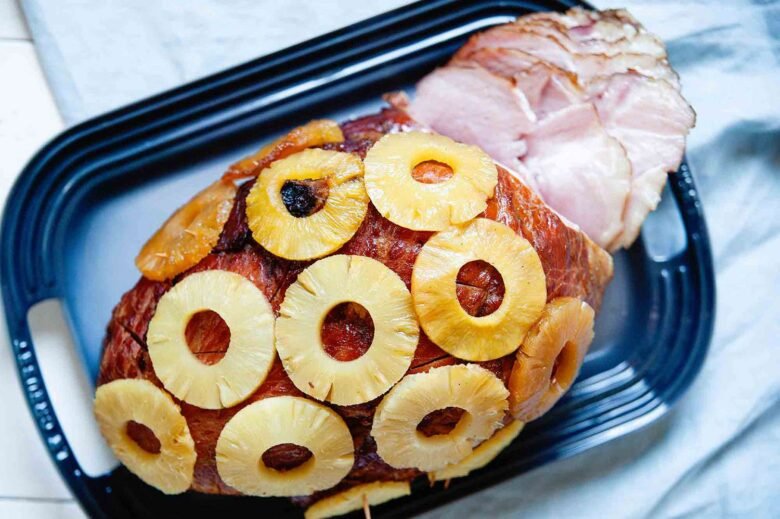
3. Add pineapple rings for presentation. Lay several rings of canned pineapple over the surface of the ham in the slow cooker and secure with toothpicks. They caramelize beautifully during cooking and make the finished ham look extraordinarily festive on the carving board.
4. Cook on LOW — always. HIGH heat can cause the outside of the ham to dry out before the center heats through. LOW, slow, moist heat is what produces the uniformly tender, juicy result.
5. The ham is done when it reaches 140°F internally. Since the ham is already cooked, the target is simply to heat it through to 140°F (60°C) at the thickest point, not touching the bone. This typically takes 4 to 6 hours on LOW for a 7 to 8-pound bone-in ham.
6. Rest before carving. Allow the ham to rest for 15 minutes after the broiler finish before carving. The slices will be cleaner and the ham will retain more moisture.
7. Save the bone. The ham bone is the foundation of one of the great comfort food soups — ham and bean soup. Refrigerate after the meal and use within a week, or freeze for up to 3 months.
Serving the Easter Ham
An Easter ham deserves a proper table and proper accompaniments.
Carving. For a bone-in ham, start by cutting a few slices from the thinnest side to create a flat base. Then carve slices by cutting perpendicular to the bone — straight down until you hit the bone, then cut along the bone to release the slices. For a spiral-cut ham, simply run a knife along the bone to release all the pre-cut slices at once.
The platter. Arrange the carved slices on a large platter, overlapping slightly, with the bone positioned dramatically on the end. Garnish with fresh pineapple slices, maraschino cherries (classic), sprigs of fresh rosemary or thyme, and a scatter of whole cloves.
The Complete Easter Table
Sides:
- Scalloped or au gratin potatoes — creamy, cheesy, the classic ham companion
- Roasted asparagus with lemon and Parmesan — spring’s vegetable
- Honey-glazed roasted carrots — they echo the glaze on the ham
- Deviled eggs — an Easter table tradition
- Soft dinner rolls — for ham sandwiches with the leftovers
Dessert:
- Carrot cake with cream cheese frosting — the undisputed Easter dessert
- Lemon meringue pie — bright, springtime, and perfect after a rich ham dinner
- Hot cross buns — for a more traditional Easter finish
Drinks:
- Sparkling lemonade or mimosas for the adults
- Fresh-squeezed orange juice for children
- Iced tea — particularly good in the American South
The Day-After Ham Sandwich
One of the great gifts of an Easter ham is what happens the next day. Cold sliced ham on good bread with Dijon mustard, a handful of arugula, and a smear of leftover pineapple glaze as a condiment is one of the best sandwiches of the year. Plan for it. Buy good bread the day before.
Easy Variations
- Honey Dijon glaze. Replace the pineapple juice with orange juice and increase the Dijon to 3 tablespoons. A cleaner, more sophisticated glaze without the tropical sweetness.
- Cola ham. Replace the pineapple juice with Coca-Cola or Dr Pepper. The cola’s caramel notes add a subtle depth and the carbonation helps tenderize the surface. A Southern classic.
- Maple and bourbon glaze. Replace the brown sugar and pineapple juice with pure maple syrup and bourbon. Deeply flavored, warmly sweet, and distinctly American.
- Cherry glaze. Replace the pineapple with cherry preserves and cherry juice. Use maraschino cherries pressed into the scored diamonds instead of cloves. A visually stunning variation.
- Spicy apricot glaze. Use apricot jam, apple cider vinegar, Dijon, and a generous pinch of cayenne. A sweet-spicy-tangy glaze that is excellent on both the ham and as a sandwich condiment.
Make-Ahead and Storage
Make-ahead: The glaze can be made up to 5 days ahead and stored in the refrigerator. The ham can be scored and cloves inserted the day before.
Refrigerator: Leftover ham keeps tightly wrapped for up to 5 days. Store sliced ham with some of the pan sauce drizzled over it to keep it moist.
Freezer: Ham freezes well for up to 2 months. Freeze in portions with sauce. Thaw overnight in the fridge.
The ham bone: Refrigerate for up to a week or freeze for 3 months. Use for ham and bean soup — one of the great uses for a holiday ham bone.
Shopping List
The Ham
- 1 bone-in, skin-on ham, 6–8 lbs (2.7–3.6 kg), preferably spiral-cut
- 20–25 whole cloves (for pressing into the scored surface)
The Pineapple Glaze
- 1 can (20 oz) crushed pineapple, undrained
- ½ cup (120ml) pineapple juice (from the can or additional)
- ½ cup (100g) packed dark brown sugar
- 3 tbsp Dijon mustard
- 2 tbsp apple cider vinegar
- 1 tbsp bourbon (optional)
- ½ tsp ground ginger
- ¼ tsp ground cinnamon
- Pinch of ground cloves
- Pinch of black pepper
For Presentation
- 1 can (20 oz) pineapple rings (for decorating the ham)
- Maraschino cherries (for pressing into the pineapple rings)
- Toothpicks (for securing pineapple rings)
- Fresh rosemary or thyme for the platter
Slow Cooker Easter Ham with Pineapple Glaze
A bone-in spiral-cut ham slow-cooked for 5 to 6 hours in a rich pineapple brown sugar glaze of crushed pineapple, Dijon, warm spices, and a splash of bourbon — emerging impossibly tender, deeply glazed, and uniformly moist from surface to center. Finished under the broiler until the glaze is caramelized and lacquered, garnished with pineapple rings and maraschino cherries, and served with the reduced pan sauce alongside. The Easter ham that becomes the Easter ham from now on.
- Total Time: 5 hours 41 minutes
- Yield: 10–12 servings 1x
Ingredients
The Ham
- 1 bone-in spiral-cut ham, 6–8 lbs (2.7–3.6 kg)
- 20–25 whole cloves
The Pineapple Glaze
- 1 can (20 oz / 565g) crushed pineapple, undrained
- ½ cup (120ml) pineapple juice
- ½ cup (100g) packed dark brown sugar
- 3 tbsp Dijon mustard
- 2 tbsp apple cider vinegar
- 1 tbsp bourbon (optional)
- ½ tsp ground ginger
- ¼ tsp ground cinnamon
- Pinch of ground cloves
- Pinch of black pepper
For Presentation
- 1 can (20 oz) pineapple rings
- Maraschino cherries
- Toothpicks
- Fresh rosemary or thyme for the platter
Instructions
- Score and stud the ham. Using a sharp knife, score the fat cap of the ham in a crosshatch diamond pattern — lines approximately 1 inch apart and ¼ inch deep. Press one whole clove into the center of each diamond.
- Make the glaze. In a medium bowl, whisk together the crushed pineapple (with its juice), additional pineapple juice, brown sugar, Dijon mustard, apple cider vinegar, bourbon (if using), ginger, cinnamon, ground cloves, and black pepper until well combined.
- Place the ham. Place the ham cut-side down in the slow cooker. Pour the pineapple glaze evenly over the ham, ensuring it flows between the spiral-cut slices. Lay 3 to 4 pineapple rings over the surface and secure with toothpicks.
- Cook. Set the slow cooker to LOW and cook for 4 to 6 hours, until the ham reaches an internal temperature of 140°F (60°C) at the thickest point, not touching the bone. Baste with the glaze from the bottom of the insert 2 to 3 times during cooking.
- Rest and prepare for broiling. Carefully transfer the ham to a large roasting pan or rimmed baking sheet. Allow to rest for 10 minutes while preheating the broiler and straining the pan drippings.
- Strain the drippings. Pour the liquid from the slow cooker through a fine-mesh sieve into a small saucepan. Set aside for the pan sauce.
- Glaze and broil. Brush the ham generously with the thickest portion of the sieved glaze. Place pineapple rings back on the surface, press maraschino cherries into the center of each ring, and secure with toothpicks. Slide under a preheated broiler at HIGH, 6 inches from the heat. Broil for 5 to 8 minutes, watching continuously, until the glaze is deeply caramelized, bubbling, and slightly charred at the diamond edges.
- Make the pan sauce. Bring the strained drippings to a boil over medium-high heat. Reduce for 5 to 8 minutes until thickened. Add a splash of apple cider vinegar, taste, and adjust seasoning.
- Rest and carve. Rest the ham for 15 minutes before carving. For a spiral-cut ham, run a knife along the bone to release all the pre-cut slices. Arrange on a warm platter with fresh herbs and serve with the warm pan sauce alongside.
Notes
- Spiral-cut is the practical choice. Pre-sliced all the way through, a spiral-cut ham requires minimal carving effort and ensures the glaze penetrates every layer when poured between the slices. For a large family gathering, this is the most efficient presentation.
- Cut-side down in the slow cooker. Place the flat, cut face of the ham facing down. This protects the cut surface and positions the scored, glazed fat cap on top.
- Pour glaze between the slices. Do not just pour it over the top — work it between every spiral slice so the glaze penetrates throughout. This is the difference between a ham that is glazed only on the outside and one that has caramelized glaze in every bite.
- 140°F is the target. The ham is already cooked — you are heating it through. 140°F at the thickest part ensures it is heated evenly and safely without overcooking.
- The pan sauce is not optional for serving. The drippings are extraordinary — pineapple, brown sugar, bourbon, and ham juices all concentrated together. Reduced and served warm, it is one of the best accompaniments in the Easter dinner world.
- Watch the broiler. Brown sugar and pineapple juice caramelize very fast under a hot broiler. Stand at the oven. Watch continuously. Five minutes is usually enough; eight is the maximum before the risk of burning becomes significant.
- Save the bone. The ham bone produces one of the best soups of the year — split pea and ham, ham and white bean, or simply ham stock for seasoning everything else. Do not throw it away.
- Prep Time: 20 minutes
- Cook Time: 5 hours (on LOW)
- Category: Dinner, Holiday, Main Dish
- Method: Slow Cooking
- Cuisine: American
- Diet: Dairy-Free, Gluten-Free
Frequently Asked Questions
Do I need to cook ham in the slow cooker, or is it already cooked? Most hams sold at grocery stores are fully cooked and cured — the label will say “fully cooked,” “ready to eat,” or “heat and serve.” These hams are safe to eat cold straight from the package; slow cooking simply heats them through, allows the glaze to penetrate, and improves the texture and flavor dramatically. A small number of hams are sold “fresh” or “uncured” and require cooking to a higher internal temperature — always check the label. For a fully cooked ham, the target temperature is 140°F (60°C). For a fresh, uncured ham, cook to 160°F (71°C).
Why is my ham dry even though I used a slow cooker? Dry ham from a slow cooker is almost always the result of one of three things: cooking on HIGH instead of LOW (the higher heat dries the exterior before the interior heats through), cooking well past 140°F (overcooking a fully cooked ham dries it out just like overcooking any protein), or not enough liquid in the slow cooker (the pineapple glaze and crushed pineapple provide the moisture — if they were reduced too much or omitted, the steam environment was insufficient). A spiral-cut ham is also more prone to drying than a whole ham because of the increased surface area — pour extra glaze between the slices to compensate.
Can I make this with a boneless ham? Yes — a boneless ham works well in the slow cooker and is considerably easier to slice and serve. The main differences are a slightly less dramatic presentation, slightly less flavorful drippings (no bone marrow contribution), and a shorter cooking time since boneless hams are typically smaller and more uniformly shaped. Check a boneless ham for 140°F starting at 3 hours on LOW.
How do I get the glaze to stick and not just slide off the ham? Three things ensure the glaze adheres. First, score the fat cap deeply enough — ¼ inch deep cuts give the glaze texture to cling to. Second, apply the glaze in multiple stages — pour it over at the start, baste every hour or two during cooking, and brush it on generously right before the broiler. Third, the broiler finish is what truly locks the glaze in place — the caramelization of the sugar creates a sticky, lacquered coating that adheres firmly to the scored surface.
Can I add the pineapple rings and cherries at the start of slow cooking instead of just for the broiler? You can place pineapple rings over the ham at the start of cooking and they will soften and caramelize throughout. However, maraschino cherries added at the start will fall apart and bleed their color into the glaze. Add the cherries only for the broiler finish. If you want pineapple flavor throughout the cooking, add the rings from the start — they contribute to the liquid and flavor of the braise.
What is the best way to use the leftover ham bone? The ham bone is the starting point for some of the best comfort food soups. The classic use is split pea and ham soup — simmer the bone in water with split peas, carrots, celery, and onion for 2 to 3 hours. Ham and white bean soup (with cannellini or navy beans) is equally excellent. Or simply simmer the bone in water with aromatics for 2 to 3 hours to produce a rich, smoky ham stock that can replace chicken broth in virtually any recipe for added depth. The bone keeps in the fridge for up to a week or in the freezer for 3 months.
How do I serve ham to a large group efficiently? For a spiral-cut ham, the most efficient serving method is to run a sharp carving knife along the bone from top to bottom, releasing all the pre-cut spiral slices at once. They fan out naturally into individual portions. For a whole bone-in ham, carve in the traditional way — horizontal slices perpendicular to the bone until you reach the bone, then cut along the bone to release. Arrange carved slices on a warm platter overlapping slightly, and keep the bone as a dramatic visual anchor at one end of the platter. Have the pan sauce in a warm jug ready to drizzle over each serving.
Can I make this ham for a crowd larger than 12 people? For more than 12 people, the best approach is a larger ham rather than two separate hams — a 10 to 12-pound bone-in ham serves 14 to 18 people and fits in a large 8-quart slow cooker. If you need to serve 20 or more, two slow cookers running simultaneously with two 7 to 8-pound hams is the most practical approach. The cooking time for a larger ham will be slightly longer — plan for 6 to 8 hours on LOW for a 10 to 12-pound roast and use the thermometer rather than the clock.