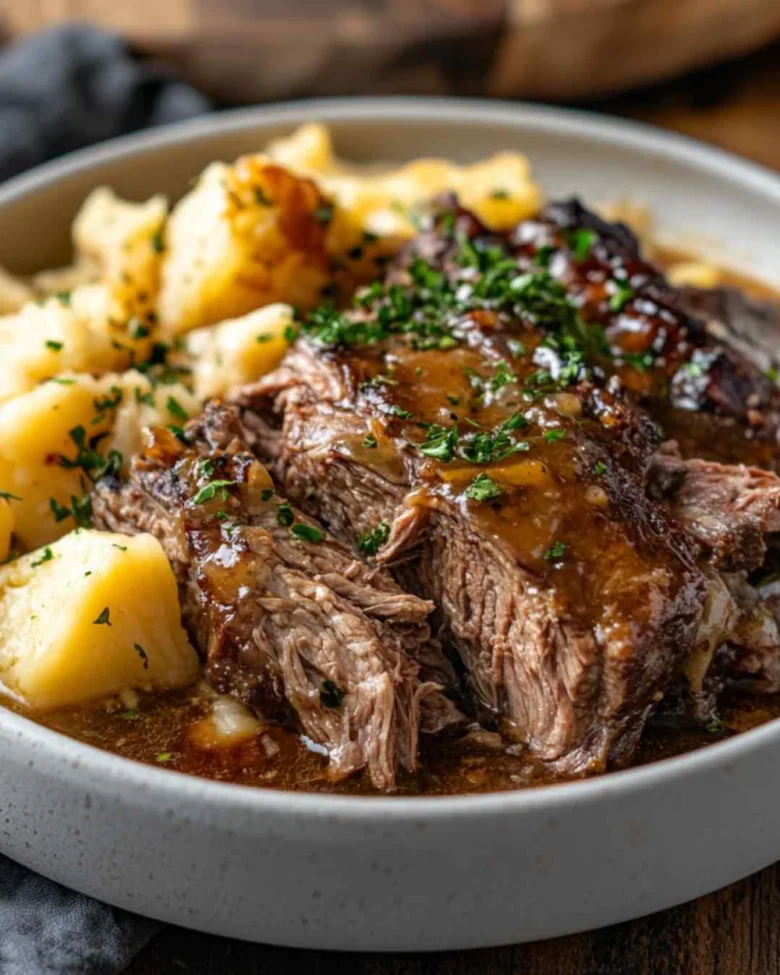
Prime rib is one of the great celebrations in the world of roasted meat. A standing rib roast — well-marbled, bone-in, rubbed with herbs and garlic, cooked until the exterior is deeply crusted and the interior is a perfect rosy pink from edge to edge — is the kind of thing that earns genuine silence around the table before the compliments begin. It is the roast that announces that something important is happening. On Christmas, that is exactly the right message.
The conventional approach to prime rib — a hot oven, careful temperature monitoring, a high-heat sear at the beginning or end — produces extraordinary results but requires confidence, vigilance, and a well-calibrated oven. One degree too many and the rosy interior that makes prime rib worth making becomes a disappointment. The anxiety of an overcooked prime rib on Christmas Day is a particular kind of stress that no one needs.
The slow cooker changes that calculation entirely. The low, even, completely controlled heat of a slow cooker is, counterintuitively, one of the best environments for cooking a large roast like prime rib. The meat comes to temperature slowly and gently, producing an even pink color from edge to center that no oven method consistently achieves. The drippings — herb-infused, beefy, aromatic — become the foundation of the most extraordinary au jus or Yorkshire pudding you have ever tasted.
The broiler does the crust work in minutes at the end. The result is prime rib that is simultaneously easier, more consistent, and arguably more beautifully cooked than the oven version.
This is the recipe for a stress-free Christmas roast that looks and tastes like it came from a professional kitchen.
Understanding Prime Rib
Prime rib refers to a standing rib roast — a section of ribs from the beef rib primal, typically cut from ribs six through twelve. It is one of the most expensive and most prized cuts of beef, and for good reason: the rib section sits along the spine, a muscle that does minimal work, producing exceptionally tender, heavily marbled meat.
Prime vs Choice. The word “prime” in prime rib refers to the cut, not the USDA grade — though for a Christmas roast of this significance, seeking out USDA Prime-graded beef is worth the additional cost. Prime-graded beef has more intramuscular fat (marbling) than Choice-graded beef, which produces a richer, more flavorful, more juicy roast. If Prime is unavailable, Choice is perfectly good. Select-grade is not recommended for a special-occasion roast.
Bone-in vs boneless. Bone-in prime rib is the traditional and correct choice for a standing rib roast. The bones act as a natural rack, conduct heat to the interior, add flavor through the marrow and collagen, and make a dramatically more impressive visual presentation than a boneless roast. If the bones have been removed and tied back (called “hotel style”), that is fine. Fully boneless is less traditional and produces a slightly less dramatic result.
Sizing. A single rib feeds approximately 2 people. A 3-rib roast (approximately 7 to 8 lbs) serves 6 to 8. A 4-rib roast (approximately 9 to 10 lbs) serves 8 to 10. For a slow cooker, you need a roast that fits with the lid sitting completely flat — most 7 to 8-quart oval slow cookers will accommodate a 3 to 4-rib roast depending on its exact shape. Measure your slow cooker before purchasing.
The Herb Crust
A great prime rib herb crust is the difference between a good roast and a memorable one. Applied generously to every surface at least 24 hours in advance, it seasons the meat deeply and forms the foundation of the caramelized, aromatic crust that develops under the broiler.
The dry brine. Before any herbs or flavorings, the most important preparation step is a 24 to 48-hour dry brine. Apply kosher salt generously — approximately ½ teaspoon per pound — to every surface of the roast. Refrigerate uncovered on a rack. The salt draws moisture to the surface, which then reabsorbs into the meat, seasoning more deeply than any amount of surface seasoning can achieve after cooking. It also dries the surface of the roast, which is essential for the broiler crust at the end.
The herb paste. Combine softened butter, fresh rosemary, fresh thyme, fresh sage, garlic, Dijon mustard, black pepper, and a small amount of olive oil into a paste. Apply this generously over the salted roast on top of the dry brine, pressing it firmly into every surface. The butter in the paste bastes the roast during cooking and produces the foundation of the herb crust.
Mustard as an adhesive. The Dijon mustard in the paste serves two purposes: it adds flavor and it acts as an adhesive, helping the herbs and aromatics adhere to the surface of the meat rather than falling off during handling and cooking.
The Slow Cooker Method for Prime Rib
The slow cooker method for prime rib works because of one fundamental principle: the meat reaches its target temperature slowly, gently, and evenly rather than from outside heat penetrating inward. This is the same principle that makes sous vide cooking produce such consistently perfect results — and the slow cooker, while less precise, achieves a similar effect.
The vegetable rack. A layer of roughly chopped onion, carrot, celery, and garlic on the bottom of the slow cooker insert creates a trivet that elevates the roast above the liquid and flavors the drippings. Place the roast bone-side down on top of the vegetables.
Low heat only. The target internal temperature for prime rib is:
- Rare: 120–125°F (49–52°C) — very red center
- Medium-rare: 130–135°F (54–57°C) — pink center, the ideal
- Medium: 140–145°F (60–63°C) — slightly pink
- Well-done: 155°F+ (68°C+) — not recommended for prime rib
With the broiler finish adding approximately 5 to 10°F to the exterior temperature, pull the roast from the slow cooker 5 degrees below your target temperature.
A meat thermometer is mandatory. Not optional. Not a suggestion. A quality instant-read thermometer inserted into the thickest part of the roast, not touching the bone, is the only way to know when to pull it. Slow cooker temperatures vary between models and roast sizes vary considerably.
Do not lift the lid. Every time the lid is lifted, heat and steam escape and the cooking temperature drops. Set it and leave it until the target temperature is within 10°F.
The Broiler Crust — The Essential Finish
Slow cooker prime rib is perfectly cooked inside — but pale, soft, and lacking the dramatic, caramelized, herb-encrusted exterior that makes prime rib visually stunning. The broiler provides that in minutes.
After the slow cooker reaches the target temperature, transfer the roast to a large roasting pan or rimmed baking sheet. Slide it under a preheated broiler at the highest setting, 6 inches from the heat. Broil for 5 to 10 minutes — watching absolutely continuously — until the herb crust is deeply browned, sizzling, and aromatic.
The transformation is dramatic. The pale, slow-cooked exterior becomes the golden, caramelized, herb-encrusted crust that makes prime rib look like prime rib. The internal temperature will rise 5 to 10°F during broiling and resting — factor this into when you pull from the slow cooker.
The Au Jus
The drippings left in the slow cooker after the roast is removed are extraordinary — richly beefy, herb-infused, deeply flavored from hours of slow cooking. They are the basis of the au jus that is served alongside.
Strain the drippings through a fine-mesh sieve into a fat separator or measuring jug. Allow to settle and skim the fat. Pour the defatted drippings into a small saucepan. Add additional beef broth to reach the desired volume and simmer for 5 to 8 minutes until slightly reduced and concentrated. Season with salt and pepper and a small squeeze of lemon to brighten.
Serve warm in a small jug or sauce boat alongside the carved prime rib. The au jus should be clear, deeply colored, and intensely beefy — a drizzle over each slice of roast is both traditional and transformative.
Horseradish Cream
Prime rib and horseradish cream have a classic relationship that deserves acknowledgment. The sharp, pungent heat of prepared horseradish against the rich, fatty beef is one of the great pairings in the meat-and-condiment world.
Simple horseradish cream: Combine ½ cup of sour cream, 2 to 3 tablespoons of prepared horseradish (or freshly grated), 1 tablespoon of Dijon mustard, 1 teaspoon of lemon juice, salt, and pepper. Stir and refrigerate for at least 30 minutes before serving to allow the flavors to meld. Can be made up to 3 days ahead.
Tips for Perfect Slow Cooker Prime Rib
1. Dry brine 24 to 48 hours ahead — no exceptions. The salt penetration from an overnight dry brine is the most important single step in the entire recipe. It seasons the meat from the inside, improves moisture retention, and dries the surface for a better broiler crust. This step cannot be shortcut.
2. Bring the roast to room temperature before cooking. Remove the roast from the fridge 1 hour before placing in the slow cooker. A room-temperature roast cooks more evenly from edge to center than a cold roast.
3. Use a quality instant-read thermometer. A Thermapen or similar quality instant-read thermometer is the single most useful piece of equipment for cooking prime rib. Pull the roast from the slow cooker 5°F below your target temperature to account for the broiler finish.
4. Rest for 20 to 30 minutes after broiling. This is one of the longest rests in this series — prime rib is a thick, dense roast and the juices need time to redistribute through the entire mass of meat. Carving too early produces a flood of juice on the cutting board and a drier roast. Tent loosely with foil and wait.
5. Carve against the grain, bone in hand. Carve the roast by cutting between the bones first to separate individual rib sections if serving bone-in, or slice across the grain into ½ to ¾-inch slices for the most tender result.
6. Have everything else ready before the roast is done. Prime rib waits for no side dish. Have the mashed potatoes, Yorkshire pudding, roasted vegetables, and horseradish cream all ready before the roast comes out of the slow cooker.
7. Save the bones. After the meal, the rib bones are extraordinary for making beef bone broth. Refrigerate and use within a week, or freeze for up to 3 months.
The Complete Christmas Dinner
Prime rib is the centerpiece. Build the Christmas table around it.
- Yorkshire pudding — made in the oven while the roast rests under the broiler, using some of the drippings
- Creamy mashed potatoes — generous, buttery, with the au jus spooned over
- Roasted root vegetables — parsnips, carrots, and Brussels sprouts with herbs
- Creamed spinach — rich and savory alongside the beef
- Horseradish cream — the essential condiment
- Crusty bread — for soaking up the au jus
- A good red wine — Cabernet Sauvignon, Bordeaux, or a Barolo
Easy Variations
- Herb and garlic only. Omit the mustard from the paste for a cleaner, more traditional herb crust. The garlic and rosemary combination is timeless.
- Coffee and pepper crust. Add 1 tablespoon of finely ground espresso and 1 tablespoon of coarsely ground black pepper to the herb paste. A bold, sophisticated crust that pairs beautifully with the au jus.
- Red wine au jus. Add ½ cup of good red wine (Cabernet or Merlot) to the slow cooker liquid base. The wine enriches the drippings and produces a more complex, deeper-colored au jus.
- Garlic butter only. For a simpler approach, use a paste of softened butter, roasted garlic, salt, and pepper only. The simplicity lets the beef quality speak entirely for itself.
Shopping List
The Roast
- 1 standing rib roast, 3–4 ribs, bone-in (approximately 7–10 lbs / 3.2–4.5 kg), USDA Prime or Choice
- Kosher salt (for dry brine — approximately ½ tsp per lb)
The Herb Paste
- 4 tbsp (60g) unsalted butter, softened
- 6 cloves garlic, minced
- 2 tbsp fresh rosemary, finely chopped
- 2 tbsp fresh thyme leaves
- 1 tbsp fresh sage, finely chopped
- 1 tbsp Dijon mustard
- 1 tbsp olive oil
- 1 tsp black pepper (coarsely ground)
The Vegetable Rack
- 1 large onion, roughly quartered
- 2 carrots, roughly chopped
- 2 stalks celery, roughly chopped
- 1 whole head garlic, halved
- 2 sprigs fresh rosemary
- 3 sprigs fresh thyme
- 2 bay leaves
The Liquid
- 1 cup (240ml) low-sodium beef broth
The Au Jus
- Strained slow cooker drippings
- 1–2 cups additional beef broth
- Salt, pepper, and lemon juice to taste
The Horseradish Cream
- ½ cup (120g) sour cream
- 3 tbsp prepared horseradish
- 1 tbsp Dijon mustard
- 1 tsp fresh lemon juice
- Salt and pepper
Slow Cooker Christmas Prime Rib
A magnificent standing rib roast slow-cooked to a perfect, rosy medium-rare from edge to center — the gentle, even heat of the slow cooker achieving what an oven rarely can — then finished under a screaming hot broiler until the herb and garlic crust is deeply caramelized and fragrant. The drippings become an extraordinary au jus. Served with horseradish cream and everything else a Christmas table deserves. Easier than any oven method, more consistent than any oven method, and the Christmas roast that earns the longest silence before the compliments begin.
- Total Time: 6–9 hours (day of)
- Yield: 6–10 servings depending on roast size 1x
Ingredients
The Roast
- 1 standing rib roast, 3–4 ribs, bone-in (approximately 7–10 lbs)
- 1 tbsp kosher salt per 2 lbs of roast (for dry brine)
The Herb Paste
- 4 tbsp (60g) unsalted butter, softened
- 6 cloves garlic, minced
- 2 tbsp fresh rosemary, finely chopped
- 2 tbsp fresh thyme leaves
- 1 tbsp fresh sage, finely chopped
- 1 tbsp Dijon mustard
- 1 tbsp olive oil
- 1 tsp coarsely ground black pepper
The Vegetable Rack
- 1 large onion, roughly quartered
- 2 carrots, roughly chopped
- 2 stalks celery, roughly chopped
- 1 head garlic, halved crosswise
- 2–3 sprigs fresh rosemary and thyme
- 2 bay leaves
The Liquid
- 1 cup (240ml) low-sodium beef broth
The Au Jus
- Strained drippings from the slow cooker
- 1 cup (240ml) additional beef broth
- Salt, pepper, and a squeeze of lemon
Horseradish Cream (served alongside)
- ½ cup (120g) sour cream
- 3 tbsp prepared horseradish
- 1 tbsp Dijon mustard
- 1 tsp fresh lemon juice
- Salt and pepper to taste
Instructions
- Dry brine 24–48 hours ahead. Pat the roast completely dry. Apply kosher salt generously to every surface — approximately ½ teaspoon per pound of meat. Place bone-side down on a rack set over a rimmed baking sheet. Refrigerate uncovered for 24 to 48 hours. Do not skip this step.
- Apply the herb paste. 1 hour before cooking, remove the roast from the fridge. Combine all herb paste ingredients in a small bowl. Rub the paste generously over every surface of the salted roast, pressing firmly so it adheres completely.
- Build the vegetable rack. Arrange the quartered onion, carrots, celery, halved garlic head, and fresh herb sprigs on the bottom of the slow cooker insert. Add the bay leaves. Pour the beef broth over the vegetables.
- Place the roast. Place the prime rib, bone-side down, on top of the vegetable rack. The roast should be elevated above the liquid.
- Cook on LOW. Set the slow cooker to LOW and cook until the internal temperature reaches 5°F below your target — for medium-rare (the ideal for prime rib), pull at 125–130°F (before the broiler adds the final degrees). Begin checking with an instant-read thermometer at the 4-hour mark for a 7-lb roast. A larger roast may take 6 to 8 hours. Check every 30 to 45 minutes once within 15°F of target.
- Rest while preparing the broiler. Transfer the roast to a large roasting pan or rimmed baking sheet, bone-side down. Tent loosely with foil and rest for 15 minutes while the broiler preheats and you strain the drippings.
- Strain the drippings. Pour all the liquid from the slow cooker through a fine-mesh sieve into a heatproof jug. Press the vegetables to extract maximum flavor. Skim the fat. Set aside for the au jus.
- Broil the crust. Remove the foil. Slide the roast under a preheated broiler at HIGH, 6 inches from the heat. Broil for 5 to 10 minutes, watching continuously, until the herb crust is deeply browned, sizzling, and caramelized. The internal temperature will rise 5 to 8°F during this time.
- Rest — this is mandatory. Transfer to a carving board and rest loosely tented with foil for 20 to 30 minutes. Do not carve early. The juices need this time to redistribute.
- Make the au jus. While the roast rests, pour the strained drippings into a small saucepan. Add additional beef broth to desired volume. Simmer over medium-high heat for 5 to 8 minutes until slightly reduced. Season with salt, pepper, and a small squeeze of lemon.
- Make the horseradish cream. Combine all ingredients, stir well, and taste. Refrigerate until serving.
- Carve and serve. Carve by slicing between the ribs for individual bone-in portions, or across the grain into ½ to ¾-inch slices for boneless-style serving. Serve on a warm platter with au jus in a warm jug alongside and horseradish cream in a small bowl.
Notes
- The dry brine is the most important step. Forty-eight hours is better than twenty-four. The salt penetrates the meat deeply, seasons from the inside, and dries the exterior for a dramatically better broiler crust. Make this happen.
- Medium-rare is the target. Prime rib cooked to medium-rare (130–135°F after resting) is the version that honors the quality of the cut. Above 140°F, the fat stops rendering into the meat and the texture changes from silky to firm. Pull from the slow cooker at 125–130°F — the broiler and the rest will carry it to 135°F.
- The thermometer is mandatory. Slow cooker temperatures vary between models and prime rib roasts vary in shape, bone density, and starting temperature. There is no reliable time estimate for doneness. The thermometer is the only truth.
- The rest is mandatory. A 20 to 30 minute rest for a roast of this size is not optional. The interior temperature continues to rise during resting (carry-over cooking) and the juices need time to redistribute. Cutting early produces a disappointing, dry-edged result.
- The slow cooker produces an even pink from edge to center. This is the great advantage over oven roasting. The oven produces a gradient — very well-done at the edges, perfectly pink in the center. The slow cooker’s even heat produces the same temperature throughout — every slice is equally beautiful.
- Save the vegetables and bones. The slow cooker vegetables are deeply flavored and make an excellent addition to beef soup or stew. The bones, after the meal, are extraordinary for beef bone broth.
- Prep Time: Dry Brine; 24–48 hours ahead – Prep Time20 minutes
- Cook Time: 5 – 8 hours (on LOW, depends on roast size)
- Category: Dinner, Holiday, Main Dish
- Method: Slow Cooking
- Cuisine: American, British
- Diet: Dairy-Free, Gluten-Free
Frequently Asked Questions
What internal temperature should prime rib be? Target temperatures for prime rib are: rare 120–125°F (49–52°C), medium-rare 130–135°F (54–57°C), medium 140–145°F (60–63°C), medium-well 150°F (65°C). Medium-rare is the classic and recommended temperature — it is the point at which the fat has rendered into the meat, the protein is silky and tender, and the rosy pink color is at its most beautiful. For the slow cooker method, pull the roast at 125–130°F to account for the 5 to 10°F rise during the broiler finish and the subsequent rest.
Can I cook prime rib in a slow cooker without searing or broiling? Technically yes — the meat will be fully cooked and tender. But the result will be pale, without a crust, and significantly less visually impressive than a properly finished roast. The broiler finish takes 8 minutes and transforms the appearance and flavor of the exterior completely. For a Christmas roast of this quality and cost, the broiler step is not optional in any practical sense.
How do I know when to start the slow cooker for Christmas dinner? Work backward from when you want to serve. For a 7 to 8-pound roast at medium-rare, plan for 5 to 6 hours in the slow cooker, 8 minutes under the broiler, and 25 minutes of rest — approximately 6 hours and 35 minutes from slow cooker start to carving. For a 9 to 10-pound roast, plan for 7 to 8 hours plus the same finishing time. Always give yourself an extra hour buffer — the roast can be held in the slow cooker on WARM briefly if it is done early, or moved to a low (175°F) oven, tented with foil.
What if my prime rib is done too early? If the roast reaches target temperature earlier than expected, you have two options. First, if serving within 1 hour, hold the roast in the slow cooker on WARM (without broiling yet) — the temperature will not rise significantly on WARM. Broil and rest just before serving. Second, if serving more than 1 hour away, broil and carve, then hold the sliced roast in a low oven (170°F) loosely covered with foil with some of the au jus spooned over the slices to keep them moist.
Does prime rib need to be covered with liquid in the slow cooker? No — and it should not be. The prime rib rests on the vegetable trivet, elevated above the small amount of liquid in the base. The slow cooker’s enclosed environment creates a steam atmosphere that cooks the roast without submerging it. Submerging the roast in liquid would produce a braised beef result rather than a roasted one — the texture and flavor would be entirely different and considerably less impressive.
Is slow cooker prime rib as good as oven-roasted prime rib? Different rather than better or worse in most respects — with one significant advantage. Slow cooker prime rib produces more even cooking from edge to center than an oven roast. The oven creates a gradient of doneness — well-done exterior, medium toward the edges, perfectly medium-rare in the center — that is characteristic and loved by some but means different guests get different quality of meat. The slow cooker produces essentially the same temperature throughout the roast — every slice is equally rosy and equally beautiful. The broiler provides the exterior crust that the oven’s radiant heat creates from the start. The main thing oven prime rib does better is the dripping-based basting effect during roasting — which the herb butter paste partially compensates for.
Can I make the au jus ahead of time? The au jus is best made from the slow cooker drippings on the day of cooking — that is what makes it extraordinary. However, you can make a basic beef au jus from roasted beef bones and aromatics up to 3 days ahead and store it in the fridge. On Christmas Day, combine your pre-made au jus with the fresh drippings from the slow cooker for the best of both — depth from the prepared base and freshness from the day’s drippings.
What wine pairs best with prime rib? Prime rib’s rich, fatty, deeply beefy character calls for a full-bodied, tannic red wine that can stand up to and cut through the fat. The classic pairings are: Cabernet Sauvignon (Napa Valley or Bordeaux — the most traditional), Syrah/Shiraz (for a spicier, more complex pairing), Barolo or Barbaresco (Italian Nebbiolo — elegant and deeply structured), Malbec (a more accessible, fruit-forward option). Whatever you choose, serve it at a slightly cool room temperature (around 62–65°F) — too warm and the alcohol becomes aggressive against the rich meat.