Grocery List for Big Families Who Cook in Bulk
A systematic guide to bulk procurement, inventory management, batch cooking methodologies, and the economics of feeding six or more people efficiently every week.
The economic case for bulk buying
The financial case for bulk buying is well-documented — but the numbers are more dramatic than most families realise. Transitioning from traditional grocery habits to a bulk-buy and batch-cooking framework delivers significant savings, reduced food waste, and a far more streamlined daily routine.
While bulk buying requires a higher initial outlay, the “retail premium” paid for small, convenient packaging is essentially an interest payment on the lack of storage. By treating the home pantry as a micro-warehouse, large families can hedge against food inflation and supply chain volatility.
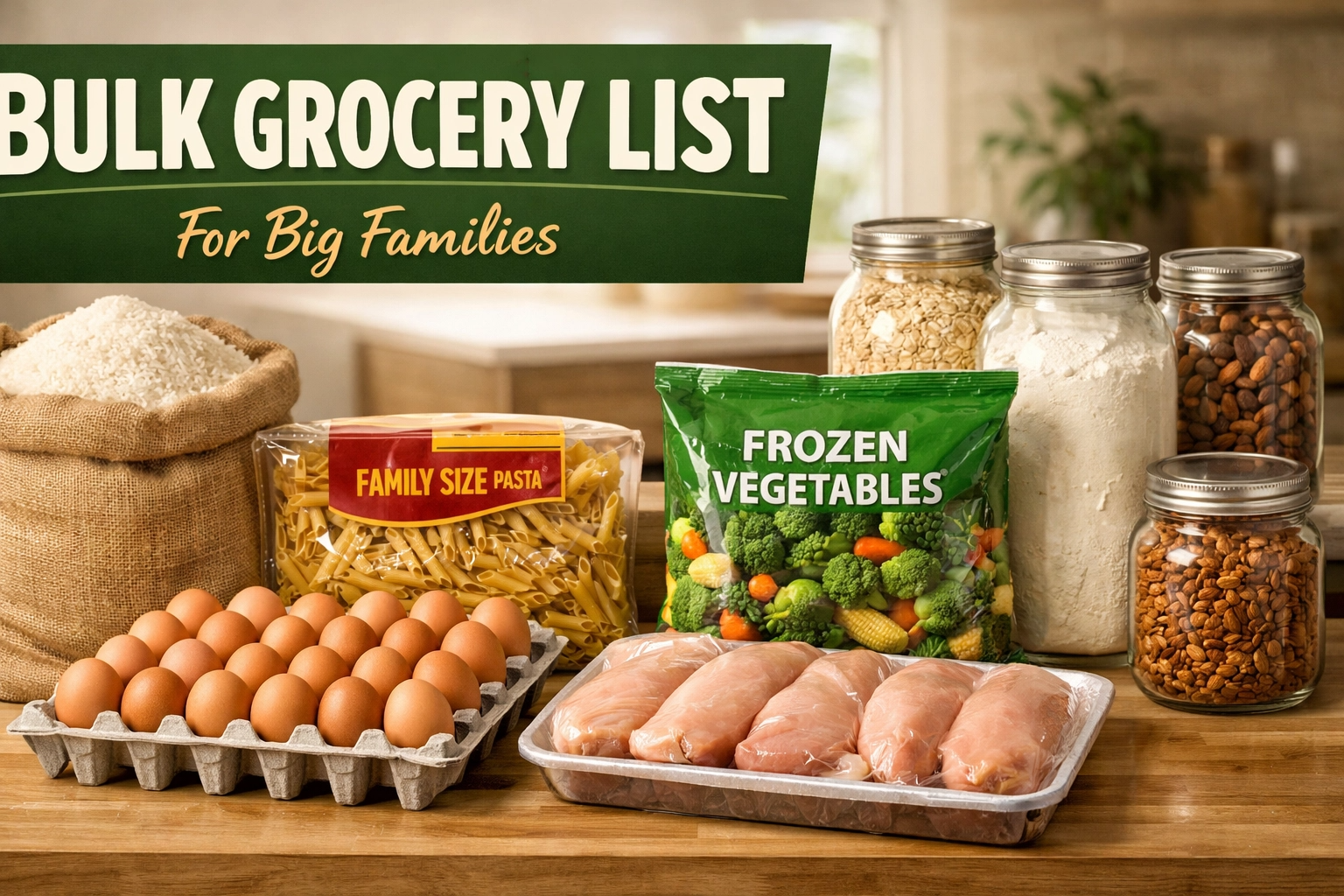
The master bulk grocery list
A successful bulk strategy is built on a core-and-satellite model. The “core” is shelf-stable items forming the base of most meals. “Satellites” are fresh components bought more frequently on top of the core pantry.
- Quarter or half cow from local locker — lowest price per lb
- Pork shoulder — 10+ lb bulk packs
- Ground beef — 10 lb bulk tubes
- Bulk cases of chicken thighs (40 lbs)
- Chicken breast — wholesale club cases
- Whole chickens — cheaper per lb than parts
- Black beans — 25 lb bags
- Pinto beans — 25 lb bags
- Lentils — 25 lb bags
- Eggs — by the flat (30) or case (15 dozen)
- Jasmine or basmati — 20 to 50 lb bags
- One of the cheapest calories-per-dollar foods available
- Penne, rotini, spaghetti — bulk boxes
- Rolled oats — large canisters or bags
- Couscous — 10 lb bags
- Barley — 10 lb bags
- All-purpose flour — 25 lb bags
- Sugar — 25 lb bags
- Baking powder & baking soda
- Salt — large containers
- Potatoes — 50 lb bags
- Onions — 10 lb bags
- Carrots — 10 lb bags
- Store for weeks to months in cool, dark conditions
- Peas
- Corn
- Broccoli florets
- Mixed stir-fry vegetables
- Picked at peak ripeness — zero prep waste
- Tomato sauce
- Diced tomatoes
- Corn
- Chickpeas
- Restaurant-size cans for large-batch cooking
- Olive oil — 1 gallon jugs
- Vegetable or canola oil — 1 gallon
- Butter — 4 lb bulk blocks
- Non-stick cooking spray — multi-pack
- Salt — 4 lb containers
- Black pepper — large grinder jar
- Garlic powder — 1 lb bag
- Onion powder — 1 lb bag
- Smoked paprika — 1 lb bag
- Cumin, oregano, chili powder
- Soy sauce — large bottle
- Worcestershire sauce
- Hot sauce — large bottles
- Ketchup — gallon jug
- Mayonnaise — large jar
- Stock — large cartons or powder
Inventory management: FIFO & digital tracking
Managing 25 lb bags of flour and 40 lbs of chicken requires more than shelf space — it requires a system. Two methods are essential for any large-family pantry.
The FIFO method (First In, First Out)
New stock must always be placed behind older stock. This is critical for dairy, eggs, and frozen meats. Label every item with a “Purchase Date” using a permanent marker — a simple habit that prevents spoilage worth hundreds of dollars per year.
Digital inventory tracking
For families of 6+, a spreadsheet (Excel or Google Sheets) or dedicated inventory app prevents double-buying and ensures meal planning is based on what is actually in stock — not what you think is in stock. Track these five columns:
Bulk cooking methodologies
Bulk cooking is the process of preparing large quantities of food at once to be consumed over several days or weeks. Two methods cover almost every scenario a large family faces.
- Brown 10 lbs of ground beef — seasoned generically for tacos, spaghetti, or shepherd’s pie
- Shred 20 lbs of chicken — use a stand mixer; poach first for easy shredding
- Cook a massive pot of rice or quinoa — portion into containers and freeze
- Roast 10 lbs of root vegetables — works as side dish or soup base
- Dump meals — raw ingredients in a gallon freezer bag, ready to tip straight into the slow cooker
- Casseroles in aluminium pans — lasagna, enchiladas, baked ziti — bake straight from frozen
- Breakfast burritos — assembly-line production of 50+ burritos, individually wrapped and frozen
- Soups and stews — freeze in large portions, the fastest possible weeknight dinner
Essential equipment for the bulk household
These are one-time investments that pay for themselves quickly. Standard kitchen equipment simply cannot handle 10-lb batch quantities.
Getting started: the stepping stone strategy
One of the biggest barriers to bulk buying is the initial investment hurdle. For families living paycheck to paycheck, spending $100 on bulk staples may feel impossible — even if it saves $40 over three months. The Stepping Stone Strategy overcomes this gradually.
The bottom line
Feeding a large family efficiently is a system problem, not just a shopping problem. By building a core-and-satellite pantry, implementing FIFO inventory control, adopting component-prep or OAMC batch cooking, and acquiring the right equipment, a family of 6–10 can dramatically reduce both their food spend and the daily cognitive load of “what’s for dinner?” — while consistently eating well.