
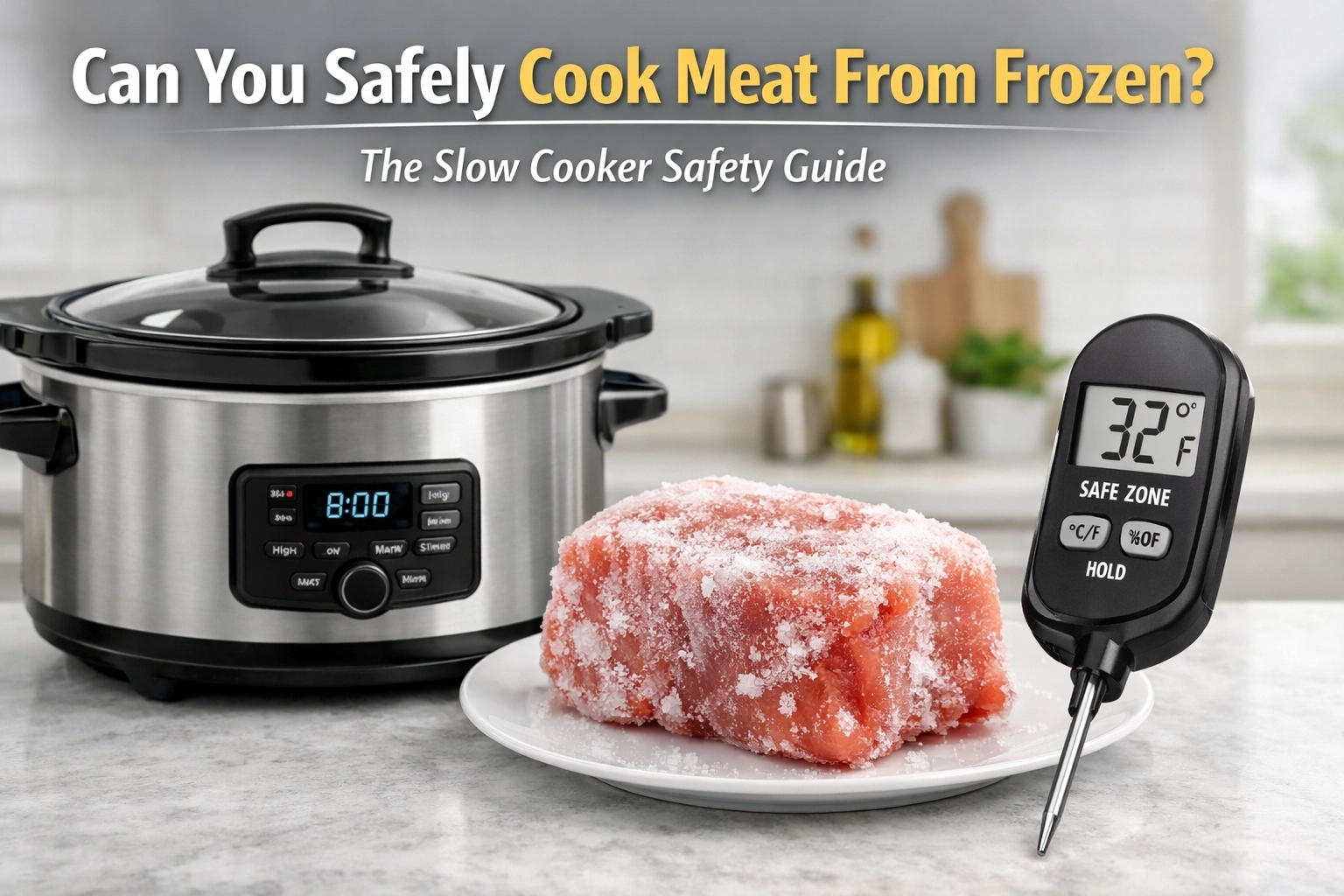
Can You Safely Cook Meat From Frozen in a Slow Cooker?

Can You Safely Cook Meat From Frozen in a Slow Cooker?
Can You Safely Cook Meat From Frozen?
Guides & Tips · Food Safety

Can You Safely Cook Meat From Frozen in a Slow Cooker?

⚠️
The short answer: No. Food safety authorities including the USDA advise against placing frozen meat directly into a slow cooker. This guide explains exactly why — and what to do instead.

The problem with frozen meat in a slow cooker

Slow cookers are beloved for their convenience — but that same low-and-slow approach becomes a liability when dealing with frozen meat. Placing a solid block of frozen meat into a slow cooker means the meat spends a prolonged period warming up, which can keep it — and everything around it — in the bacterial danger zone for far too long.

This isn’t a niche concern. The USDA’s Food Safety and Inspection Service (FSIS) is explicit: always thaw meat before slow cooking. The risks involve both food safety and cooking quality.

🌡️
The temperature danger zone: 40°F – 140°F (4°C – 60°C)
Within this range, bacteria like Salmonella, E. coli, and Listeria can double in number every 20 minutes. A large piece of frozen meat can keep the slow cooker’s contents within this zone for several hours — creating ideal conditions for bacterial growth.

Why it’s unsafe — the science

Slow heating can’t outpace bacteria
Slow cookers heat between 170°F–280°F, but they do so gradually. Frozen meat prevents the cooker from climbing out of the danger zone quickly enough.
Heat-stable bacterial toxins
Bacteria like Staphylococcus aureus produce toxins that are not destroyed by cooking, even once the bacteria themselves are killed. Extended time in the danger zone allows toxin build-up.
Uneven cooking
Frozen meat cooks unevenly — the outside may reach temperature while the inside remains dangerously cold, making it impossible to confirm safety.
Reduced cooking quality
Beyond safety, frozen meat releases excess water, diluting the cooking liquid and preventing proper flavour development and browning.

Safe thawing methods

Food safety authorities recommend three approved methods for thawing meat before slow cooking. Each involves keeping the meat consistently below the danger zone throughout the thaw.

❄️
In the refrigerator
24 hrs per 5 lbs
The gold standard. Consistent cold temperature keeps the meat well below the danger zone throughout. Requires planning ahead.
Best method
💧
Cold water
~1 hr per lb
Submerge in a sealed leak-proof bag in cold tap water. Change the water every 30 minutes to keep it cold. Cook immediately after thawing.
Faster option
🔆
In the microwave
Minutes
Use the defrost setting. Some parts may begin to cook unevenly — you must place the meat directly into the slow cooker and start cooking immediately.
Cook right away
Never Thaw meat on the kitchen counter at room temperature. The outer layer enters the danger zone while the inside is still frozen — the worst of both worlds for bacterial growth.

Are there any exceptions?

Pre-cooked or partially cooked frozen items — such as frozen meatballs, pre-cooked sausages, or other fully cooked products — carry a lower risk, as they have already been brought to a safe temperature once. Always follow the manufacturer’s cooking instructions for these products.

Some modern slow cookers heat up faster than older models, but the USDA’s guidance remains the same regardless of model. The safest approach is always to thaw first — the risk is simply not worth the convenience shortcut.


Tips for cooking meat safely in a slow cooker

  • Always start with fully thawed meat.
  • Cut meat into smaller pieces where possible — smaller portions heat through faster and more evenly.
  • Fill the slow cooker between half and two-thirds full for optimal, even heat distribution.
  • Never overfill — overcrowding prevents food from reaching safe temperatures in time.
  • Keep the lid on throughout cooking. Every time you open it, you extend cooking time and drop temperature.
  • Always verify doneness with a meat thermometer — visual cues alone are unreliable.
  • Use the Low setting for tough cuts and longer cooks; High for smaller, quicker recipes.

Safe internal temperatures

Poultry (chicken, turkey)
165°F / 74°C — no exceptions. Check the thickest part, away from bone.
Pork
145°F / 63°C with a 3-minute rest. For pulled pork, cook to 195–205°F for shreddable texture.
Beef (whole cuts)
145°F / 63°C minimum for steaks and roasts. For shredding, cook to 195°F+.
Ground meat
160°F / 71°C for beef, pork, lamb. 165°F / 74°C for ground poultry.

Best cuts of meat for slow cooking

Once thawed, the slow cooker excels with tough, collagen-rich cuts. The long, gentle cook breaks down connective tissue into silky, flavourful tenderness.

Beef chuck roast
The go-to for pot roasts and beef stews. Rich marbling yields incredible tenderness.
Chicken thighs
Dark meat stays moist and tender. Far superior to chicken breast for slow cooking.
Pork shoulder
Perfect for pulled pork and carnitas. Fat and collagen render beautifully over hours.
Stewing beef
Affordable cuts that transform into melt-in-your-mouth chunks with low-and-slow heat.
Avoid Lean cuts like chicken breast and pork loin tend to dry out over long slow cooks. If using them, reduce cook time and add extra liquid or a dairy-based sauce stirred in at the end.

Common slow cooker mistakes to avoid

Adding frozen meat
The core food safety risk covered in this guide. Always thaw first — no exceptions.
Lifting the lid
Each peek releases heat and extends cooking time by 20–30 minutes. Trust the process.
Overfilling
More than two-thirds full prevents even cooking and raises food safety concerns.
Too little liquid
Without adequate liquid the food can scorch and cook unevenly around the edges.
Using the wrong cut
Lean cuts dry out badly. Choose collagen-rich, fatty cuts for the best slow cooker results.
Not checking temperature
Always use a meat thermometer. Colour and texture alone cannot confirm safe doneness.

Frequently asked questions

Can frozen chicken go in a slow cooker?
No. Like all meats, frozen chicken should be fully thawed before slow cooking. Chicken is particularly high-risk because of Salmonella — and the slow cooker simply cannot heat it out of the danger zone fast enough from frozen.
Can you cook frozen ground beef in a slow cooker?
Not recommended. Ground beef has more surface area exposed to potential contamination than whole cuts, making the danger zone risk even more significant. Thaw it in the fridge or under cold water first.
How long does thawed meat take to cook in a slow cooker?
A general guide: 4–6 hours on High or 8–10 hours on Low for a 3–4 lb roast. Always cook to the correct internal temperature rather than relying on time alone.
What if I accidentally cooked frozen meat in a slow cooker?
While it won’t always result in illness, the risk is real. The safest course of action is to discard the food — especially if you have no way of knowing how long it spent in the danger zone.
Are pre-cooked frozen items safe in a slow cooker?
Yes — frozen meatballs, pre-cooked sausages, and similar fully cooked frozen products carry a lower risk as they have already been pasteurised. Follow the manufacturer’s instructions and cook until heated through to 165°F.

Conclusion

Slow cookers are exceptional tools for home cooking — but their convenience should never come at the cost of food safety. The consensus from every major food safety authority is clear: always thaw meat before it goes in the slow cooker.

Taking the extra time to thaw properly — whether overnight in the fridge, in cold water, or quickly in the microwave — ensures that your slow-cooked meal is not just delicious but genuinely safe to eat.

Remember A meat thermometer is your single most important food safety tool. No matter the meat, no matter the cooker — always verify the internal temperature before serving.